

Oshkosh, WI
SPECIAL FLIGHT PROCEDURES EFFECTIVE JULY 16, 2026 1200 CDT
TO JULY 27, 2026 1200 CDT
This notice does not supersede restrictions contained in other FDC NOTAM
For one week each year, EAA AirVenture Oshkosh has the highest concentration of aircraft in the world. Your careful reading and adherence to the procedures in this Notice are essential to maintaining the safety record of this event. Flight planning should include thorough familiarity with Notice procedures, as well as knowledge of primary and alternate airports. Keep a copy of this Notice available for in-flight reference.
- Planning your Alternate Airport
- Pilots intending to land at Wittman Regional Airport (OSH) should be prepared for the possibility of diverting to an alternate airport, such as Fond du Lac (FLD), Appleton (ATW), or Green Bay (GRB). These airports have parking and scheduled transportation to Oshkosh.
- If your alternate is Fond du Lac, check the FOND DU LAC ARRIVAL/DEPARTURE section for temporary control tower information.
- Pilots on VFR flight plans diverting from Oshkosh are reminded to change their flight plan destination with flight service.
- OSH Flight Planning
- Beginning Thursday, July 16, 2026, OSH is closed to all arriving aircraft from 8:00 PM until 7:00 AM CDT daily, except Thursday July 23, 2026 – no Fisk arrivals before 8:00am. Also, some or all categories of aircraft may not be accepted due to parking saturation, ground conditions, TFRs, scheduled airshows, or other activities.
- OSH Airshow Demonstration Area/TFRs
- Check FDC NOTAMs for the Airshow Demonstration Area. TFR information will be posted at tfr.faa.gov.
2026 Oshkosh Airshow/TFR Times (CDT) |
Monday, July 01, thru Saturday, July 25: 2:15- 6:30 PM |
NIGHT SHOW Wednesday, July 22: 8:00-10:30 PM |
NIGHT SHOW Saturday, July 25: 8:00-10:30 PM |
Sunday, July 26: 1:00- 5:00 PM |
Wittman Regional Airport will be closed via Class D NOTAMs and all aircraft must remain clear of the Airshow Demonstration Area and the TFRs when they are active.
Check the Arrival ATIS (125.9) to determine when the airport is reopened. OSH arrivals are normally resumed 30 minutes after each afternoon airshow.
a. Separate aircraft parking areas are used at OSH for different types of aircraft. Parking for show planes (experimental, warbird, rotorcraft, amphibian, and production aircraft
manufactured prior to 1971) has generally been available throughout EAA AirVenture. Parking and camping areas for other aircraft may reach saturation at times.
b. Parking area status is available via www.eaa.org/aircraftparking. The AirVenture Arrival ATIS (125.9) also has parking availability information, when applicable.
c. Some aircraft camping and parking areas have changed for 2026 to maximize use of available space. Pilots need to follow ground marshal signals to the locations currently in use.
d. Pilots landing at OSH must use a printed sign to designate their intended parking or camping area. The sign should have large dark letters readable from at least fifty feet. It can
be handmade or printed from www.eaa.org/signs (no tablet computer signs, please). Display it in the left side of your windshield after landing. Use one of the following codes:
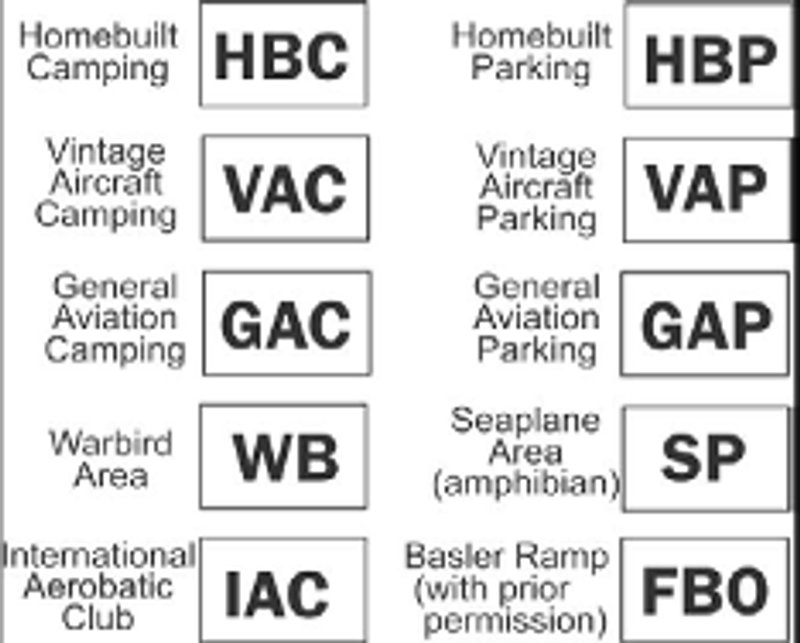
e. Optional: GAC and GAP may place an additional sign with N or S to request North 40 or South
(1) THESE REQUESTS ARE NOT GUARANTEED.
f. A similar sign with the letters VFR or IFR will be used when you depart.
g. Text OSHARRIVAL to 64600 for updates on the current status of AirVenture arrivals.
- 5. VFR Route Planning Guide
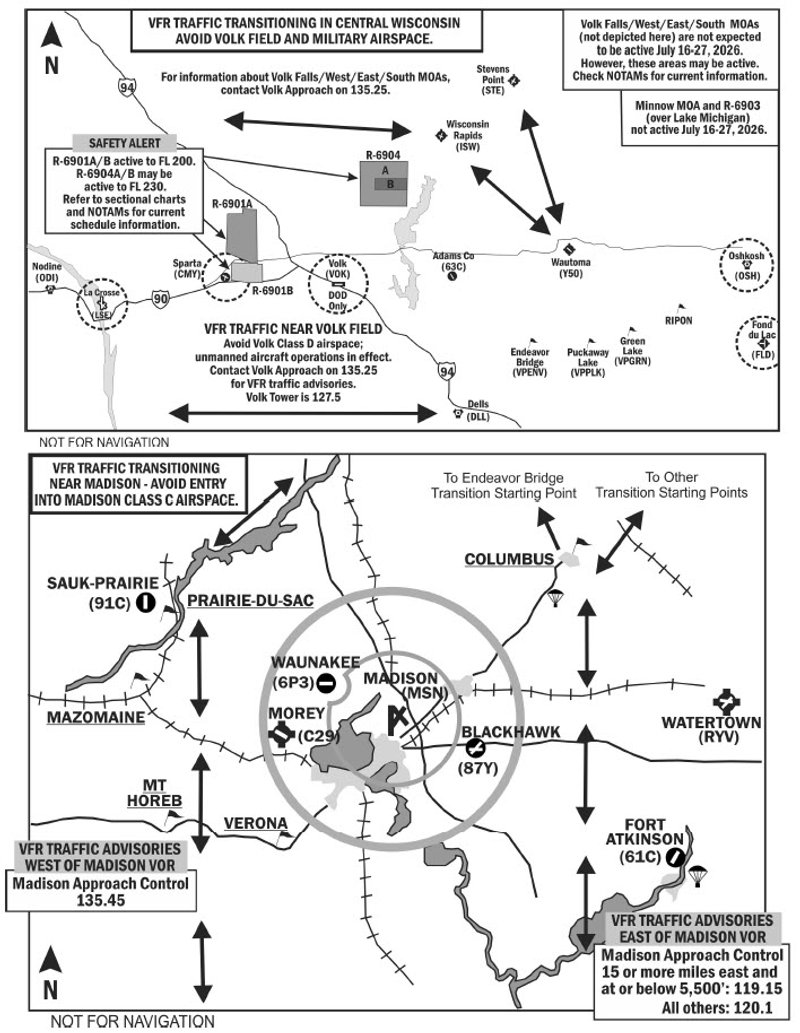
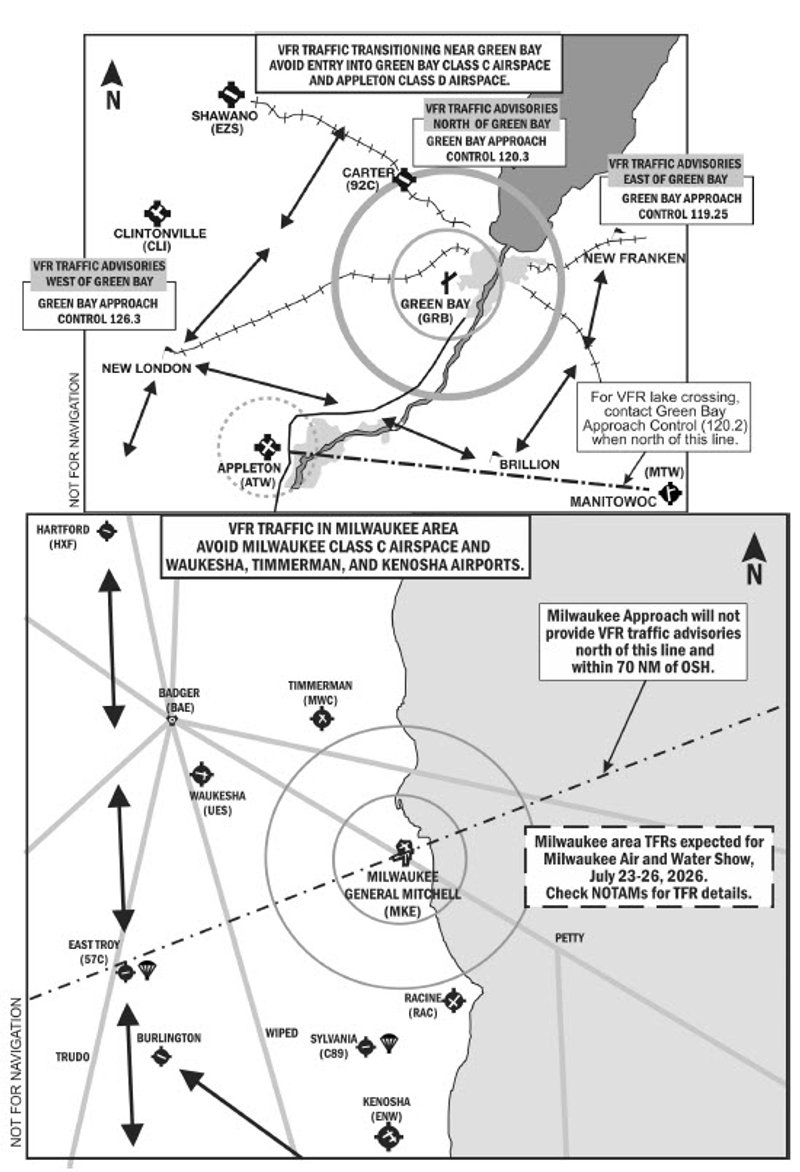
a. The VFR arrival to Oshkosh starts at the ATC designated Transition to the City of Ripon, Wisconsin (Chicago sectional chart). These four graphics show sample routes that bypass
high- density airports enroute to and leaving the AirVenture area. Be sure to use current charts. Use extra caution for heavy traffic.
(1) Check NOTAMs for large Military Operations Areas (MOAs) in west central Wisconsin.
- 6. VFR Transition through Chicago Approach
a. Pilots are urged to use the VFR FLYWAY PLANNING CHART for the Chicago area.
b. Class Bravo clearances for VFR aircraft not available.
c. VFR services at or above 5500:
(1) North of ORD 128.57
(2) South of ORD 126.62
d. ORD arrivals enter Chicago airspace between 9000 and 12000 feet. VFR overflights strongly encouraged to receive flight following.
e. Aircraft transiting the shoreline MDW ATIS 132.75. If MDW landing 22L, jet traffic crosses shoreline at 3000 feet. Pilots urged to remain below MDW Class C airspace.
f. The floor of the west side Class Bravo is 4000 feet. Use caution for jet traffic level at 4000 feet.
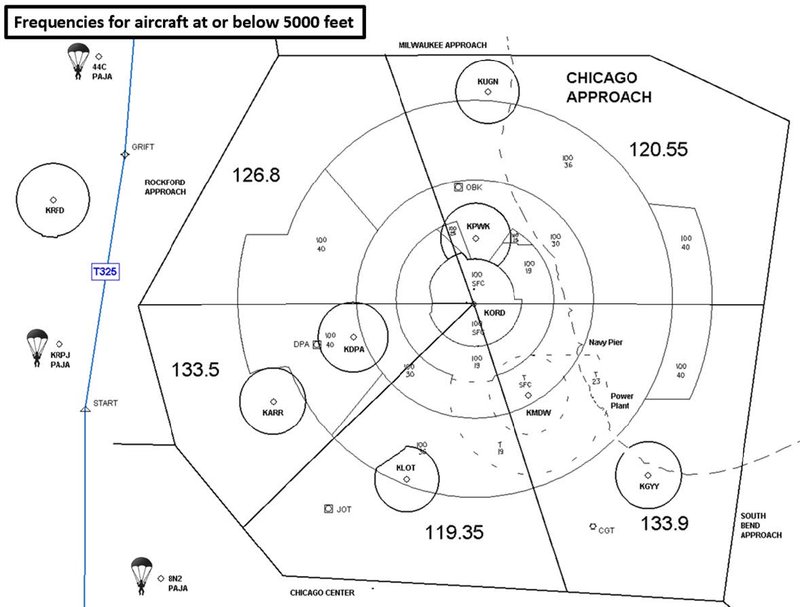
e. Caution heavy parachute activity near 8N2, RPJ and 44C at or below 14,500’MSL
- FISK VFR ARRIVAL TO OSH
- General Information
- This procedure is to be used by all VFR aircraft landing at OSH from Thursday, July 16 at Noon CDT through Noon Monday, July 27, 2026 (except those using the Turbine/Warbird, Ultralight or NORDO arrivals). Thursday July 23, 2026 – No arrivals before 8:00am.
- The procedure starts by using one of the ATC designated Transitions to Ripon, WI (15NM SW of OSH), requires visual navigation, and can be supplemented by VFR Waypoints.
- Pilots then follow a railroad track from Ripon to Fisk, WI. ATC at Fisk controls traffic flow and assigns OSH landing runways and approach paths (see FISK VFR ARRIVAL TO OSH section).
- Planning
- Plan your arrival to avoid airport closure periods, such as the daily airshows (listed under PREFLIGHT PLANNING). Arrivals normally resume 30 minutes after daytime airshows. Allow ample time to arrive and park before the daily airport closure at 8 PM CDT.
- Plan your fuel load carefully. If you do not have sufficient fuel for unexpected holding and possible landing go-arounds, divert to an alternate. If your fuel status is critical, notify ATC immediately.
- First, fly the aircraft. If you are not comfortable with the OSH AirVenture procedures, please consider flying into FLD or ATW and taking public transportation to OSH.
- Approaching Transition Starting Point
- Ensure lights are on within 50 miles of OSH. Leave transponder on throughout approach.
- Tune to Arrival ATIS (125.9) no later than 60 miles from OSH Airport and note arrival runways in use. Have the FISK VFR ARRIVAL TO OSH NOTICE sections available. Then monitor Fisk Approach (120.7).
- Arrive at Transition Starting Point at 90 knots and 1,800’. For aircraft unable to operate comfortably at 90 knots:
- Slower aircraft should use maximum cruising speed. ATC recommends arrival at Fisk 7:00-7:30 AM CDT if practicable.
- Faster aircraft use 135 knots and 2,300’ if needed for safety of flight. Expect descent at or after Fisk.
- Transitions
- Begin the procedure at the ATC designated Transition starting point. ATC will advertise the transition starting point on the Arrival ATIS however real time changes may be made on FISK Approach Frequency. Pick out an aircraft of similar type and speed to follow. Remain at least ½ mile in-trail behind the aircraft you are following. Do not fly side by side unless you are a flight. Do not overtake another aircraft. Do not “S-turn” to follow another aircraft, instead break off the procedure and proceed to the starting point and follow another aircraft of similar speed.
- General Information
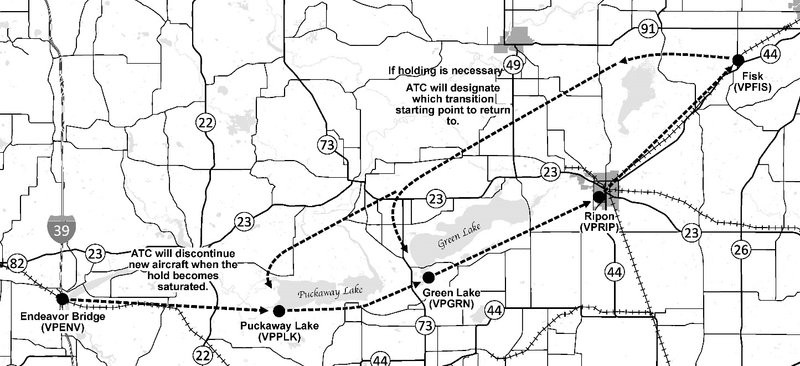
- This Transition starts at the city of Endeavor, WI (47 miles SW of OSH) and is used during extremely high volumes of traffic. This transition has a VFR Waypoint (VPENV= 434503N/892856W) and is located over the junction of Interstate 39 and railroad tracks north of the city. Proceed from this point to the SW corner of Puckaway Lake, then the SW corner of Green Lake, then Ripon, then Fisk via the railroad tracks. There are few visual reference points on this transition between Endeavor and Puckaway Lake. A 095° track for 11 miles is a good reference.
- e. Endeavor Bridge Transition
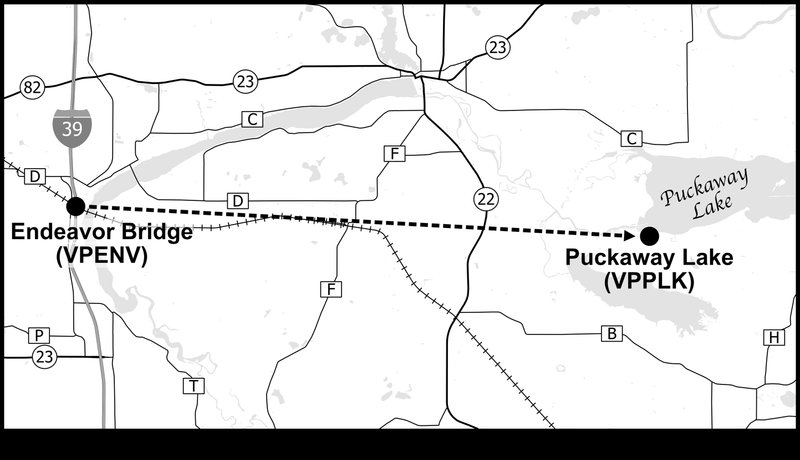
- This Transition starts at the SW corner of Puckaway Lake, WI (36 miles SW of OSH) and has a VFR Waypoint (VPPLK= 434425N/891329W). Proceed from this point to the SW corner of Green Lake keeping the shoreline of Puckaway Lake off your left, then to Ripon, then to Fisk via the railroad tracks. Maintaining appropriate in-trail spacing will improve the likelihood of continuing inbound on the procedure later.
- f. Puckaway Lake Transition
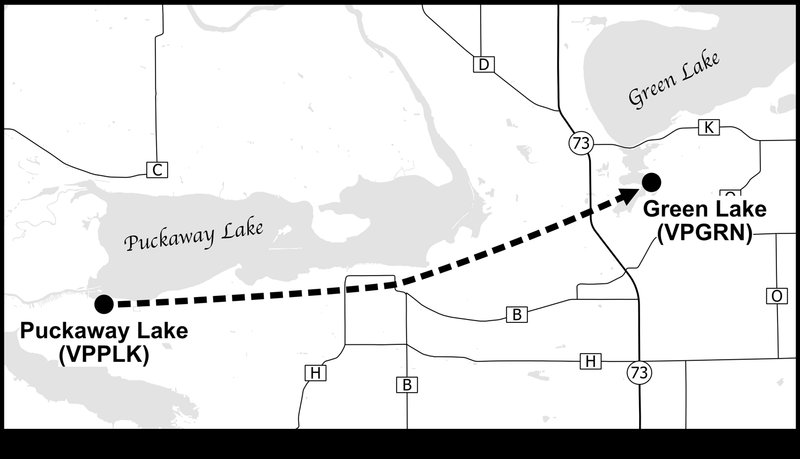
- This Transition starts at the SW corner of Green Lake, WI (26 NM SW of OSH). This Transition has a VFR Waypoint (VPGRN = 434608N/890250W). Proceed single file from the SW corner of Green Lake to the city of Ripon (RIPON= 435017N/885040W) then Fisk, WI via the railroad tracks. Remain ½ mile in- trail of the aircraft you are following.
- g. Green Lake Transition
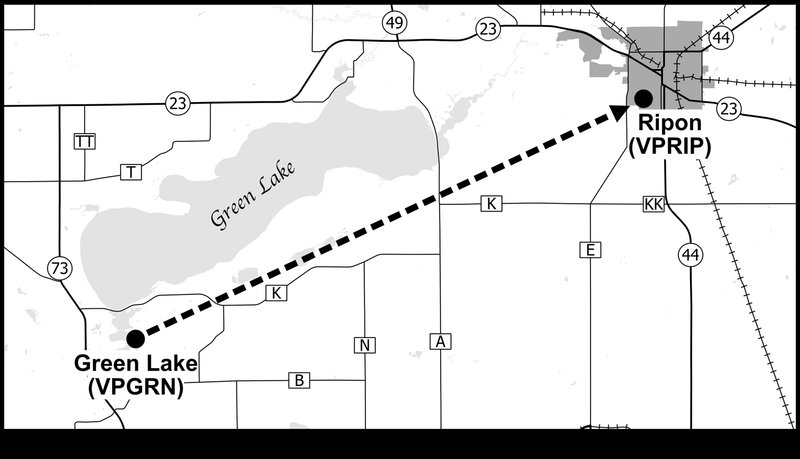
- If holding is not in progress, proceed to the northeast corner of Ripon (OSH 232°, 15.5 DME).
- Proceed single file, directly over the railroad tracks from Ripon northeast to Fisk (10 miles). Remain at least ½ mile in-trail behind any aircraft you are following. Do not overtake another aircraft unless authorized by ATC.
- Do not “S-turn” to follow an aircraft; instead, break off the procedure; proceed to the starting point; and follow another aircraft of similar speed.
- Pilots may reference Ripon and Fisk VFR Waypoints, VPRIP and VPFIS. All aircraft must visually navigate directly over the railroad tracks from Ripon to Fisk.
- If possible, lower your landing gear prior to reaching Fisk.
- The small town of Pickett is about 4 miles from Fisk (steam from the grain drying facility). After this point, listen very carefully for ATC instructions directed at your aircraft.
- g. Ripon to Fisk
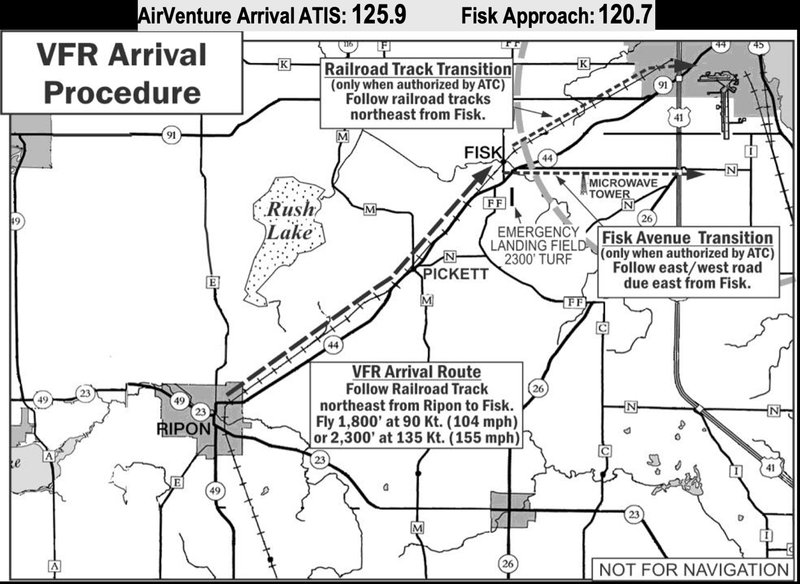
Ripon
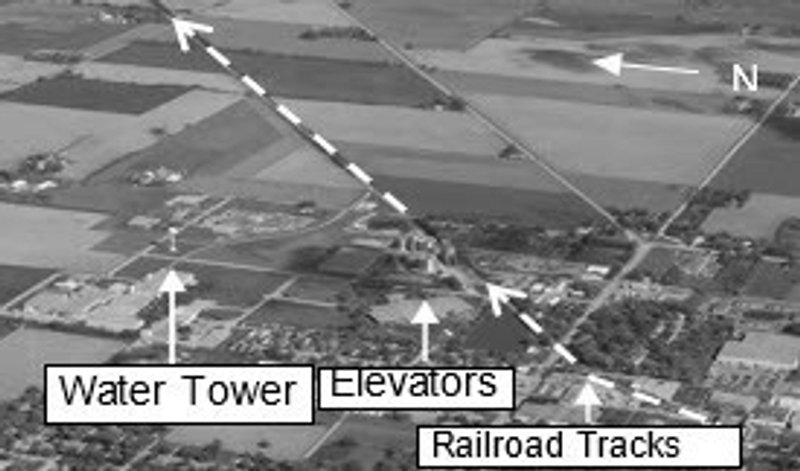
- i. At Fisk
- Controllers will call your aircraft by color and type (if known). No verbal responses are required. If you do not understand the ATC instructions, or need clarification, request instructions on frequency.
- When you are in the immediate vicinity of Fisk (less than 2 miles), ATC will issue a runway assignment, transition to the airport and appropriate Tower frequency to monitor. Do not proceed beyond Fisk or change to Tower frequency without ATC authorization.
- Runway assignments for the airport will include either “Follow the railroad tracks northeast” or
- “Reaching Fisk, turn right and follow east/west road (Fisk Ave.)”.
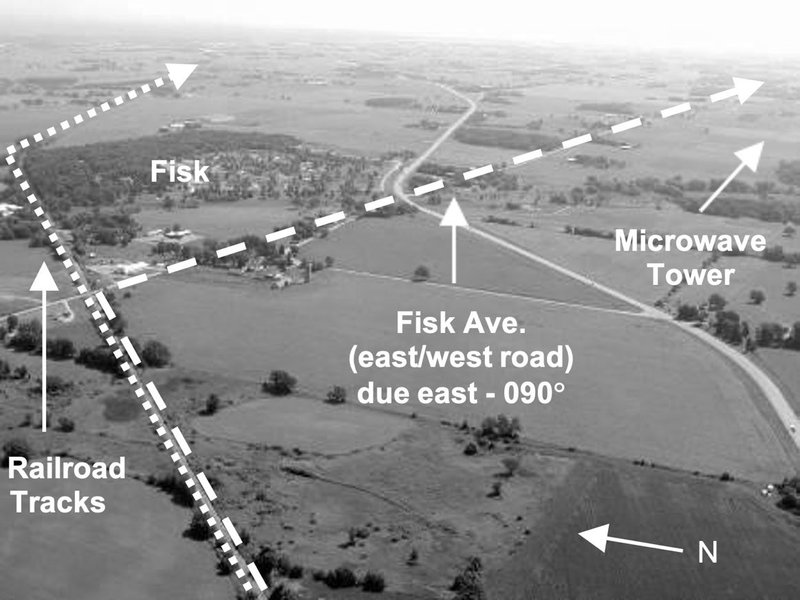
- k. Railroad Track Transition
- Continue following the railroad tracks northeast from Fisk to Oshkosh.
- Fisk Avenue runs 090° from the town of Fisk. Do not confuse this road with Highway 44.
- A large microwave tower is located approximately one mile east of Fisk and ¼ mile south of Fisk Avenue. Navigate close to Fisk Ave, on the south side, but remain north of the microwave tower.
- A waiver has been issued reducing arrival and departure separation standards for category 1 and 2 aircraft (primarily single-engine and light twin- engine aircraft).
- Pilots should be prepared for a combination of maneuvers that may include a short approach with descending turns, followed by touchdown at a point specified by ATC which may be almost halfway down the runway. Use extra caution to maintain a safe airspeed throughout the approach to landing.
- Maintain 90 KTS until entering the pattern
- Note that two separate ATC radio frequencies are used for each landing runway – departures on one frequency and arrivals on a separate frequency.
- As a result, landing pilots may see aircraft departing from or crossing the landing runway, but not hear ATC communications with those aircraft.
- Some pilots travel together to AirVenture as a “flight”. Flights approaching Ripon should, traffic volume permitting, advise Fisk ATC (120.7) of position, identifying as a “flight of number and type aircraft”.
- Flights that choose to maintain formation less than ½ mile in-trail are responsible for their own separation between members of the flight.
- Although flight members generally want to remain together to the airport, this may not always be feasible. Make advance reconnection plans with all flight members in the event you become separated from one another upon arrival.
- To increase efficiency and safety of traffic arriving at Wittman Regional Airport, several large groups of similar- performance aircraft have been approved to make formation arrivals. Participation in these arrivals is limited to aircraft registered in each group and requires an FAA letter of authorization.
- These formation arrivals are scheduled for mid-morning through afternoon on Saturday, July 18, and for mid-morning through early afternoon on Sunday, July 19. Weather and other factors may change the schedule. Traffic using the Fisk VFR arrival to Oshkosh can expect delays during these large formation arrivals. See EAA website for specific times and changes to large formation arrivals.
- Note – The Fisk VFR arrival will close prior to all scheduled airport closures.
- Holding
- ATC controllers at Fisk will advise on 120.7 when holding is necessary.
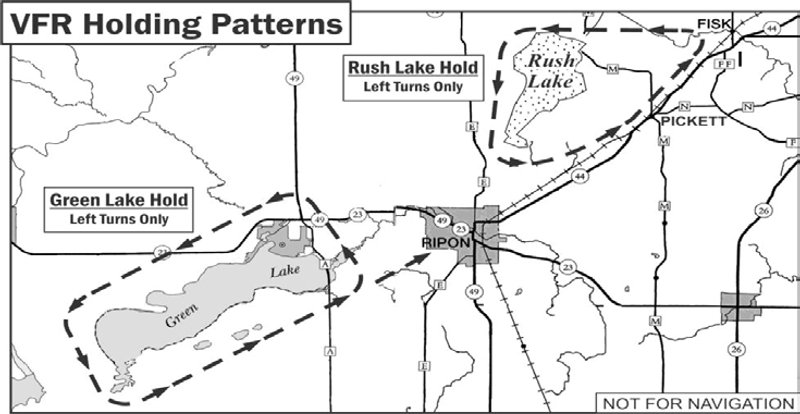
- Aircraft over Fisk will be instructed to turn due westbound, remain single file north of the lakes, and return to the ATC designated starting point to begin the procedure again. See map under Transitions.
- At ATC discretion the VFR holds depicted below may be used:
- Aircraft at or beyond Ripon: Continue to Fisk and enter the Rush Lake holding pattern as depicted.
- Aircraft approaching Ripon on the Green Lake Transition: Watch for traffic to follow and enter the hold at Green Lake as depicted.
- Aircraft approaching Green Lake on the Puckaway Lake Transition: Watch for traffic to follow and enter the hold at Puckaway Lake: Counter-clockwise starting at the SW corner.
- Holding Altitudes/Airspeeds: Maintain 90 knots (or maximum cruise speed if below 90 knots) and 1,800’ MSL. If unable, maintain 135 knots and 2,300’ MSL.
- Holding pattern Saturation: If the holding patterns are observed or reported to be nearing capacity, stay clear and proceed no further. Instead, make left turns over a point on the ground and continue to hold until ATC advises you to proceed or to transition into one of the published holding patterns.
- Clearing Holding Patterns
- When ATC advises aircraft to depart a specific holding pattern, those aircraft shall transition to the arrival procedure in the following manner:
- Rush Lake: Rejoin railroad tracks at the southeast corner of Rush Lake and proceed northeast towards Fisk.
- Green Lake: Upon reaching the south- east corner of Green Lake, proceed directly to Ripon and follow the railroad tracks northeast towards Fisk.
- Puckaway Lake: Upon reaching the SW corner of Puckaway Lake, proceed on the transition as published toward Green Lake.
- Others: Proceed to Transition starting point and follow the procedure towards Ripon.
Help keep this event safe – stay within your personal and aircraft limits!
Airport Elevation 808’ Oshkosh Tower North: 118.5 (Departures on separate frequency)
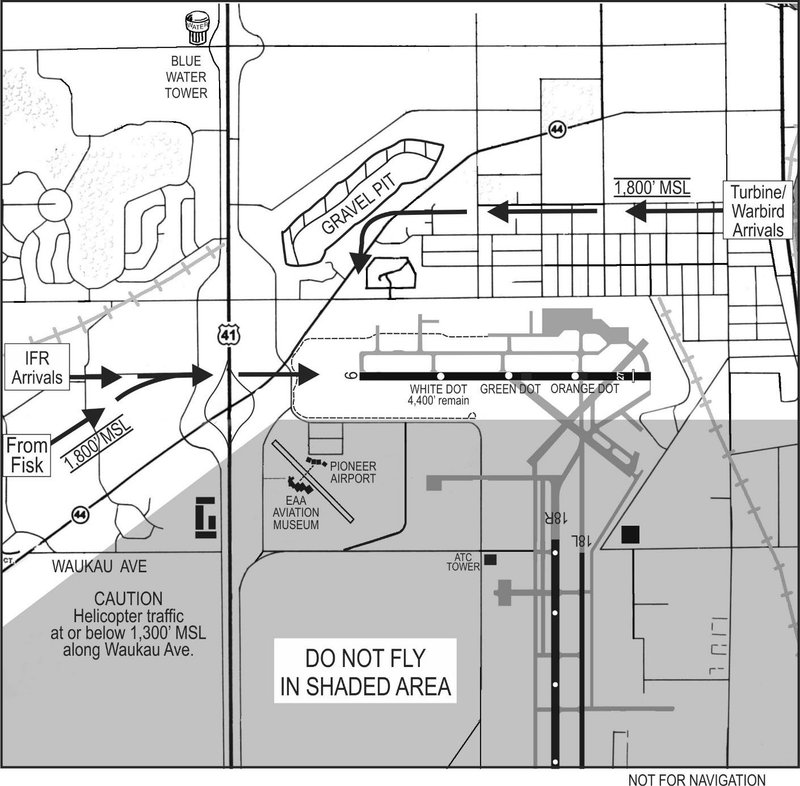
Maintain a safe airspeed and avoid low turns on landing approach.
If a go-around is needed, notify ATC immediately for resequencing instructions.
RWY 9 landing distances | |
Threshold | 6,179’ |
White Dot | 4,400’ |
After landing and when speed permits, aircraft under 6,250 lbs. are required to exit RWY 9 to the left or right, as directed, onto the sod. Do not turn back onto the runway. Be alert and use caution for hazards marked with cones and/or flags.
After exiting runway, you must put a parking/camping sign in windshield and follow EAA flagperson directions.
Fisk VFR Arrival to OSH RWY 27
This Arrival May Require a Short Approach.
Airport Elevation 808’ Oshkosh Tower North: 118.5 (Departures on separate frequency)
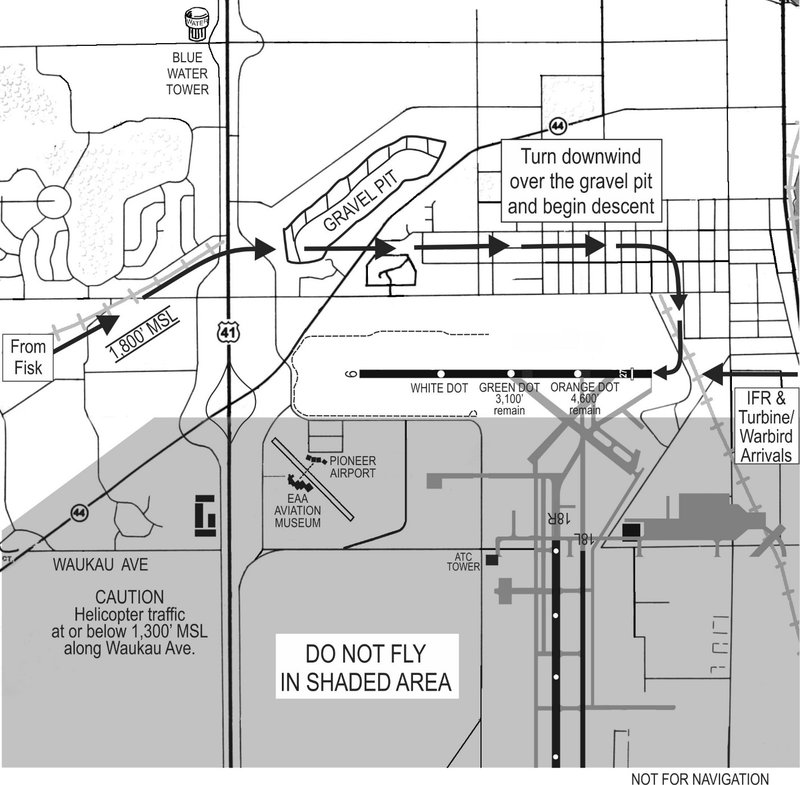
Maintain a safe airspeed and avoid low turns on landing approach.
Turn base prior to reaching shoreline. Do not continue past shoreline unless advised by ATC.
If a go-around is needed, notify ATC immediately for resequencing instructions.
RWY 27 landing distances | |
Displaced Threshold | 5,647’ |
Orange Dot | 4,600’ |
Green Dot | 3,100’ |
After landing and when speed permits, aircraft under 6,250 lbs. are required to exit RWY 27 to the left or right, as directed, onto the sod. Do not turn back onto the runway. Be alert and use caution for hazards marked with cones and/or flags.
After exiting runway, you must put a parking/camping sign in windshield and follow EAA flagperson directions.
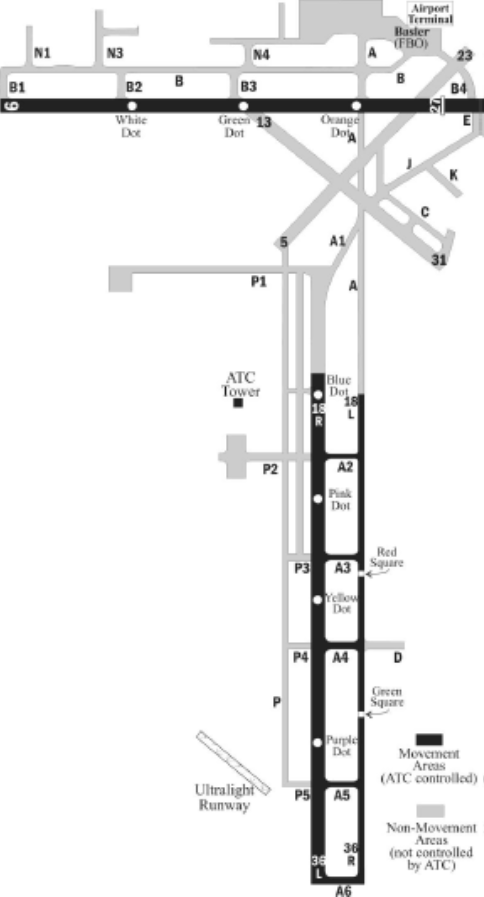
Fisk VFR Arrival to OSH RWY 18R
This Arrival Requires a Short Approach and a Long Landing.
Airport Elevation 808’ Oshkosh Tower South: 126.6 (Departures on separate frequency)
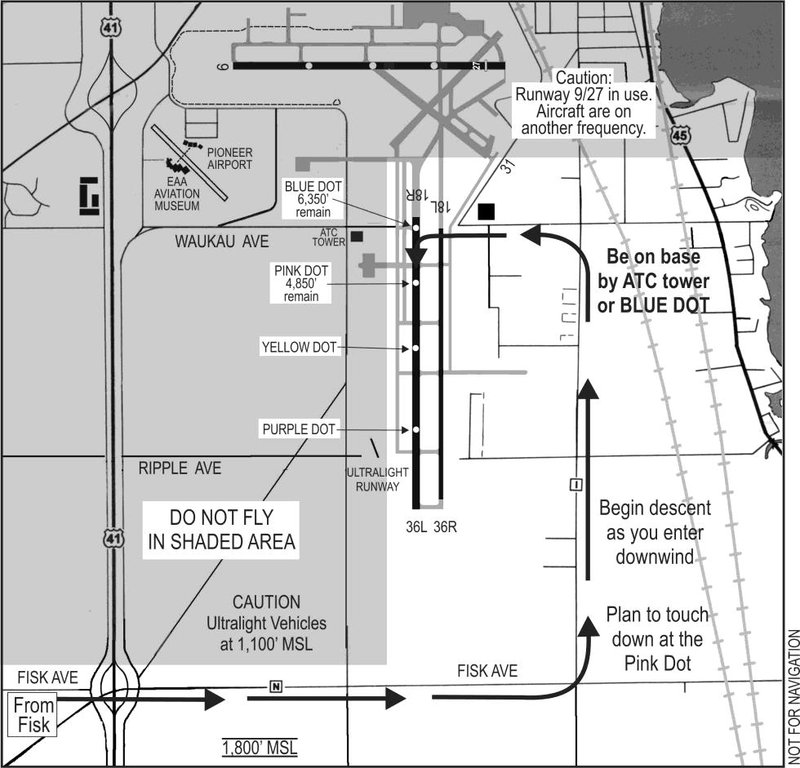
Maintain a safe airspeed and avoid low turns on landing approach.
Turn base abeam the Blue Dot. If unable, make immediate right turn to the Southeast for resequencing.
Do not continue past the Blue Dot unless advised by ATC.
The RWY 18R relocated threshold is well beyond the concrete edge and is marked by Runway End Identification Lights and white lines. Do not land short of this threshold without specific Tower approval.
If a go-around or pattern break is needed, notify ATC immediately.
RWY 18R landing dist. | |
Blue Dot | 6,350’ |
Pink Dot | 4,850’ |
Fisk VFR Arrival to OSH RWY 36L/R
Airport Elevation 808’ Oshkosh Tower South: 126.6 (Departures on separate frequency)
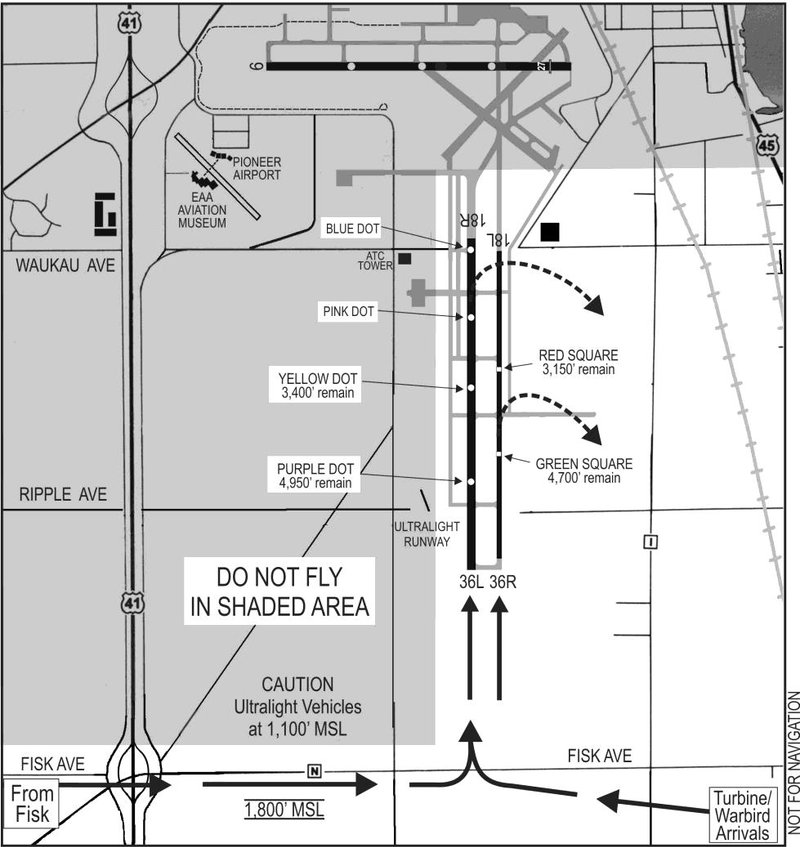
If a go-around is needed, notify ATC immediately and do not continue past ATC Tower. If unable to notify ATC, make a right turn to the southeast prior to ATC tower for resequencing.
RWY 36L landing dist. (150’ wide) | |
Yellow Dot | 3,400’ |
RWY 36L landing dist. (150’ wide) | |
Purple Dot | 4,950’ |
Threshold | 6,700’ |
RWY 36R landing dist. (60’ wide) | |
Red Square | 3,150’ |
Green Square | 4,700’ |
Threshold | 6,300’ |
Aircraft landing on RWY 36L must not roll beyond the Blue Dot without specific Tower authorization.
Aircraft landing on RWY 36R can expect to land long and roll to end for parking. Do not turn left unless advised by ATC. If so, you must hold short of RWY 36L until cleared via 126.6 or a pink shirt OSH controller.
a. Canadian pilots flying Canadian registered experimental amateur-built aircraft, basic or advanced ultralight aeroplanes must obtain an
FAA Special Flight Authorization (SFA) to operate in the United States.
b. The SFA may be obtained from the FAA web site: www.faa.gov/aircraft/gen_av/ultralights/sfa
c. The SFA must be carried on board the aircraft when operating in the United States. It constitutes valid FAA authorization to operate in United States airspace,
provided the operator of one of these specific aircraft types complies with the operating limitations that are part of the SFA.
d. Canadian pilots flying experimental Warbirds are encouraged to contact the FAA Milwaukee Flight Standards District Office (FSDO) to apply for an
SFA for their flight to/from Oshkosh.
e. Questions concerning this SFA should be addressed to: FAA Milwaukee FSDO, 414-486-2920; EAA Aviation Services, 920-426-4821; or Transport Canada Recreational Aviation,
613-993- 7284 or 1-800-305-2059.
f. Canadian pilots flying aircraft issued a Canadian “Flight Permit-Owner Maintenance” are prohibited from flying in the U.S.
a. To enhance safety, all pilots are encouraged to use radios (including hand-held aircraft radios).
b. This no-radio (NORDO) procedure is provided for use only by Vintage aircraft incapable of radio communication.
c. Each arriving no-radio aircraft must land at an airport within approximately 45 minutes of Wittman Regional Airport (OSH), call Oshkosh Tower (920-424-8002) between
7 AM and 10 AM CDT and receive approval for a NORDO arrival.
d. If authorized by Oshkosh Tower, no-radio aircraft will be assigned a route and a runway to use based on traffic and weather conditions.
e. No-radio arrivals must not taxi across RWY 18R/36L until receiving a clearance via hand signal from an FAA controller wearing a pink shirt.
a. All movement on other than paved runways is at pilot’s own risk. Use extra caution when operating in non-movement areas. Be alert for taxiing aircraft in all areas.
b. Aircraft landing during peak saturation periods may be asked to depart if insufficient parking spaces are available.
c. All aircraft parked on grass must be tied down securely; all aircraft parked on paved surfaces must be chocked.
d. Aircraft parking and camping is allowed in designated areas only. No aircraft camping is allowed east of TWY B3.
e. For hard-surface parking and fueling information, contact Basler Flight Service (920-236-7827).
f. If Wittman Regional Airport is IFR, taxiing is prohibited except for aircraft with IFR clearance.
g. Engine operation and taxiing are prohibited when the airport is closed. (during airshows and overnight: 8:00 PM to 6:00 AM CDT).
g. Mishaps, incidents, or accidents must be reported to the FAA Flight Standards District Office, NTSB, a Sheriff’s Deputy or Wittman Regional Airport personnel.
h. Only authorized personnel are allowed on runways, taxiways, and the terminal ramp at any time. Motorcycles and bicycles are also strictly prohibited on these areas.
i. Observe all fire prevention rules. No campfires or stoves are permitted near aircraft.
j. Student pilot training and student solos are not permitted at OSH during the AirVenture period.
l. Contact law enforcement or Wittman Regional Airport personnel with any airport safety related questions (920-236-4930).
(1) SAFETY ALERT: Call 911 for emergencies
- 11. VFR DEPARTURE FROM OSHKOSH
- a. Pilots are urged to obtain a complete weather briefing and review all applicable NOTAMs prior to departure. FSS weather briefings and flight plan filing services are available via phone at 1- 800-WX-BRIEF.
b. You must place a sign in your windshield with the letters “VFR” to show ground personnel that you intend to depart VFR. Note that Wittman Regional Airport is closed to departing aircraft from 8 PM until 6 AM CDT daily, during the scheduled airshows and at other times.
c. Monitor the Departure ATIS (121.75) prior to engine start. There must be no engine operation or aircraft movement until the Departure ATIS indicates the airport is open.
d. When the airport is IFR, all taxiing is prohibited except for aircraft with an IFR clearance.
e. Taxi toward the designated runway without contacting Ground Control. Follow EAA flagperson instructions. To expedite departures, you may be directed to a different runway than you expected.
f. FAA controllers wearing pink shirts are stationed on elevated platforms near the runway departure points. Monitor their radio frequency (listed in table below).
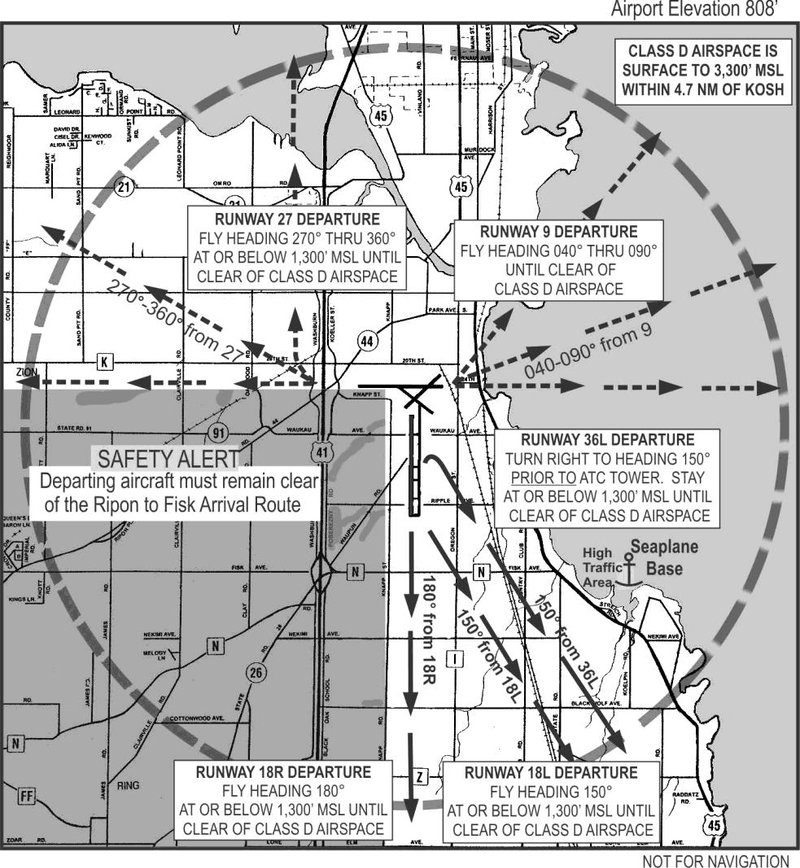
g. After takeoff, fly the routes depicted in the graphic below, based on your departure runway.
(1) You must avoid the Ripon/Fisk arrival route and the AirVenture Seaplane Base.
(2) RWY 36L departures must turn right to heading 150° prior to ATC Tower.
h. Milwaukee Approach Control will not provide VFR traffic advisories within 70 NM of Oshkosh.
i. Fond du Lac Airport has a temporary control tower. See Fond du Lac section for details. Do not fly in FLD airspace without contact the temporary control tower.
A waiver has been issued reducing arrival and departure separation standards for category 1 and 2 aircraft (primarily single-engine and light twin engine aircraft.
Another waiver has been issued amending “Line Up and Wait” procedures; more than one aircraft may be instructed to “Line Up and Wait” on both sides of the runway centerline.
OSH Departure Distances and Frequencies
Departure From | Remaining | Monitor | |||
RWY 9 at TWY B1 | 6,150’ | 128.75 | |||
RWY 9 at TWY B2 | 4,600’ | 128.75 | |||
RWY 18L | 6,300’ | 126.6 | |||
RWY 18R at Tower Road | 6,300’ | 118.9 | |||
RWY 27 at TWY A | 4,600’ | 128.75 | |||
RWY 36L at TWY P5 | 5,050’ | 118.9 | |||
Oshkosh Departure Frequencies | |||||
AirVenture Departure ATIS | 121.75 | ||||
Oshkosh Clearance Delivery | 119.05 | ||||
Oshkosh Ground Control | 132.3 | ||||
Oshkosh UHF | 290.9 | ||||
Green Bay Radio | 122.25 | ||||
OSH VORTAC | 116.75 | ||||
SAFETY ALERT: Do not depart on RWYs 13/31 or 5/23; they are closed. Help keep this event safe - stay within your personal and aircraft limits.
- 12. IFR DEPARTURE FROM OSHKOSH
- a. See IFR ARRIVAL/DEPARTURE section below for departure routings.
b. You must place a sign in aircraft wind- shield with block letters “IFR” to specify routing by ground personnel.
c. Monitor Departure ATIS (121.75) prior to engine start.
d. Request IFR departure clearance from Clearance Delivery (119.05) no more than 20 minutes prior to your STMP reservation time (see IFR ARRIVAL/DEPARTURE section below). Do not start engines until authorized by Clearance Delivery.
e. Remain on 119.05 until told to contact Ground Control (132.3).
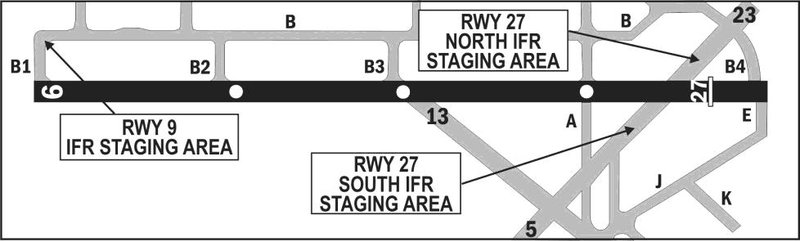
f. Taxi as instructed by Ground Control and EAA flagpersons. Unless directed by Ground Control, ensure you are established in the IFR staging area for your assigned runway (see chart below)
g. IFR clearances are not valid without a transponder code. Expect transponder code assignment just prior to departure. Do not take off without an assigned transponder code.
a. Restricted to aircraft types listed
b. This procedure is restricted to high- performance turbojet, turboprop, and Warbird aircraft capable of cruising at 130 knots or greater. Slower Warbird aircraft shall use the VFR
Arrival from the ATC designated Transition (FISK VFR ARRIVAL TO OSH section).
c. The city of Fond du Lac is the entry point for all Turbine/Warbird arrivals. Monitor the AirVenture Arrival ATIS (125.9) for anticipated landing runways
(see runway charts under FISK VFR ARRIVAL TO OSH).
d. Avoid the Fond du Lac County Airport (FLD) airspace. FLD has a temporary control tower from Saturday, July 18 until Sunday, July 26, 2026 (operating hours in FOND DU LAC
ARRIVAL/DEPARTURE section). FLD airspace is 3,300’ MSL and below within 4 NM.
e. Aircraft weighing more than 12,500 pounds must advise ATC on initial contact.
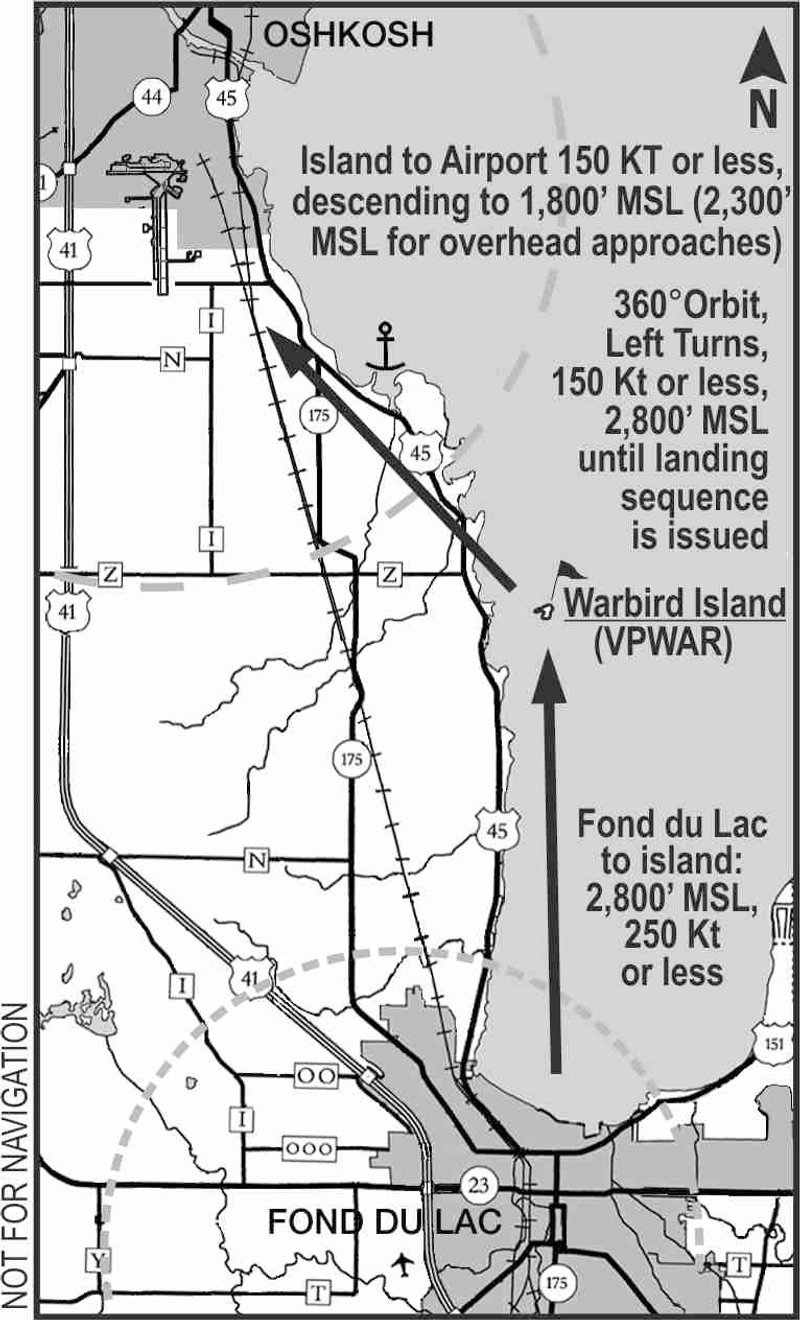
f. All aircraft shall report arrival over the city of Fond du Lac and again at Warbird Island to Oshkosh Tower on the appropriate tower frequency:
(1) When RWY 36L/R is in use, report on 126.6
(2). Otherwise report on 118.5
(3) Examples: “Blue and yellow Wildcat, Fond du Lac” “White Citation, Warbird Island”
g. Proceed from the city of Fond du Lac direct to Warbird Island (6 miles SE of OSH, along the west shore of Lake Winnebago). When 4 NM North of FLD,
descend to maintain 2,800’ MSL.
h. Pilots may be instructed to orbit the island until a landing sequence is issued. Use caution; make left turns; and stay alert for other aircraft!
i. When cleared at Warbird Island, proceed to the assigned runway as directed by ATC, reduce speed to 150 knots or less and begin descent to 1,800’ MSL (2,300’ MSL for overhead
approaches). Pilots are cautioned to maintain VFR separation at all times.
j. If your landing clearance appears unsafe because of spacing, speed of preceding aircraft, or any other reason, go around! A new sequence will be issued.
k. Pilots may request a 360° overhead approach to RWY 36 L/R or RWY 27. Break altitude is 2,300’ MSL. Expect a right break only.
l. ATC may initiate a 360° overhead approach to other runways as needed for spacing. Break altitude will be 2,300’ MSL. Expect a north break for RWYs 9/27 and
an east break for RWYs 18/36.
m. Under all circumstances, avoid the VFR arrivals area southwest of OSH.
n. Pilots of Warbird aircraft are encouraged to call Warbird Ground (123.9) when arriving at the Warbird area and also before starting engines for departure.
o. Warbird Helicopters wishing to land in the warbird area require advanced approval. If required, land short of Oshkosh airport (within 30 min) and call the tower,
920-424-8002, for arrival instructions.
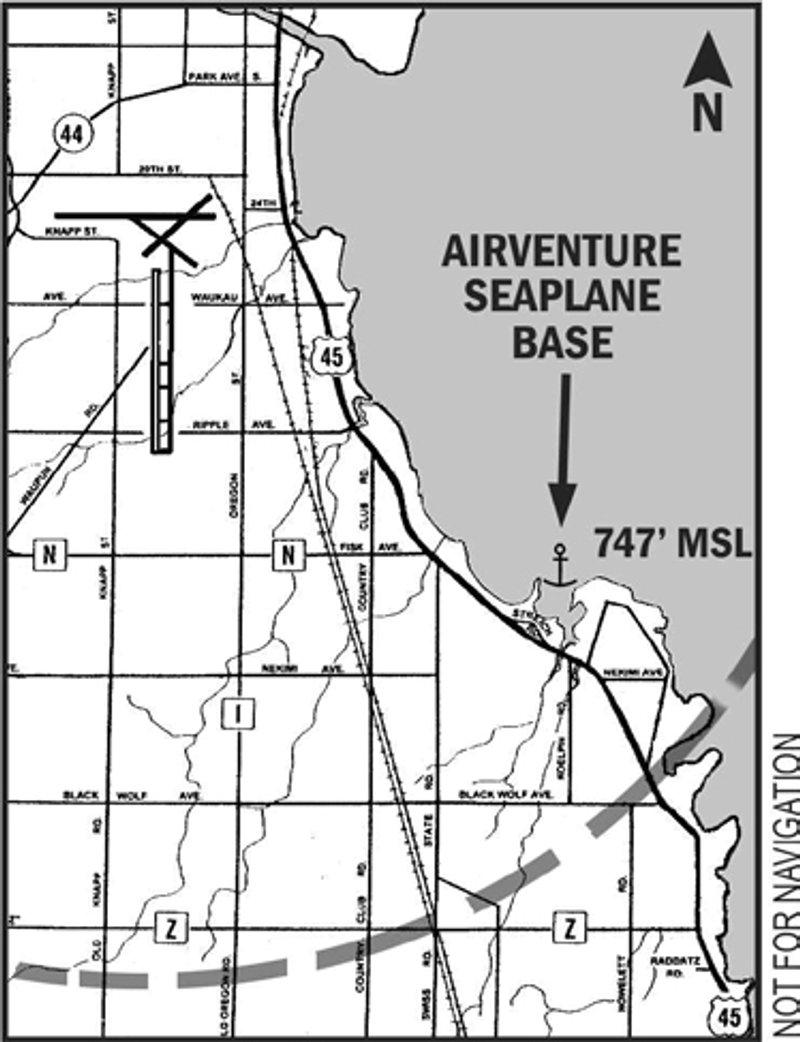
a. The EAA AirVenture Seaplane Base, 3.8 NM southeast of OSH (134º), on the west shore of Lake Winnebago, will be operational Saturday, July 18 – Sunday, July 26, 2026
(Monday-Saturday 8:00 AM- 6:00 PM and Sunday 8:00 AM-5:00 PM).
15. VFR Arrival
a. flight plans should use destination identifier 96WI.
b. At times, Lake Winnebago can have very rough water conditions. Water condition information is available by radio call to 123.3 or by telephone at 920-230-7829. A rough water
alternate landing area at Warbird Island is shown in the graphic above.
c. Seaplane arrivals should avoid nearby Class D airspace, except when on approach and departure east from the Seaplane Base over Lake Winnebago.
d. Do not use the Fisk VFR arrival route and do not contact Oshkosh Tower.
e. Fly a pattern over water, 1,350’ MSL or below, with left turns. Landing and takeoff patterns are at pilot’s discretion. Avoid flying low over boats and structures.
(1) Caution: Turbine and Warbird aircraft along shoreline at or above 1,800’ MSL.
Seaplane Base Frequencies | |
AirVenture Seaplane Base | 123.3 |
Green Bay Radio | 122.25 |
AirVenture Arrival ATIS | 125.9 |
AirVenture Departure ATIS | 121.75 |
Seaplane Base Telephone | 920-230-7829 |
- a. Information on housing, food, activities, arrival procedures, and important rough water alternate landing areas is available at www.eaa.org/seaplanebase, or by e-mail before the
event to airventureseaplanechariman@gmail.com.
b. The Seaplane Base radio frequency is 123.3; however a radio is not required. Operators are authorized to deviate from the two-way radio communications requirements of
FAR 91.129(c) for arriving and departing at EAA AirVenture 2026.
c. Helicopter operations require prior approval via telephone (920-230-7829).
d. Pilot briefings are mandatory prior to local flights or departures.
e. Taxi slowly in bay near lagoon; heavy traffic enters and leaves lagoon.
f. No takeoff or landings allowed in lagoon.
g. No takeoffs allowed directly over seaplane base shoreline or crowds. With south wind use lagoon opening as line of reference for takeoffs and turn east to stay over lagoon and farm
fields when climbing.
h. Boats are available to take you to and from your aircraft.
i. Larger aircraft may anchor in the bay next to the lagoon.
j. Daily camping with showers is available to pilots and crew operating from the base.
k. Bus transportation is available to and from the main EAA AirVenture site.
l. Wittman Regional Airport (OSH) is closed during airshows, so you must land outside its Airshow Demonstration Area (listed under PREFLIGHT PLANNING) and then taxi to the
Seaplane Base. No operations are allowed during TFRs.
m. Amphibian aircraft may also land at OSH and park in a designated location in the Vintage Aircraft area. Use the Fisk VFR Arrival (FISK VFR ARRIVAL TO OSH section) and
windshield sign code SP as described in the PREFLIGHT PLANNING section.
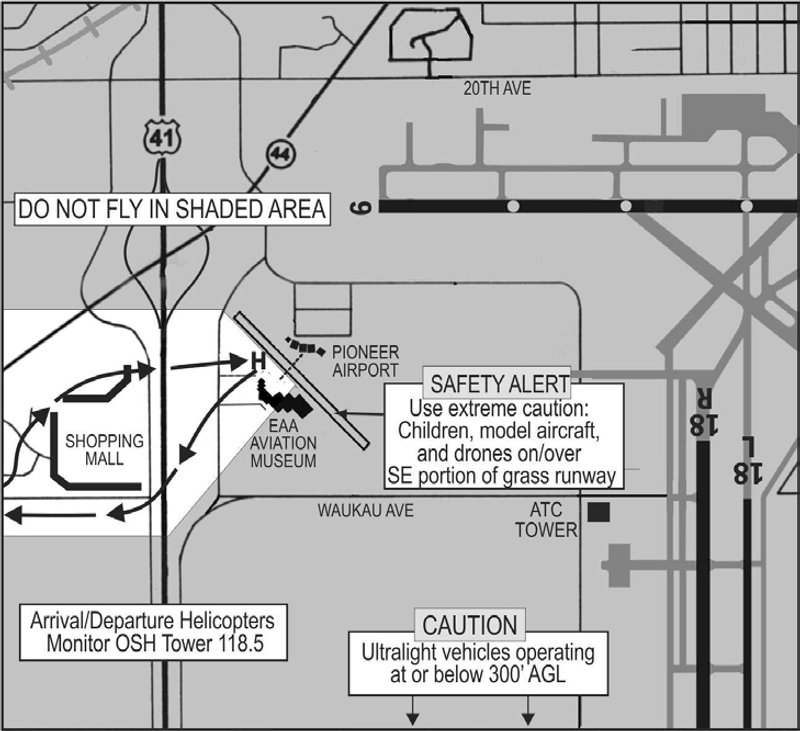
17. TRANSIENT HELICOPTER VFR ARRIVAL/DEPARTURE
a. The AirVenture helipad and long-term helicopter parking are located on Pioneer Airport. The helipad is designated on a turf area with a white box surrounding the letters “HELI”.
Camping is not allowed in this area.
b. Obtain AirVenture Arrival ATIS (125.9) prior to entering Oshkosh Class D airspace.
c. Helicopters arriving VFR shall enter the Oshkosh Class D airspace from the west, following and remaining north of Waukau Ave. at 1,300’ MSL. Stay south of Runway 9/27 and
monitor Oshkosh Tower (118.5).
d. Caution: High-volume, fixed-wing traffic along railroad tracks to Runway 9/27; Ultralight vehicles operating at or below 1,100’ MSL south of Waukau Ave.;
Continuous Pioneer EAA helicopter operations; Zeppelin mooring near helipad. Landing at Pioneer Airport is at pilot’s discretion.
e. Transient helicopter operations are limited to arrivals and departures; no local flights. See www.eaa.org/transienthelicopter
f. Arrivals/departures are not authorized when Wittman Regional Airport (OSH) is IFR or closed, including during the daily airshows
(times listed in the PREFLIGHT PLANNING section).
g. Helicopters may depart VFR from Pioneer Airport at pilot’s discretion. Obtain AirVenture Departure ATIS (121.75) and then monitor Oshkosh Tower (118.5).
Depart north of the AirVenture Museum and remain well south of the RWY 9/27 extended centerline.
Follow and remain south of Waukau Ave at 1,300’ MSL until clear of Class D airspace to the west.
Helicopter operators are authorized to deviate from the two- way radio communications requirements specified in FAR 91.129(c) for arriving and departing at EAA AirVenture 2024.
18. ULTRALIGHT/HOMEBUILT ROTORCRAFT ARRIVAL/DEPARTURE
a. This procedure is effective Saturday July 18, and Sunday July 19, 2026, 7:00 AM to 8:00 PM CDT, and Monday July 20 through Sunday July 26, 2026, 7:00 AM to 2:15 PM and
6:30 PM to 8:00 PM CDT.
b. The procedure may be used only after receiving approval from EAA Ultralight Flightline Operations (920-230-7759).
c. Helicopters and gyroplanes flying in should arrive between Noon and 2:00 PM CDT unless prior arrangements have been made. Large helicopters should use the
Transient Helicopter procedure (TRANSIENT HELICOPTER VFR ARRIVAL/DEPARTURE section) and land at Pioneer Airport.
d. If radio equipped, monitor AirVenture Arrival ATIS (125.9) prior to entering at Highway Z and Highway 26. Then monitor Ultralight/ Rotorcraft advisory frequency (123.75).
e. Enter at Highway Z and Highway 26, approximately 5 miles SW of Oshkosh.
f. Be alert for aircraft inbound from Fisk entering a left base for RWY 36L/R. Maintain a vigilant watch at all times while flying into or out of the Oshkosh area.
g. Pattern is clockwise (right turns) for landings to the southeast. Pattern is counter-clockwise (left turns) for landings to the northwest.
h. Ultralights/Rotorcraft must remain clear of OSH RWYs 18L/R and 3 6L/R.
i. Runway closure will be marked with a yellow X. Be prepared to divert to an alternate airport when runway is closed.
j. Use caution for numerous obstructions near approach and departure ends of Ultralight RWYs 15 and 33.
k. Departing traffic has the right of way.
l. Do not fly over people, houses, livestock, parked aircraft, etc. lower than 300’ AGL.
m. If radio equipped, obtain AirVenture Departure ATIS (121.75) prior to departure.
n. Compliance with this arrival/departure procedure waives the requirements of FAR 103.17 for operations at AirVenture 2026.
(1) Ultralight Pattern 2026 - Check www.eaa.org/ultralightarrivals for details.
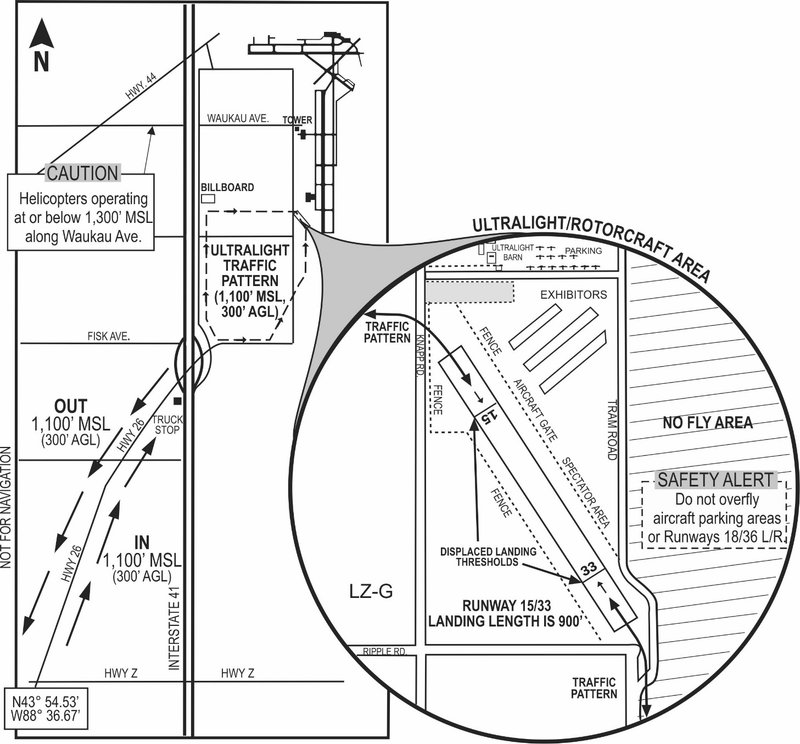
More Ultralight procedure information is at www.eaa.org/ultralightarrivals.
19. FOND DU LAC ARRIVAL/DEPARTURE
a. The FAA will operate a temporary air traffic control tower at the Fond du Lac County Airport (FLD) from Saturday, July 18 through Sunday, July 26, 2026.
The Tower will be operational from 7:00 AM until 8:30 PM CDT, except closing at 2:00 PM CDT on Sunday, July 26.
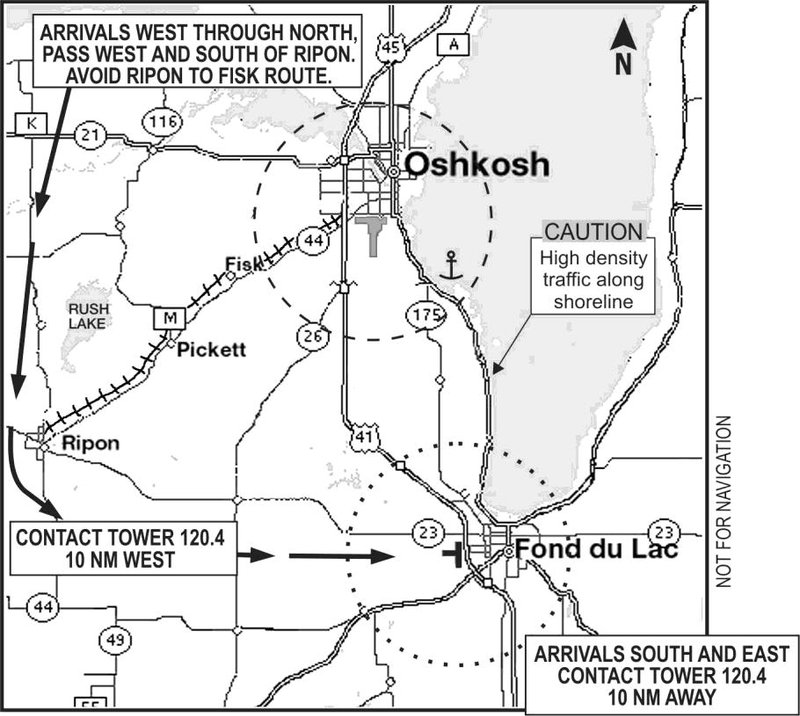
b. Communication with FLD Tower is required when at or below 3,300’ MSL within 4 NM of FLD. See graphic below for locations to contact Tower.
c. Because of expected delays due to heavy traffic volume, watch your fuel status closely.
d. To enhance safety, arrivals after sunset are discouraged.
e. Be alert for high-density traffic enroute to Oshkosh and for Turbine/Warbird aircraft in vicinity of FLD airport.
f. Turn lights on within 30 miles of FLD.
20. Fond du Lac VFR Arrival
a. Obtain Fond du Lac ATIS (121.1).
b. Avoid high-traffic arrival routes from Ripon to Fisk and along shoreline.
c. Contact Fond du Lac Tower (120.4) when 10 NM from airport.
d. After landing, close VFR flight plan with Green Bay Radio (122.5).
21. Fond du Lac IFR Arrival
a. See IFR Information in the IFR ARRIVAL/DEPARTURE section below. Expect a visual approach or radar vectors to a final approach course from Milwaukee Approach.
Weather permitting, cancel IFR with Milwaukee Approach and proceed VFR to the airport.
22. Fond du Lac No-radio (NORDO) Arrival
a. Follow another aircraft if possible and watch the Tower for a green or red light.
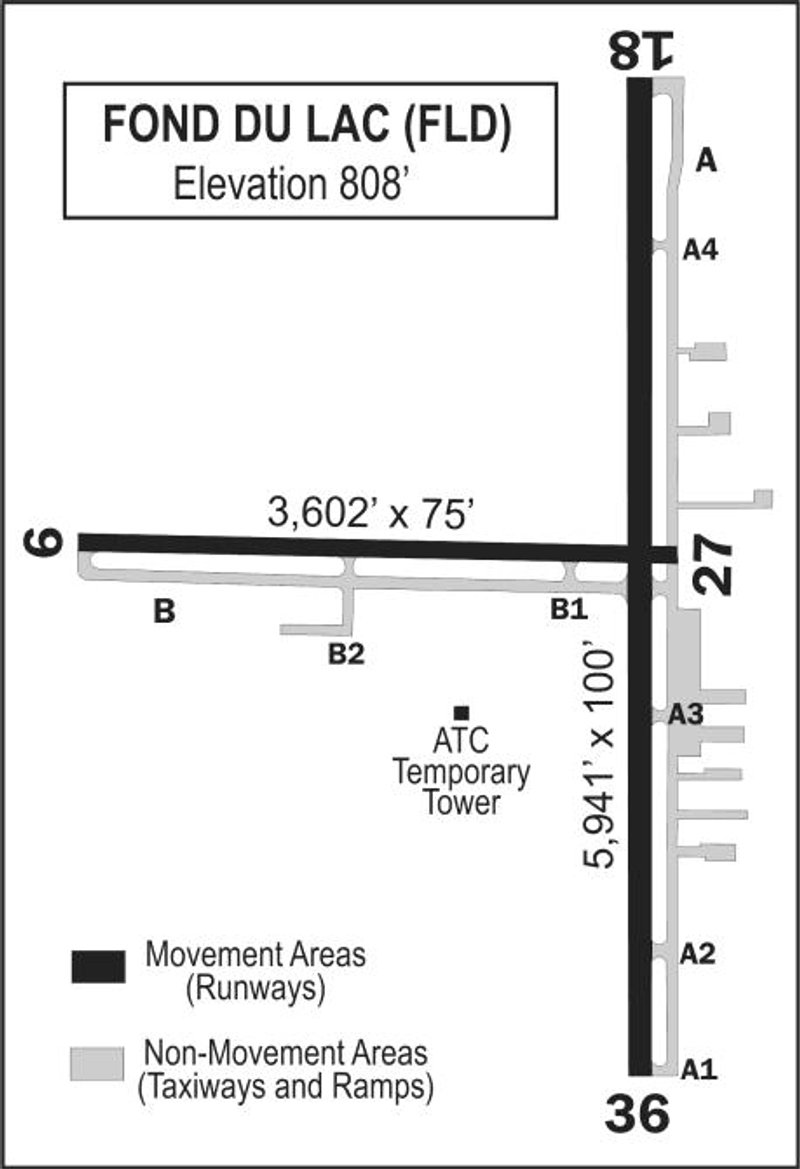
a. All movement on other than paved runways is at pilot’s own risk.
b. Do not walk across taxiways or runways.
c. Camping and showers are available.
d. Bring your own tie downs; all aircraft must be secured.
e. Hard surface parking available by prior arrangement with Fond du Lac Skyport (920-922-6000).
f. Scheduled transportation is available to/from Oshkosh.
g. FBO is unattended 9:00 PM – 6:30 AM.
Fond du Lac Area Frequencies | ||||
ATIS | 121.1 | |||
Milwaukee Approach | 127.0 | |||
Temporary Tower | 120.4 | |||
Ground Control | 121.85 | |||
Unicom (CTAF when tower closed) | 123.05 | |||
ASOS (920-922-4444) | 134.0 | |||
Green Bay Radio | 122.5 | |||
Intersection Departures | ||||
RWY 18 at A4 | 4,940’ | |||
RWY 18 at B | 2,940’ | |||
RWY 27 at B1 | 2,900’ | |||
RWY 36 at A2 | 5,040’ | |||
RWY 36 at A3 | 3,740’ | |||
RWY 36 at B | 3,000’ | |||
a. Pilots are urged to obtain a complete weather briefing and review all applicable NOTAMs prior to departure.
Flight plan filing and briefing services are available from Flight Service (1-800-WX-BRIEF).
a. See IFR ARRIVAL/DEPARTURE section below for required IFR departure routings.
b. Within 5 minutes of taxi, contact Ground Control (121.85) and advise that you are IFR. Clearance, taxi and departure information will be issued on Ground Control frequency.
c. After takeoff, FLD Tower will advise when to contact Milwaukee Approach, normally when clear of traffic.
Pilot Notice: A waiver has been issued reducing arrival and departure standards for category 1 and 2 aircraft (primarily single engine and light twin engine aircraft).
Be alert for last minute changes to previously issued clearances or anticipated procedures.
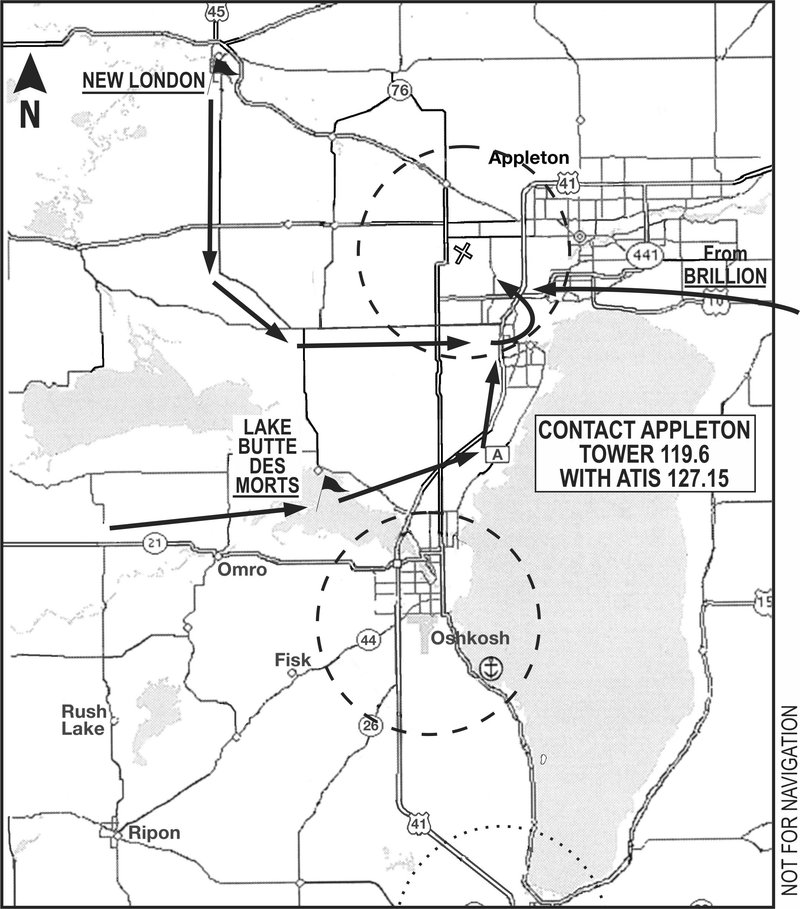
26. APPLETON ARRIVAL/DEPARTURE
a. The Control Tower at Appleton International Airport (ATW) operates from 5:30 AM until 11:00 PM CDT daily. See graphic for recommended arrival routes.
b. Because of expected delays due to heavy traffic volume, watch your fuel status closely and plan an extra reserve.<>Be alert for high-density traffic enroute to Oshkosh.
c. Leave lights on within 30 miles of Appleton.
d. Any vendor providing demonstration or other rides must contact ATW ATC Manager for a course briefing before July 1st.
a. Obtain Appleton ATIS (127.15).
b. Contact Appleton Tower (119.6) over recommended VFR reporting points (New London, Lake Butte Des Morts or Brillion). Advise Tower of position and ATIS code received.
Be prepared to report at arrival route points and possible holding pattern.
c. After landing, cancel VFR flight plan in person at Civil Air Patrol ramp facility.
28. ATW EAA Parking on Freq 129.05
a. Please visit www.appletonflight.com for new ATW procedures.
a. See IFR arrival information under IFR ARRIVAL/DEPARTURE section below.
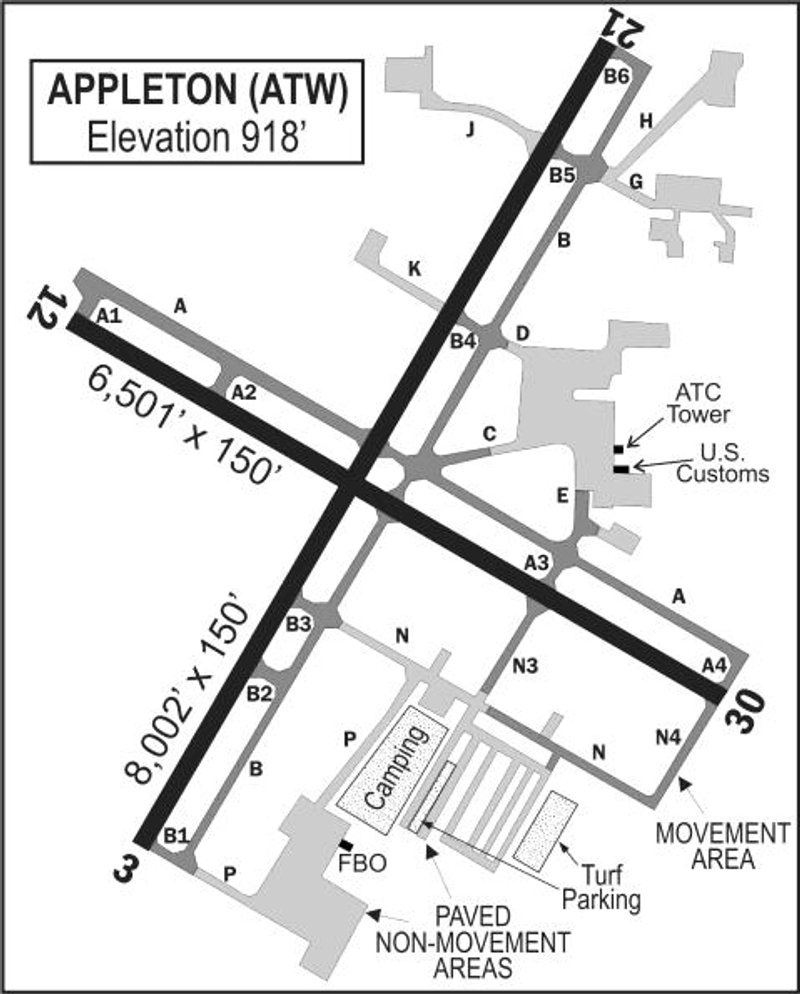
a. All transient parking (hard surface and grass) is in the south GA area, south of RWY 12/30 and east of RWY 3/21.
Shuttles transport visitors to the FBO (Appleton Flight Center, 920-738-3034).
b. Grass and hard surface parking areas are closed to all EAA operations (arrivals and departures) from 8:00 PM until 6:00 AM CDT from Saturday, July 18, through Sunday, July 26, 2026.
c. Airport management requires that all aircraft be secured to the ground. Aircraft on grass must be tied down. Tiedowns are available for purchase.
d. Aircraft parking brakes must remain OFF while parked at ATW. ATW Line Staff reserve the right to move any aircraft when necessary.
e. Cash and checks not accepted for services at ATW.
f. Camping not allowed at Appleton (ATW).
g. Scheduled transportation to and from Oshkosh is at the terminal and the FBO.
h. The self-service fuel station is not available during AirVenture. Fueling is at aircraft parking and the FBO.
i. International arrivals must clear Customs, located just south of the Tower. For more information, contact 920-968-2348.
j. Departure Runway is assigned by ATC based on direction of flight. See appletonflight.com/airventure
Appleton Area Frequencies | |
ATIS | 127.15 |
Green Bay Approach | 126.3 |
Tower (5:30 AM–11:00 PM CDT), CTAF | 119.6 |
Ground Control | 121.7 |
Clearance Delivery | 124.25 |
Appleton Flight Center Unicom | 122.95 |
AWOS (920-832-2597) | 127.15 |
Green Bay Radio (airborne only) | 122.55 |
EAA Parking | 129.05 |
Land and Hold Short (LAHSO) Information (Day only) | ||
Landing Runway | Hold Short Point | Measured Distance |
RWY 03 | RWY 12/30 | 3,300 feet |
RWY 21 | RWY 12/30 | 4,100 feet |
RWY 30 | RWY 03/21 | 3,400 feet |
31. ATW IFR Departure Routings
a. IFR departures must use the following routes to avoid long delays for flight plan amendment.
b. Routing to KMKE and its satellite airports: KATW CHING BJB…
c. Routing to KORD satellite airports: KATW CHING BJB OBK…
d. Routing to KMSN and its satellite airports: KATW BANKY DLL...
e. Routing to other destinations below 14,000’ should avoid MKE airspace:
(1) Southeast: KATW NEROE WELKO...
(2) South around ORD airspace: KATW BANKY FOMAG…(see IFR ARRIVAL/DEPARTURE section below for routing after DLL)
(3) Southwest: KATW BANKY…
(4) West: KATW BANKY…
a. Obtain ATIS (127.15).
b. IFR flights: Request IFR clearance prior to engine start from Ground Control (121.7) or Clearance Delivery (124.25), as indicated on ATIS.
c. Taxi to grass-parking exit, holding short of hard surface taxiways.
d. When number one at the grass-parking exit, contact Ground Control (121.7) with position, ATIS code received, and direction of flight.
e. For VFR flight following over Lake Michigan, contact Green Bay Approach (120.2) 10 NM northwest of KMTW.
(1) Special Traffic Management Program
(2) A Special Traffic Management Program (STMP) will be implemented at the following Oshkosh Area and Madison Area airports:
Oshkosh Area Airports (use IFR Routings to Oshkosh Area airports table below) | |
KOSH | Wittman Regional |
KATW | Appleton International |
KFLD | Fond du Lac County |
KRYV | Watertown Municipal |
KSBM | Sheboygan County Memorial |
KUNU | Dodge County - Juneau |
8D1 | New Holstein Municipal |
Madison Area Airports (no required routes) | |
C29 | Middleton Municipal – Morey |
C35 | Reedsburg Municipal |
C47 | Portage Municipal |
KDLL | Baraboo Wisconsin Dells |
KLNR | Tri-County Regional – Lone Rock |
61C | Fort Atkinson Municipal |
(1) Arrival slot reservations will be required for all domestic non-scheduled IFR arrivals from: Thursday, July 16 1200-2000 CDT (1700-0100 UTC), Friday July 17 through
Sunday, July 26, 2026 0700-2000 CDT (1200-0100 UTC). Arrival slot reservations will be available beginning Monday, July 13 at 1200 CDT (1700 UTC) and will not be assigned
more than 72 hours in advance.
(2) Reservations will not be allocated to KOSH during the scheduled hours of the daily airshows, but they will be allocated to the other listed airports.
(3) An IFR arrival slot reservation does not guarantee a parking spot at KOSH if parking areas are full.
(1) Departure slot reservations will be required for all domestic non-scheduled IFR departures from Wittman Regional Airport (KOSH), but not from the other listed airports.
They will be required from Monday, July 20 through Sunday, July 26, 2026 0600-2000 CDT (1100-0100 UTC).
(2) Departure slot reservations will be available beginning Friday, July 17 at 0600 CDT (1100 UTC) and will not be assigned more than 72 hours in advance or be allocated
during the daily airshows.
d. How to Obtain a Reservation
(1) STMP reservation may be obtained by using the computer interface (e-STMP). A touch-tone phone interface option is no longer available.
(2) e-STMP: Computer access is available at www.fly.faa.gov/estmp. A user guide is available on the website.
(3) The reservation system is available 24 hours a day. If you experience difficulties with the website, contact the TFM Help Desk at (609) 485-9601.
(4) If you experience difficulty making / canceling / confirming a reservation, contact the Airport Reservation Office at (540) 422-4246.
(5) Be prepared to provide your departure / destination airports, estimated UTC time of departure / arrival, UTC date, aircraft call sign and type. Upon completion of a slot reservation, you will receive a preliminary reservation number.
(6) Between 24 and 12 hours prior to your arrival/departure reservation, you must confirm your reservation and you will receive a confirmation number. If your reservation is not confirmed by 12 hours prior to your reservation time, it will be cancelled and automatically returned to the reservations system for reassignment. Reservations made within 24 hours of the arrival/departure time are automatically confirmed with a confirmation number.
(7) The slot reservation confirmation number must be included in the remarks section of your flight plan. If possible, file flight plan at least six hours prior to departure.
(8) Aircraft are required to arrive at a reservation airport or depart KOSH within +/- 15 minutes of their reservation time. If a reservation requires change or cancellation, please do so as early as possible, to release the slot for another flight.
(9) Slot reservations do not preclude possible delays if weather conditions necessitate additional traffic management initiatives.
(1) An IFR slot reservation confirmation number is required for IFR flights to the Oshkosh Area and Madison Area STMP airports listed in the tables above.
Keep this number on board for verification by ATC.
(2) If you do not have a confirmed reservation number, do not file IFR to one of the STMP airports – file to a destination airport away from the Oshkosh area;
then cancel IFR as appropriate and proceed to the Oshkosh area using the published VFR routes.
(3) File flight plans early (minimum 6 hours prior to departure, maximum 22 hours).
(4) Pilots departing from airports within 600 NM of KOSH should receive their IFR clearances before departure; to prevent excessive airborne holding,
airborne IFR clearance pickup is not recommended.
(5) Canceling IFR: When the KOSH ceiling is reported at or above 4,500’ and the visibility is greater than 5 miles, all IFR arrivals except turbojet and air carrier aircraft are
strongly encouraged to cancel their IFR flight plan 60 NM from Oshkosh. Piston aircraft must then execute the VFR arrival procedure from the ATC designated Transition
(FISK VFR ARRIVAL TO OSH section);
(6) high- performance aircraft unable to use that procedure must use the Turbine/ Warbird arrival from Fond du Lac (TURBINE/WARBIRD ARRIVAL section).
(7) When the reported weather is less than 4,500’ ceiling or 5 miles visibility, you may retain your IFR flight plan and expect radar vectors to the active instrument runway.
KOSH arrivals can expect Direct IGVEW or PRIMO for the RNAV (GPS) RWY 27 approach, or Direct WUVMO or HETUP for the RNAV (GPS) RWY 9 approach.
(8) Be extremely alert for a high volume of traffic with widely varying performance characteristics in the Oshkosh area.
(9) In VFR weather conditions, IFR arrivals at Oshkosh will be sequenced with VFR arrivals and may be asked to land on a runway dot.
Review NOTICE section FISK VFR ARRIVAL TO OSH.
IFR Routings to Oshkosh Area airports (listed in Oshkosh Area Airports table above) (non-RNAV aircraft can expect radar vectors)
From | Destination | Route (Shaded routes are over water.) |
Northeast: | ||
KOSH, KFLD, KSBM, KRYV, KUNU, or 8D1 | WELKO NEROE Direct or MBL NEROE Direct | |
KATW | TVC V420 GRB KATW or WELKO NEROE GRB KATW | |
East: | ||
KOSH, KFLD, KSBM, KRYV, KUNU, or 8D1 | GETCH GAYLE FAALZ Direct * | |
KATW | GETCH GRB Direct | |
Southeast: | ||
All area airports | SMUUV GAYLE FAALZ Direct * | |
KOSH, KATW, or KMTW | MAPPS SMARS T325 LUNGS RANDO V431 OSH Direct | |
KFLD, KSBM, or 8D1 | MAPPS SMARS T325 HOMNY Direct | |
KUNU or KRYV | MAPPS SMARS T325 LUNGS Direct | |
South: | ||
KOSH, KATW, or KMTW | PNTAC SMARS T325 LUNGS RANDO V431 OSH Direct | |
KFLD, KSBM, or 8D1 | PNTAC SMARS T325 HOMNY Direct | |
KUNU or KRYV | PNTAC SMARS T325 LUNGS Direct | |
Southwest: | ||
KOSH, KATW, or KMTW | DBQ V341 OSH Direct | |
KFLD, KSBM, or 8D1 | DBQ V341 MSN HOMNY Direct | |
KUNU or KRYV | DBQ V341 MSN Direct | |
West: | ||
KOSH, KATW, or KMTW | BOOTY DLL RANDO V341 OSH Direct | |
KFLD, KSBM, or 8D1 | BOOTY DLL HOMNY Direct or ZZIPR MSN HOMNY Direct | |
KUNU or KRYV | BOOTY MSN Direct or ZZIPR MSN Direct | |
Northwest: | ||
KOSH, KFLD, KSBM, KRYV, KUNU, or 8D1 | WLCHS RIPON Direct | |
KATW | BIPID KATW | |
North: | ||
All area airports | GRB Direct | |
* Expect to cross GAYLE at or above 6,000’
f. IFR Departure Route Planning
(1) IFR flight plans should be filed prior to departure. Chicago Center, Minneapolis Center and surrounding Approach Control facilities will not accept
airborne filing of flight plans within 150 NM of OSH. See Airborne IFR Clearance Pickup after VFR Departure section below for airborne clearance pick-up.
(2) Non-transponder and inoperative transponder IFR aircraft may experience lengthy delays and will only be handled as workload permits.
(3) Aircraft operating at or below 15,000’ MSL shall not file flight plans through Chicago Approach Control airspace.
(4) Oshkosh departures: See IFR Reservation Program, procedures in the IFR DEPARTURE FROM OSHKOSH section, and use routings in chart below.
(5) Appleton (KATW) departures: Use routings in the APPLETON ARRIVAL/DEPARTURE section.
(6) Other area airport departures: Use routings in chart below.
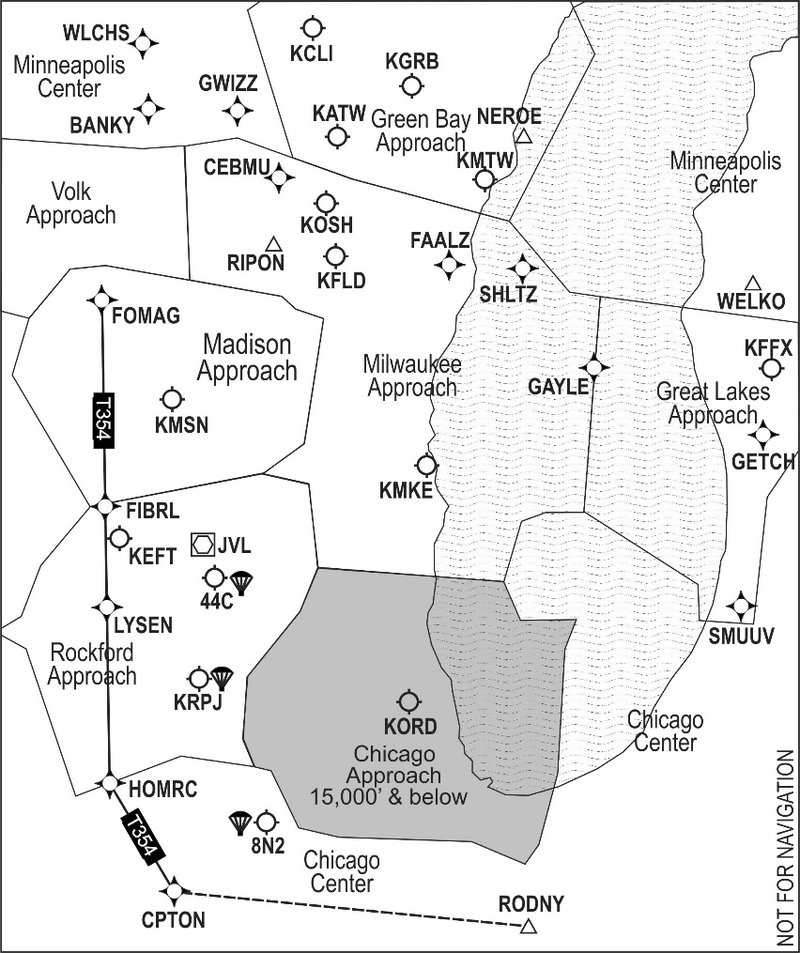
IFR Routings from Oshkosh Area airports
Direction | Altitude | Type | Required Initial Routes (Shaded routes are over water.) |
All: | |||
16,000’ & above | All | Radar Vectors on course | |
except SBM departures departing Northeast thru Southeast: | 16,000’ & above | RNAV | SHLTZ WELKO |
Non-RNAV | Radar Vectors WELKO | ||
North: | |||
15,000’ & below | All | Radar Vectors on course | |
Northeast thru Southeast: | |||
15,000’ & below | All | FOMAG T354 CPTON RODNY or Radar Vectors SHLTZ WELKO | |
South: | |||
15,000’ & below | All | FOMAG T354 CPTON | |
Southwest: | |||
15,000’ & below | All | FOMAG | |
West: | |||
15,000’ & below | All | BOOTY | |
Northwest: | |||
15,000’ & below | RNAV Non-RNAV | CEBMU GWIZZ Radar Vectors EAU | |
g. Airborne IFR Clearance Pickup after VFR Departure
(1) Aircraft departing VFR from Oshkosh area airports must use the following procedures in order to pick up IFR clearances when airborne.
Note that Milwaukee Approach Control will not issue airborne IFR clearances within 100 NM of OSH.
(2) Airborne pickup of IFR clearances may be received from the ATC facilities listed below. Flight plans must specify the appropriate pickup point within the facility’s airspace;
otherwise the facility will not be able to access your flight plan and may not issue an IFR clearance.
h. Madison Approach Control / Chicago Center
(1) File Dells Regional Airport (KDLL) as your departure airport. Your filed route must avoid Chicago Approach Control airspace (see graphic airspace diagram above)
with initial routing from table below.
(2) When over KDLL request IFR clearance based on your current altitude as follows:
(3) at or below 10,000’, contact Madison Approach Control (135.45),
(4) at or above 10,500’, contact Chicago Center (133.3).
DIRECTION | FILED ALTITUDE | REQUIRED INITIAL ROUTE |
East | 15,000’ & below | KDLL FOMAG T354 CPTON RODNY |
South | 15,000’ & below | KDLL FOMAG T354 CPTON |
(1) File Monroe Municipal Airport (KEFT) as your departure airport. Your filed route must avoid Chicago Approach Control airspace (see graphic airspace diagram above)
with initial routing from table below.
(2) Request IFR clearance from Rockford Approach Control (126.0) when within 10nm of KEFT at or below 11,500'.
DIRECTION | FILED ALTITUDE | REQUIRED INITIAL ROUTE |
East | 15,000’ & below | KEFT LYSEN T354 CPTON RODNY |
South | 15,000’ & below | KEFT LYSEN T354 CPTON |
j. Great Lakes Approach Control (AZO)/Minneapolis Center (ZMP)/Chicago Center (ZAU)
(1) If route of flight is WELKO or North, file from WELKO. When in the vicinity of WELKO request IFR clearance with Minneapolis Center (120.85)
(2) If route of flight is South of WELKO file from Fremont, MI (KFFX). When within 10NM of KFFX, request IFR clearance with:
(a) If At or Below 10,000’, Great Lakes Approach (119.8)
(b) If At or Above 10,500’, Chicago Center (128.5)
(1) File Clintonville Municipal Airport (KCLI) as your departure airport. Filed route cannot re-enter Milwaukee Approach airspace (see graphic airspace diagram above).
Use initial routing from table below.
(2) Request IFR clearance from Green Bay Approach Control (126.3) when in vicinity of KCLI at or below 12,500'. Eastbound departures filed off KCLI MUST request
IFR clearances at least 15NM westof Green Bay Airport (KGRB) to guarantee issuance.
DIRECTION | FILED ALTITUDE | REQUIRED INITIAL ROUTE* |
Southeast | 13,000’ & below | KCLI NEROE GETCH (or north of that route) |
14,000’ & higher | KCLI GRB GETCH (or north of that route) | |
West | All | KCLI BANKY |
*Non-RNAV aircraft can expect radar vectors.
34. FLIGHT SERVICE INFORMATION
a. Preflight Planning and Flight Plan Filing
(1) Please file all flight plans as far in advance as possible. IFR flight plans can be filed up to 22 hours in advance. VFR flight plans have no advance time limit.
(2) Telephone briefings and flight plan filing are available 24 hours/day at 1-800-WX-BRIEF (1-800- 992-7433).
(3) In-flight services include flight plan activation, cancellation and weather updates. See chart below for frequency.
(1) Inbound flights – Add 30 minutes to your ETE.
(2) Flight plans containing multiple stops are strongly discouraged. They should be filed as separate flight plans.
(3) Please cancel VFR flight plans while approaching destination airport. Parking delays can exceed 45 minutes.
(4) Air Traffic Control Towers do not forward VFR arrival information to Flight Service.
(5) When contacting Flight Service, provide your complete call sign, general location, and the frequency you are using. Example: Green Bay Radio, N5241A over Ripon, 122.25
(6) Due to frequency congestion, air filing of flight plans is discouraged between 0600-2100 CDT.
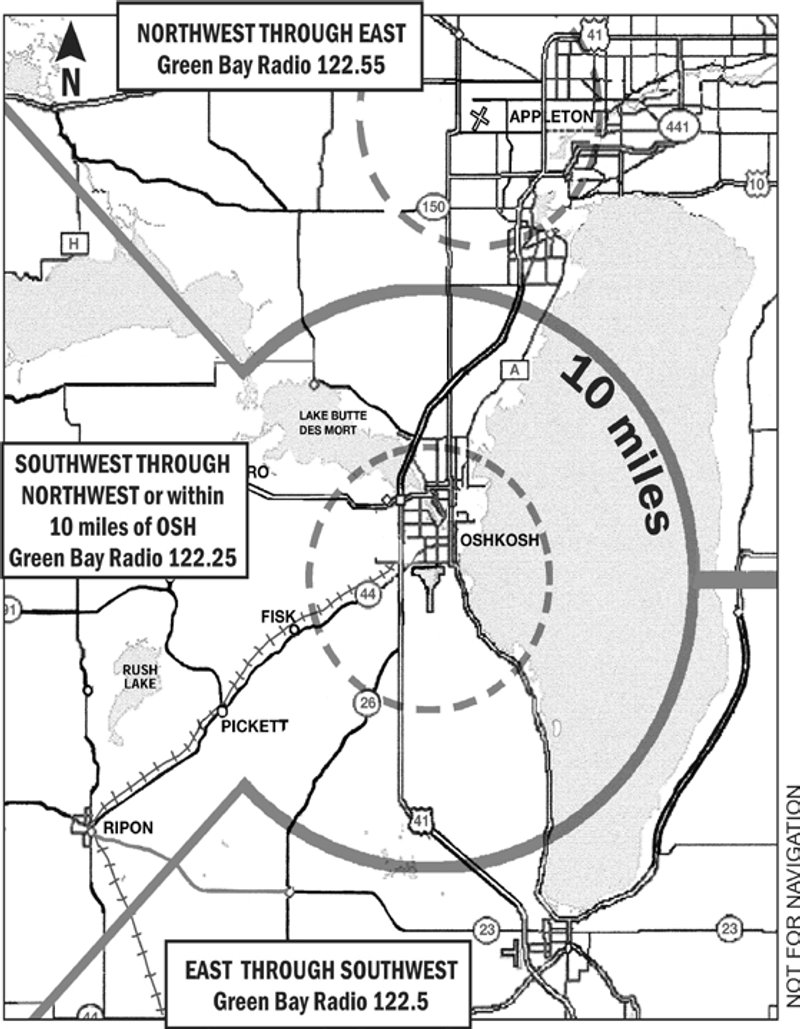
(7) Avoid using 122.25 and 122.5 for weather information. For weather information contact Green Bay Radio near:
[1] Green Bay: 122.55,
[2] Milwaukee: 122.4,
[3] Madison: 122.6,
[4] Wausau: 122.4.
Oshkosh Area Frequencies | |
Oshkosh Arrival | |
AirVenture Arrival ATIS | 125.9 |
Fisk Approach | 120.7 |
Oshkosh Tower North, RWY 09/27 | 118.5 |
Oshkosh Tower South, RWY 18/36 | 126.6 |
Unicom (Basler Flight Service FBO) | 122.95 |
Green Bay Radio | 122.3 |
OSH VORTAC | 116.75 |
Oshkosh Departure | |
AirVenture Departure ATIS | 121.75 |
Oshkosh Clearance Delivery | 119.05 |
Oshkosh Ground Control | 132.3 |
RWY 09/27 Departures Monitor | 128.75 |
RWY 18/36 Departures Monitor | 118.9 |
Milwaukee Approach | 127.0 |
Green Bay Radio | 122.3 |
AirVenture Seaplane Base | 123.3 |
AirVenture Warbird Area | 123.9 |
Oshkosh Telephone Numbers | |
AirVenture Arrival ATIS | 866-493-5553 |
Oshkosh Tower for No-Radio Arrival Instructions | 920-424-8002 |
Police/Fire/Medical at Oshkosh | |
Emergencies | 911 |
Non-Emergencies | 920-236-7300 |
Wittman Regional Airport | 920-236-4930 |
Appleton Area Frequencies | |
ATIS | 127.15 |
Green Bay Approach | 126.3 |
Tower (5:30 am–11:00 pm CDT), CTAF | 119.6 |
Ground Control | 121.7 |
Clearance Delivery | 124.25 |
Unicom | 122.95 |
AWOS (920-832-2597) | 127.15 |
Green Bay Radio (airborne only) | 122.55 |
EAA Parking | 129.05 |
Fond du Lac Area Frequencies | |
ATIS | 121.1 |
Temporary Tower | 120.4 |
Ground Control | 121.85 |
Unicom (CTAF when tower closed) | 123.05 |
ASOS (920-922-4444) | 134.0 |
Green Bay Radio | 122.5 |
Sheboygan Telephone Numbers | |
Clearance Delivery | 414-489-2174 |
2026 Oshkosh Airshow/TFR Times (CDT) |
Monday, July 20, thru Saturday, July 25: 2:15- 6:30 PM |
NIGHT SHOW Wednesday, July 22: 8:00-10:30 PM |
NIGHT SHOW Saturday, July 25: 8:00-10:30 PM |
Sunday, July 26: 1:00- 5:00 PM |
From Noon CDT July 16 through 6:00 AM CDT July 27, 2026, Wittman Regional Airport will be closed to all ARRIVING aircraft from 8 PM until 7 AM CDT daily and closed to all DEPARTING aircraft from 8 PM until 6 AM CDT daily.
The airport will also close periodically for aerobatic demonstrations, TFRs, or other special activities.
During airport closure periods, no arrivals, departures, engine operation or aircraft movement is permitted.
For a free, printed copy of this NOTICE booklet, call EAA at 1-800-564-6322.
To view or download this information, visit www.eaa.org/notam, or www.faa.gov/air_traffic/publications/notices.
FUTURE AIRVENTURE DATES |
July 26 - Aug 1, 2027 |
July 24 – July 30, 2028 |