Chapter 4. In‐Flight Services
Section 1. General
4-1-1. DESCRIPTION
In-flight services are those provided to or affecting aircraft in-flight or otherwise operating on the airport surface. This includes services to airborne aircraft, such as:
- ATC clearance relay.
- Voice communications for designated portions of ARTCC airspace.
- Flight progress reports.
- Advisories or requests.
- Issuance of military flight advisory messages.
- NOTAM delivery.
- SAR communications searches.
- Flight plan handling.
- Transcribed or live broadcasts.
- Weather observations.
- PIREP solicitation and dissemination.
- Pilot briefings.
4-1-2. PRE‐DUTY REQUIREMENTS
- Familiarization. Prior to assuming in-flight duties, specialists must familiarize themselves with meteorological and aeronautical conditions in accordance with appropriate facility directives. After assuming duties, specialists must continue to review data during the watch to maintain comprehensive knowledge of conditions affecting operations. This includes:
- General locations of weather-causing systems and general weather conditions.
- Detailed information of current and forecast weather conditions for the assigned FPA or AOR.
- Aeronautical information; particularly, NOTAMs, SUAs, TFRs, and air traffic delays.
- Transfer of position responsibility. Specialists must accomplish the transfer of position responsibility in accordance with paragraph 2-1-3, Transfer of Position Responsibility, of this order.
4-1-3. OPERATIONAL PRIORITY
Provide in‐flight services in accordance with the procedures in this chapter to aircraft on a “first come, first served” basis, as circumstances permit.
- Aircraft in distress have priority over all other aircraft.
- Treat air ambulance flights as follows:
- Provide priority handling to civilian air ambulance flights when the pilot, in radio transmissions, verbally identifies the flight by stating “MEDEVAC” followed by the FAA authorized call sign or the full civilian registration letters/numbers. Specialists must use good judgment in each situation to facilitate the most expeditious movement of a MEDEVAC aircraft.
- Provide priority handling to AIR EVAC and HOSP flights when verbally requested by the pilot.
- Assist the pilots of MEDEVAC, AIR EVAC, and HOSP aircraft to avoid areas of significant weather and adverse conditions.
- If requested by a MEDEVAC, AIR EVAC, or HOSP pilot, provide additional assistance (for example, landline notifications) to expedite ground handling of patients, vital organs, or urgently needed medical materials.
- Provide maximum assistance to aircraft performing a SAR mission.
- Provide special handling to expedite, as required, to aircraft engaged in flight inspections, also known as Flight Check. Unless otherwise agreed to, maintain direct contact with the pilot and provide information regarding known traffic in the area and request the pilot's intentions.
4-1-4. IN‐FLIGHT WEATHER BRIEFINGS
- Upon request, provide en route aircraft with pertinent weather information applicable to the phase of flight, altitude, and/or route.
- Provide in‐flight weather briefings in accordance with the procedures outlined in Chapter 5, Pre‐Flight Services.
- When conditions dictate, provide information for alternate routes and/or altitudes to assist the pilot in the avoidance of hazardous flight conditions.
4-1-5. AIRCRAFT‐REPORTED NAVIGATIONAL EQUIPMENT MALFUNCTIONS
4-1-6. RECORDING IN‐FLIGHT INFORMATION
- Record all actions taken in the provision of in-flight services.
- Aircraft contacts.
- When using flight progress strips, if the station has the aircraft's flight plan, enter “FP” in item 14 on the strip to show the flight plan is on file at the facility.
- If there is no flight plan on file for the aircraft, specialists must obtain the following from the aircraft:
- Aircraft identification.
- Type of flight.
- Time of contact.
- Other operationally significantitems.
- If the in-flight position is recorded, you may limit entries in the aircraft contact portion of the strip to those necessary for your use.
- The following should be logged using the symbols in TBL 4-1-1 and TBL 4-1-2:
- Type of briefing – standard, abbreviated, or outlook.
- Type of flight – IFR, VFR, or DVFR.
- Category of flight – air carrier, air taxi, military, or general aviation.
- Aircraft identification.
- Type of service – airport advisory, clearance request.
- Remarks. Operating position if not automatically logged by the operational system.
TBL 4-1-1Clearance Abbreviations Abbreviation
Meaning
A
Cleared to airport (point of intended landing)
B
ARTCC clearance delivered
C
ATC clears (when clearance relayed through non-ATC facility)
CAF
Cleared as filed
D
Cleared to depart from the fix
F
Cleared to the fix
H
Cleared to hold and instructions issued
L
Cleared to land
N
Clearance not delivered
O
Cleared to the outer marker
PD
Cleared to climb/descend at pilot's discretion
Q
Cleared to fly specified sectors of a NAVAID defined in terms of courses, bearings, radials, or quadrants within a designated radius
T
Cleared through (for landing and takeoff through intermediate point)
V
Cleared over the fix
X
Cleared to cross (airway, route, radial) at (point)
Z
Tower jurisdiction
TBL 4-1-2Miscellaneous Abbreviation Abbreviation
Meaning
BC
Back course approach
CT
Contact approach
FA
Final approach
GPS
GPS approach
I
Initial approach
ILS
ILS approach
MA
Missed approach
NDB
Non-directional radio beacon approach
OTP
VFR conditions-on-top
PA
Precision approach
PT
Procedure turn
RH
Runway heading
RP
Report immediately upon passing (fix/altitude)
RX
Report crossing
SA
Surveillance approach
SI
Straight‐in approach
TA
TACAN approach
TL
Turn left
TR
Turn right
VA
Visual approach
VR
VOR approach
- Flight plans and related messages (for example, modifications, cancellations, activations, and closures). When closing an active VFR flight plan, obtain departure point and destination, if not already known.
- ATC clearances.
- Pilot briefings.
- Weather and flight data messages.
- Other operationally significant actions.
- Aircraft contacts.
- In‐flight contacts may be logged in the operational system, the multi‐touch electronic flight strip (EFS) system, or other facility approved alternate forms.
- Locally approved procedures may be used to manually record data during heavy traffic periods or system outages and should be logged in the operational system as soon as practicable.
- Use control/clearance symbols, abbreviations, location identifiers, and contractions for recording position reports, traffic clearances, and other data.
- When recording data, you may use:
- Plain language to supplement data when it will aid in understanding the recorded information.
- Locally approved contractions and identifiers for frequently used terms and local fixes not listed in FAA Order JO 7340.2, Contractions, or accessible through FAA Order JO 7350.9, Location Identifiers. Use only within your facility, not on data or interphone circuits. All locally approved contractions and identifiers must be available in facility files for record and reference purposes.
- When recording data manually, use the standard hand-printed characters shown in TBL 4-1-3 to prevent misinterpretation.
- To correct or update data, draw a horizontal line through it and write the correct information adjacent to it.
- Do not erase any item.
TBL 4-1-3Hand Printed Character Chart Typed
Hand‐Printed
Typed
Hand‐Printed
A
A
S
S
B
B
T
T
C
C
U
U
D
D
V
V
E
E
W
W
F
F
X
X
G
G
Y
Y
H
H
Z
Ƶ
I
I
1
l
J
J
2
2
K
K
3
3
L
L
4
4
M
M
5
5
N
N
6
6
O
O
7
7
P
P
8
8
Q
Q
9
9
R
R
0
Ø
4-1-7. FLIGHT PROGRESS STRIPS AND ENTRY DATA
- When officially used to record in-flight data, use the multi‐touch EFS to record:
- Aircraft contacts.
- ATC clearances.
- Pilot briefings on airborne aircraft.
- Other operationally significant items.
- Locally approved procedures may be used to manually record flight progress during heavy traffic periods or system outages and should be logged in the multi-touch EFS as soon as practicable.
- Use a flight progress strip for each aircraft and record all contacts with that aircraft on the same strip. If supplemental strips are needed for additional writing space, keep the original and supplemental strips together.
- Flight progress strip (see FIG 4-1-1).
FIG 4-1-1Flight Progress Strip 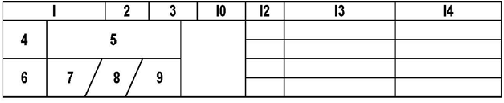
- Flight progress strip entry examples (see FIG 4-1-2 and FIG 4-1-3).
FIG 4-1-2Strip Entry 1 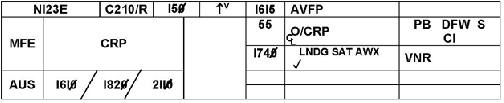
FIG 4-1-3Strip Entry 2 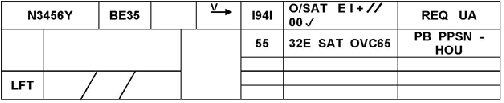
- Flight progress strip item and information (see TBL 4-1-4).
TBL 4-1-4Item and Information Item
Information
1
Aircraft identification. To identify IFR aircraft piloted by solo U.S. Air Force undergraduate pilot, the letter `Z' will be added to aircraft ID on the flight progress strip. Do not use the suffix in ground-to-air communications.
2
Type of aircraft/special equipment.
3
True airspeed (TAS) and altitude (IFR). Altitude (VFR/DVFR, if known).
4
Departure point.
5
Route of flight.
6
Destination.
7
Actual departure time, or time VFR flight plan activated.
8
ETA at destination.
9
Estimated time of fuel exhaustion.
10
Type of flight.
11
Action time (for example, overdue time, fuel exhaustion time, LR contact time).
12
Time of contact with pilot.
13
Information received from pilot/another facility.
14
Data issued to the aircraft.
- Flight progress strip abbreviations (see TBL 4-1-5).
TBL 4-1-5Flight Progress Strip Abbreviations Abbreviation
Meaning
Õ
Over flight
↓
Inbound flight
↑
Outbound flight
A
AIRMET or G-AIRMET
AA
Airport advisory
CWT
Caution wake turbulence
D
DVFR
DA
Decided against flight
DD
Decided to delay flight
DW
Downwind
FP
Filed flight plan
I
IFR
IC
Incomplete briefing
PB
Pilot brief
RY
Runway
S
SVFR
V
VFR
VNR
VFR flight not recommended (pilot brief)
WS
SIGMET
WST
Convective SIGMET
- Record ATC instructions and clearances completely and exactly.
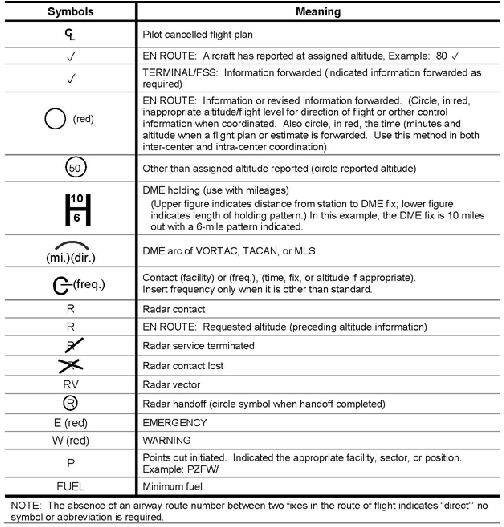
- Summarize other data using approved symbols and contractions. See FIG 4-1-4 and FIG 4-1-5.
- Do not record issuance of altimeter setting unless that is the only information provided during the contact.
FIG 4-1-4Control Information Symbols Chart 1 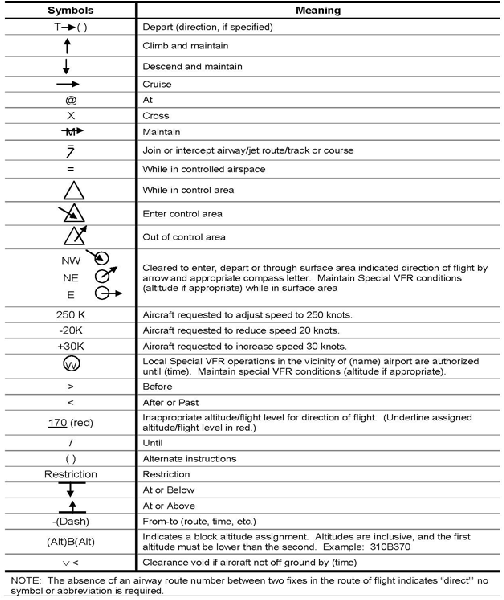
FIG 4-1-5Control Information Symbols Chart 2