Chapter 8. Offshore/Oceanic Procedures
Section 6. Separation from Airspace Reservations
8-6-1. TEMPORARY STATIONARY AIRSPACE RESERVATIONS
Separate aircraft from a temporary stationary reservation by one of two methods:
- Laterally: Clear aircraft so that the protected airspace along the route of flight does not overlap the geographical area of the stationary reservation. (See FIG 8-6-1.)
FIG 8-6-1Temporary Stationary Airspace Reservations 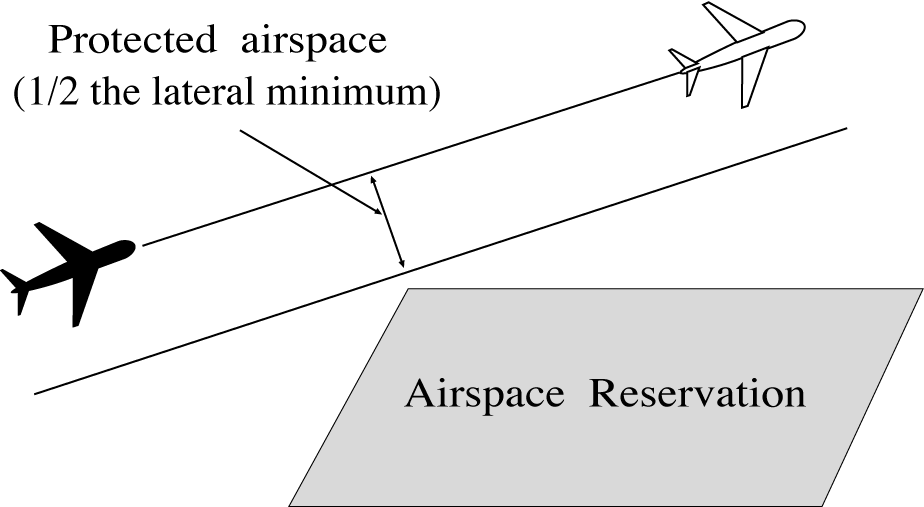
- Vertically: Clear aircraft so that vertical separation exists while the aircraft is within a geographical area defined as the stationary reservation plus a buffer around the perimeter equivalent to one‐half the lateral separation minimum. (See FIG 8-6-2.)
FIG 8-6-2Temporary Stationary Airspace Reservations 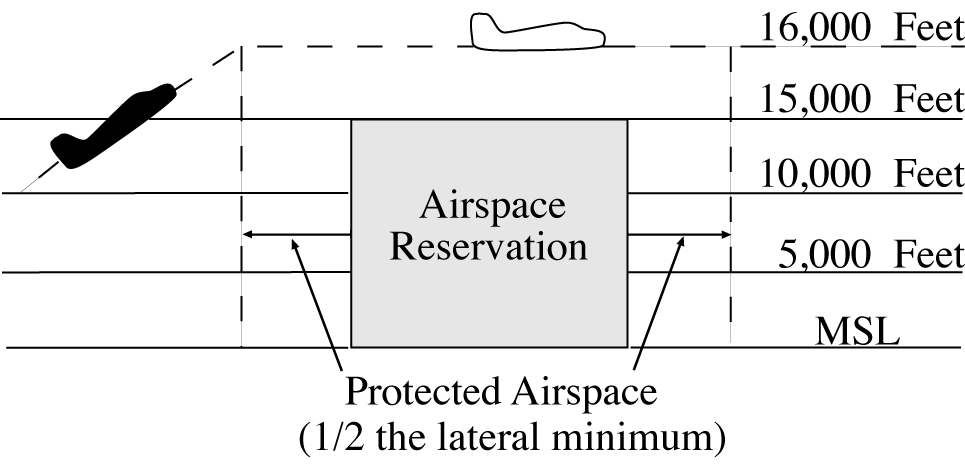
8-6-2. REFUSAL OF AVOIDANCE CLEARANCE
If a pilot refuses to accept a clearance to avoid a reservation, inform him/her of the potential hazard, advise him/her that services will not be provided while the flight is within the reservation and, if possible, inform the appropriate using agency.
8-6-3. TEMPORARY MOVING AIRSPACE RESERVATIONS
Separate aircraft from a temporary moving airspace reservation by one of the following methods:
- Laterally: Clear aircraft so that the protected airspace along the route of flight does not overlap the (time‐dependent) geographical area of the moving airspace reservation.
- Longitudinally: Clear aircraft so that the appropriate longitudinal minimum exists ahead of the first or behind the last aircraft operating within the reservation.
- Vertically: Clear aircraft so that vertical separation exists while the aircraft is within a (time‐dependent) geographical area defined as the moving airspace reservation plus a buffer around the perimeter equivalent to one‐half the lateral separation minimum.