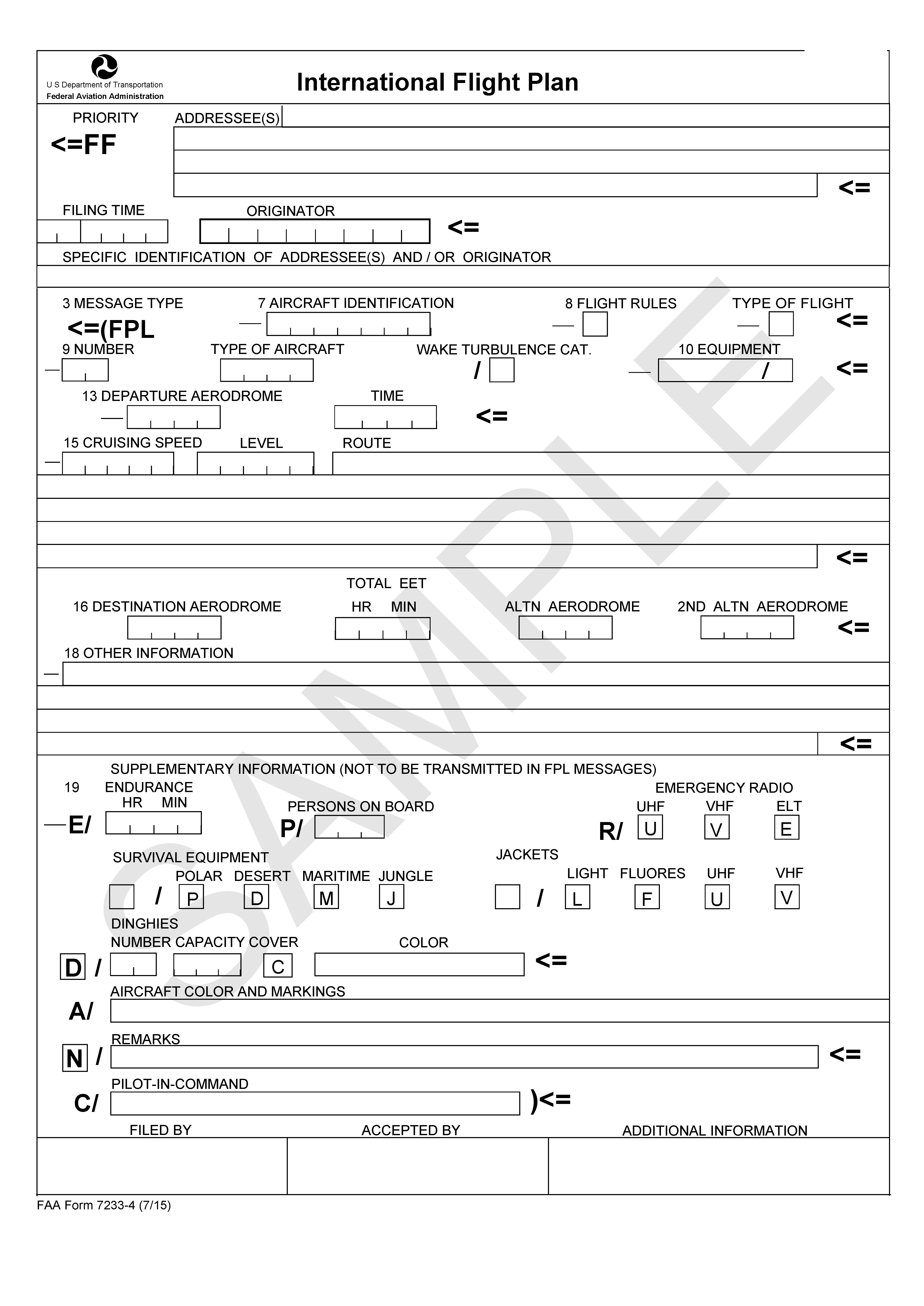
FAA Form 7233-4 - International Flight Plan
a. The FAA will accept a flight plan in international format for IFR, VFR, SFRA, and DVFR flights. File the flight plan electronically via a Flight Service Station (FSS), FAA contracted flight plan filing service, or other commercial flight plan filing service. Depending on the filing service chosen, the method of entering data may be different but the information required is generally the same.
b. The international flight plan format is mandatory for:
1. Any flight plan filed through a FSS or FAA contracted flight plan filing service; with the exception of Department of Defense flight plans and civilian stereo route flight plans, which can still be filed using the format prescribed in FAA Form 7233-1.
2. Any flight that will depart U.S. domestic airspace. For DOD flight plan purposes, offshore Warning Areas may use FAA Form 7233-1 or military equivalent.
3. Any flight requesting routing that requires Performance Based Navigation.
4. Any flight requesting services that require filing of capabilities only supported in the international flight plan format.
c. Flight Plan Contents
1. A flight plan will include information shown below:
(a) Flight Specific Information (TBL 1-1)
(b) Aircraft Specific Information (TBL 1-19)
(c) Flight Routing Information (TBL 1-20)
(d) Flight Specific Supplementary Information (Item 19)
2. The tables indicate where the information is located in the international flight plan format, the information required for U.S. domestic flights, and the location of equivalent information in the domestic flight plan format.
3. International flights, including those that temporarily leave domestic U.S. airspace and return, require all applicable information in the international flight plan. Additional information can be found in ICAO Doc. 4444 (Procedures for Air Navigation Services, Air Traffic Management), and ICAO Doc. 7030 (Regional Supplemental Procedures) as well as the Aeronautical Information Publications (AIPs), Aeronautical Information Circulars (AICs), and NOTAMs of applicable other countries.
Item |
International Flight |
Domestic U.S. Requirements |
Equivalent Item on Domestic Flight Plan (FAA Form 7233-1) |
|---|---|---|---|
Aircraft Identification |
Item 7 |
Required |
Item 2 |
Flight Rules |
Item 8 |
Required |
Item 1 |
Type of Flight |
Item 8 |
No need to file for domestic U.S. flight |
N/A |
Equipment and Capabilities |
Item 10 |
Required |
Item 3 |
Date of Flight |
Item 18 DOF/ |
Include when date of flight is not today |
N/A |
Reasons for Special Handling |
Item 18 STS/; RMK/ |
Include when special category is applicable |
Item 11 |
Remarks |
Item 18 RMK/ |
Include when necessary |
Item 11 |
Operator |
Item 18 OPR/ |
No need to file for domestic U.S. flight |
N/A |
Flight Plan Originator |
Item 18 ORGN/ |
No need to file for domestic U.S. flight |
N/A |
d. Instructions for Flight-Specific Information Items
1. Aircraft Identification (Item 7) Aircraft Identification is always required. Aircraft identification must not exceed seven alphanumeric characters and be either:
(a) The ICAO designator for the aircraft operating agency, followed by the flight identification (for example, KLM511, NGA213, JTR25). When in radiotelephony the call sign to be used by the aircraft will consist of the ICAO telephony designator for the operating agency followed by the flight identification (for example, KLM511, NIGERIA213, JESTER25);
(b) The nationality or common mark and registration of the aircraft (for example, EIAKO, 4XBCD, N2567GA), when:
(1) In radiotelephony, the call sign to be used by the aircraft will consist of this identification alone (for example, CGAJS) or preceded by the ICAO telephony designator for the aircraft operating agency (for example, BLIZZARD CGAJS); or
(2) The aircraft is not equipped with radio.
2. Flight Rules (Item 8a)
(a) Flight rules are always required.
(b) Flight rules must indicate IFR (I) or VFR (V).
(c) For composite flight plans,submit separate flight plans for the IFR and VFR portions of the flight. Specify in Item 15 the point or points where change of flight rules is planned. The IFR plan will be routed to ATC, and the VFR plan will be routed to a Flight Service for Search and Rescue services.
3. Type of Flight (Item 8b)
(a) The type of flight is optional for flights remaining wholly within U.S. domestic airspace.
(b) Indicate the type of flight as follows:
SG - General Aviation
SS - Scheduled Air Service
SN - Non-Scheduled Air Transport Operation
SM - Military
SX - other than any of the defined categories above
4. Equipment and Capabilities (Item 10, Item 18 NAV/, COM/, DAT/, SUR/)
(a) Equipment and capabilities that can be filed in a flight plan include:
S Navigation capabilities in Item 10a, Item 18 PBN/, and Item 18 NAV/
S Voice communication capabilities in Item 10a and Item 18 COM/
S Data communication capabilities in Item 10a and Item 18 DAT/
S Approach capabilities in Item 10a and Item 18 NAV/
S Surveillance capabilities in Item 10b and Item 18 SUR/
(b) Codes allowed in Item 10a are shown in Table 1-2. Codes allowed in Item 10b are shown in TBL 1-3. Codes recognized in Item 18 NAV/, COM/, DAT/, and SUR/ are shown in TBL 1-4. Note that other service providers may define additional allowable (and required) codes for use in Item 18 NAV/, COM/, DAT/, or SUR/. Codes to designate PBN capability are described in TBL 1-5.
Radio communication, navigation and approach aid equipment and capabilities
ENTER one letter as follows:
N if no COM/NAV/approach aid equipment for the route to be flown is carried, or the equipment is unserviceable,
OR
S if standard COM/NAV/approach aid equipment for the route to be flown is carried and serviceable (see Note 1),
AND/OR
ENTER one or more of the following letters from TBL 1-2 to indicate the serviceable COM/NAV/ approach aid equipment and capabilities available.
ABCDE1E2E3FGHIJ1J2J3J4J5 |
GBAS Landing SystemLPV (APV with SBAS)LORAN CDMEFMC WPR ACARSD-FIS ACARSPDC ACARSADFGNSS (See Note 2)HF RTFInertial NavigationCPDLC ATN VDL Mode 2 (See Note 3)CPDLC FANS 1/A HFDLCPDLC FANS 1/A VDL Mode ACPDLC FANS 1/A Mode 2CPDLC FANS 1/A SATCOM |
J7 |
CPDLC FANS 1/A SATCOM |
Any alphanumeric characters not indicated above are reserved.
ENTER “N” if no surveillance equipment for the route to be flown is carried, or the equipment is unserviceable,orENTER One or more of the following descriptors, to a maximum of 20 characters, to describe the serviceable surveillance equipment and/or capabilities on board.ENTER no more than one transponder code (Modes A, C, or S)SSR Modes A and C: A Transponder Mode A (4 digits – 4096 codes) C Transponder Mode A (4 digits – 4096 codes) and Mode CSSR Mode S: E Transponder Mode S, including aircraft identification, pressure-altitude, and extended squitter (ADS-B) capability H Transponder Mode S, including aircraft identification, pressure-altitude, and enhanced surveillance capability I Transponder Mode S, including aircraft identification, but no pressure-altitude capability L Transponder Mode S, including aircraft identification, pressure-altitude, extended squitter (ADS-B), and enhanced surveillance capability P Transponder Mode S, including pressure-altitude, but no aircraft identification capability S Transponder Mode S, including both pressure-altitude and aircraft identification capability X Transponder Mode S, with neither aircraft identification nor pressure-altitudeEnhanced surveillance capability is the ability of the aircraft to down-link aircraft derived data via Mode S transponder.ADS-B: B1 ADS-B with dedicated 1090 MHz ADS-B “out” capability B2 ADS-B with dedicated 1090 MHz ADS-B “out” and “in” capability U1 ADS-B with “out” capability using UAT U2 ADS-B with “out” and “in” capability using UAT V1 ADS-B with “out” capability using VDL Mode 4 V2 ADS-B with “out” and “in” capability using VDL Mode 4File no more than one code for each type of capability, e.g., file B1 or B2 and not bothADS-C: D1 ADS-C with FANS 1/A capabilities G1 ADS-C with ATN capabilitiesAlphanumeric characters not included above are reserved.ADE3RV/HB2U2V2G11. The RSP specification(s), if applicable, will be listed in Item 18 following the indicator SUR/, using the characters “RSP” followed by the specifications value. Currently RSP180 and RSP400 are in use.2. List additional surveillance equipment or capabilities in Item 18 following the indicator SUR/. |
Item |
Purpose |
Entry |
Explanation |
|---|---|---|---|
NAV/ entries used by FAA |
Radius-to-Fix (RF) capability |
Z1 |
RNP-capable flight is authorized for Radius to Fix operations. |
Fixed Radius Transitions (FRT) |
Z2 |
RNP-capable flight is authorized for Fixed Radius Transitions. | |
Time of Arrival Control (TOAC) |
Z5 |
RNP-capable flight is authorized for Time of Arrival Control. | |
Advanced RNP (A-RNP) |
P1 |
Flight is authorized for A-RNP operations. | |
Helicopter RNP 0.3 |
R1 |
Flight is authorized for RNP 0.3 operations (pertains to helicopters only). | |
RNP 2 Continental |
M1 |
Flight is authorized for RNP 2 continental operations. | |
RNP 2 Oceanic/Remote |
M2 |
Flight is authorized for RNP 2 oceanic/remote operations. | |
COM/ entries used by FAA |
N/A |
N/A |
The FAA currently does not use any entries in COM/. |
DAT/ entries used by FAA |
Capability and preference for delivery of pre-departure clearance |
Priority number followed by: |
Entries are combined with a priority number, for example; 1FANS2PDC means a preference for departure clearance delivered via FANS 1/A; with capability to also receive the clearance via ACARS PDC. |
SUR/ entries used by FAA |
Req. Surveillance Performance |
RSP180 |
Aircraft is authorized for Required Surveillance Performance RSP180 |
RSP400 |
Aircraft is authorized for Required Surveillance Performance RSP400 | ||
ADS-B |
A2 |
Aircraft has 1090 MHz Extended Squitter ADS-B compliant with RTCA DO-260B (complies with FAA requirements) | |
A2 |
Aircraft has 978 MHz UAT ADS-B compliant with RTCA DO-282B (complies with FAA requirements) |
PBN/ |
RNAV SPECIFICATIONS |
|---|---|
A1 |
RNAV10(RNP10) |
B1 |
RNAV 5 all permitted sensors |
B2 |
RNAV 5 GNSS |
B3 |
RNAV 5 DME/DME |
B4 |
RNAV 5 VOR/DME |
B5 |
RNAV 5 INS or IRS |
B6 |
RNAV 5 LORAN C |
C1 |
RNAV 2 all permitted sensors |
C2 |
RNAV 2 GNSS |
C3 |
RNAV 2 DME/DME |
C4 |
RNAV 2 DME/DME/IRU |
D1 |
RNAV 1 all permitted sensors |
D2 |
RNAV 1 GNSS |
D3 |
RNAV 1 DME/DME |
D4 |
RNAV 1 DME/DME/IRU |
PBN/ |
RNP SPECIFICATIONS |
L1 |
RNP 4 |
O1 |
Basic RNP 1 all permitted sensors |
O2 |
Basic RNP 1 GNSS |
O3 |
Basic RNP 1 DME/DME |
O4 |
Basic RNP 1 DME/DME/IRU |
S1 |
RNP APCH |
S2 |
RNP APCH with BARO-VNAV |
T1 |
RNP AR APCH with RF (special authorization required) |
T2 |
RNP AR APCH without RF (special authorization required) |
(c) The following sections detail what capabilities need to be provided to obtain services from the FAA for:
S IFR flights (general).
S Assignment of Performance-Based Navigation (PBN) routes.
S Automated Departure clearance (via Datacom DCL or PDC).
S Reduced Vertical Separation Minima (if requesting FL 290 or above).
S Reduced Separation in Oceanic Airspace.
(d) Capabilities such as voice communications, required communications performance, approach aids, and ADS-C, are not required in a flight plan that remains entirely within domestic airspace.
(e) Flights that leave domestic United States airspace may be required to include additional capabilities, per requirements for the FIRs being overflown.Consult the appropriate State Aeronautical Information Publications for requirements.
(f) Include the capability only if:
S The requisite equipment is installed and operational;
S The crew is trained as required; and
S Any required Operations Specification, Letter of Authorization, or other approvals are in hand.
5. Filing equipment and capability in an IFR Flight Plan. This section details the minimum requirements to identify capabilities in an IFR flight plan for flights in the domestic United States. Other requirements to file a capability are associated with obtaining specific services as described in subsequent sections. The basic capabilities that must be addressed include Navigation, Transponder, Voice, and ADS-B Out as described below. A designator for “Standard” capability is also allowed to cover a suite of commonly carried voice, navigation, and approach equipment with one code.
(a)Standard Capability and No Capability (Item 10a)
S Use “S” if VHF radio, VOR, and ILS equipment for the route to be flown are carried and serviceable. Use of the 'S' removes the need to list these three capabilities separately.
S Use “N” if no communications, navigation, or approach aid equipment for the route to be flown are carried or the equipment is unserviceable.
S When there is no transponder, ADS-B, or ADS-C capability then file only the letter 'N' in Item 10b.
(b)Navigation Capabilities (Item 10a, Item 18 NAV/)
S Indicate radio navigation capability by filing one or more of the codes in TBL 1-6.
S Indicate Area Navigation (RNAV) capability by filing one or more of the codes in TBL 1-7.
Capability |
Item 10a |
Item 18 NAV/ |
|---|---|---|
VOR |
O |
|
DME |
D |
|
TACAN |
T |
Capability |
Item 10a |
Item 18 NAV/ |
|---|---|---|
GNSS |
G |
SBAS (if WAAS equipped) |
INS |
I |
|
DME / DME |
DR |
|
VOR / DME |
DOR |
(c) Transponder Capabilities (Item 10b)
S For domestic flights, it is not necessary to indicate Mode S capability. It is acceptable to simply file one of the following codes in TBL 1-8.
Capability |
Item 10b |
|---|---|
Transponder with no Mode C |
A |
Transponder with Mode C |
C |
S International flights must file in accordance with relevant AIPs and regional supplements. Include one of the Mode S codes in TBL 1-9, if appropriate.
Capability |
Aircraft ID |
Altitude Encoding |
Item 10b |
|---|---|---|---|
Mode S Transponder |
No |
No |
X |
Mode S Transponder |
No |
Yes |
P |
Mode S Transponder |
Yes |
No |
I |
Mode S Transponder |
Yes |
Yes |
S |
Mode S Transponder with Extended Squitter |
Yes |
Yes |
E |
Enhanced Mode S Transponder |
Yes |
Yes |
H |
Enhanced Mode S Transponder with Extended Squitter |
Yes |
Yes |
L |
(d) ADS-B Capabilities (Item 10b, Item 18 SUR/ and Item 18 CODE/)
S Indicate ADS-B capability as shown in TBL 1-10. The accompanying entry in Item 18 indicates that the equipment is compliant with 14 CFR §91.227. Some ADS-B equipment used in other countries is based on an earlier standard and does not meet U.S. requirements.
S Do not file an ADS-B code for “in” capability only. There is currently no way to indicate that an aircraft has “in” capability but no “out” capability.
S For aircraft with ADS-B “out” on one frequency and “in” on another, include only the ADS-B “out” code. For example, B1 or U1, (See TBL 1-10).
Capability |
Item 10b |
Item 18 SUR/ |
|---|---|---|
1090 ES Out Capability |
B1 |
A2 |
1090 ES Out and In Capability |
B2 |
A2 |
UAT Out Capability |
U1 |
A2 |
UAT Out and In Capability |
U2 |
A2 |
(e)Voice Communication Capabilities (Item 10a)
The FAA does not require indication of voice communication capabilities in a flight plan for domestic flights, but it is permissible. For flights outside the domestic United States, all relevant capabilities must be indicated as follows (See TBL 1-11):
Capability |
Item 10a |
|---|---|
VHF Radio |
V |
UHF Radio |
U |
HF Radio |
H |
VHF Radio (8.33 kHZ Spacing) |
Y |
ATC SATVOICE (INMARSAT) |
M1 |
ATC SATVOICE (Iridium) |
M3 |
(f) Approach Aid Capabilities (Item 10a).
The FAA does not require filing of approach aid capability in order to request a specific type of approach, however any of the codes indicated in TBL 1-12 in 10a are permissible.
S International flights may be required to indicate approach capability, based on instructions from relevant service providers.
Capability |
Item 10a |
|---|---|
ILS |
L |
MLS |
K |
LPV Approach (APV with SBAS) (WAAS) |
B |
GBAS Landing System (LAAS) |
A |
6. Performance-Based Navigation Routes (Item 10a, Item 18 PBN/, Item 18 NAV/)- When planning to fly routes that require PBN capability, file the appropriate capability as shown in TBL 1-13.
Type of Routing |
Capability Required |
Item 10a |
Item 18 PBN/See NOTE 2 |
Item 18 NAV/See NOTE 3 |
Notes |
|---|---|---|---|---|---|
RNAV SID or STAR |
RNAV 1 |
GR |
D2 |
If GNSS | |
DIR |
D4 |
If DME/DME/IRU | |||
RNP SID or STAR |
RNP 1 |
GR |
O2 |
If GNSS only | |
RNP 1 |
DGIR |
O1 |
If GNSS primary and DME/DME/IRU backup | ||
RNP SID or STAR with RF required |
RNP 1 |
GRZ |
O2 |
Z1 |
If GNSS only |
RNP 1 |
DGIRZ |
O1 |
Z1 |
If GNSS primary and DME/DME/IRU backup | |
Domestic Q-Route (see separate requirements for Gulf of America Q-Routes) |
RNAV 2 |
GR |
C2 |
If GNSS | |
DIR |
C4 |
If DME/DME/IRU | |||
T-Route |
RNAV 2 |
GR |
C2 |
GNSS is required for T-Routes | |
RNAV (GPS) Approach |
RNP Approach, GPS |
GR |
S1 |
Domestic arrivals do not need to file PBN approach capabilities to request the approach. | |
RNAV (GPS) Approach |
RNP Approach, GPS Baro-VNAV |
GR |
S2 |
||
RNAV (GPS) Approach with RF required |
RNP Approach, GPS |
GRZ |
S2 |
Z1 |
|
RNP AR Approach with RF |
RNP (Special Authorization Required) RF Leg Capability |
GR |
T1 |
||
RNP AR Approach without RF |
RNP (Special Authorization Required) |
GR |
T2 |
7. Automated Departure Clearance Delivery (DCL or PDC). When planning to use automated pre-departure clearance delivery capability, file as indicated below.
(a) PDC provides pre-departure clearances from the FAA to the operator's designated flight operations center, which then delivers the clearance to the pilot by various means. Use of PDC does not require any special flight plan entry.
(b) DCL provides pre-departure clearances from the FAA directly to the cockpit/FMS via Controller Pilot Datalink Communications (CPDLC). Use of DCL requires flight plan entries as follows:
S Include CPDLC codes in Item 10a only if the flight is capable of en route/oceanic CPDLC, the codes are not required for DCL.
S Include Z in Item 10a to indicate there is information provided in Item 18 DAT/.
S Include the clearance delivery methods of which the flight is capable, and order of preference in Item 18 DAT/. (See AIM 5-2-2)
○ VOICE - deliver clearance via Voice
○ PDC - deliver clearance via PDC
○ FANS - deliver clearance via FANS 1/A
○ FANSP - deliver clearance via FANS 1/A+
8. Operating in Reduced Vertical Separation Minima (RVSM) Airspace (Item 10a). When planning to fly in RVSM airspace (FL 290 up to and including FL 410) then file as indicated below.
(a) If capable and approved for RVSM operations, per AIM 4-6-1, Applicability and RVSM Mandate (Date/Time and Area), file a W in Item 10a. Include the aircraft registration mark in Item 18 REG/, which is used to post-operationally monitor the safety of RVSM operations.
S Do not file a “W” in Item 10a if the aircraft is capable of RVSM operations, but is not approved to operate in RVSM airspace.
S If RVSM capability is lost after the flight plan is filed, request that ATC remove the 'W' from Item 10a.
(b) When requesting to operate non-RVSM in RVSM airspace, using one of the exceptions identified in AIM 4-6-10, do not include a “W” in Item 10a. Include STS/NONRVSM in Item 18. STS/NONRVSM is used only as part of a request to operate non-RVSM in RVSM airspace.
9. Eligibility for Reduced Oceanic Separation. Indicate eligibility for the listed reduced separation minima as indicated in the tables below. Full Operational Requirements for these services are found in the U.S. Aeronautical Information Publication (AIP) ENR 7, Oceanic Operations, available at http://www.faa.gov/air_traffic/publications/atpubs/aip_html/index.html.
Dimension of Separation |
Separation Minima |
ADS-C Surveillance Requirements |
Comm. Requirement |
PBN Requirement |
Flight Plan Entries |
|||
|---|---|---|---|---|---|---|---|---|
ADS-C in Item 10b |
CPDLC in Item 10a |
PBN in Item 18 PBN/ |
PBN in Item 18 NAV/ | |||||
Lateral |
50 NM |
N/A |
Voice comm-HF or VHF as required to maintain contact over the entire route to be flown. |
RNP10 |
N/A |
N/A |
A1 or L1 |
N/A |
Dimension of Separation |
Separation Minima |
ADS-C Surveillance Requirements |
Comm. Requirement |
PBN Requirement |
Flight Plan Entries |
|||
|---|---|---|---|---|---|---|---|---|
ADS-C in Item 10b |
CPDLC in Item 10a |
PBN in Item 18 PBN/ |
PBN in Item 18 NAV/ | |||||
Lateral |
50 NM |
N/A |
None beyond normal requirements for the airspace |
RNP10orRNP4 |
N/A |
N/A |
A1 or L1 |
N/A |
Dimension of Separation |
Separation Minima |
ADS-C Surveillance Requirements |
Comm. Requirement |
PBN Requirement |
Flight Plan Entries |
|||
|---|---|---|---|---|---|---|---|---|
ADS-C in Item 10b |
CPDLC in Item 10a |
PBN in Item 18 PBN/ |
PBN in Item 18 NAV/ | |||||
Longitudinal |
50 NM |
Position report at least every 27 minutes (at least every 32 minutes if both aircraft are approved for RNP-4 operations) |
CPDLC |
RNP10 |
D1 |
J5 and/or J7 |
A1 |
N/A |
Longitudinal |
30 NM |
ADS-C position report at least every 10 minutes |
CPDLC |
RNP4 |
D1 |
J5 and/or J7 |
L1 |
N/A |
Longitudinal |
20 NM |
ADS-C position report at least every 192 seconds |
CPDLC |
RNP4 |
D1 |
J5 and/or J7 |
L1 |
N/A |
Lateral |
30 NM |
ADS-C-based lateral deviation event contract with 5NM lateral deviation from planned routing set as threshold for triggering ADS report of lateral deviation event |
CPDLC |
RNP4 |
D1 |
J5 and/or J7 |
L1 |
N/A |
Lateral |
23 NM |
ADS-C-based lateral deviation event contract with 5NM lateral deviation from planned routing set as threshold for triggering ADS report of lateral deviation event |
CPDLC |
RNP4 |
D1 |
J5 and/or J7 |
L1 |
N/A |
Dimension of Separation |
Separation Minima |
RSP Requirement |
RCP Requirement |
PBN Requirement |
Flight Plan Entries |
||||
|---|---|---|---|---|---|---|---|---|---|
RSP in Item 18 SUR/ |
RCP in Item 10a |
CDPLC in Item10a |
PBN in Item 18 PBN/(also File 'R' in Item 10a) |
PBN in Item 18 NAV/ | |||||
Lateral |
55.5 km |
180 |
240 |
RNP 2 or RNP 4 |
RSP180 |
P2 |
J5, and/or |
L1 |
|
Performance-based |
5 Minutes |
180 |
240 |
RNAV 10 (RNP 10) RNP 4, or RNP 2 oceanic/ remote |
RSP180 |
P2 |
J5, and/or |
A1 or L1 |
M2 |
Performance-based |
55.5 km |
180 |
240 |
RNP 4 or RNP 2 oceanic/ remote |
RSP180 |
P2 |
J5, and/or |
L1 |
M2 |
Performance-based |
93 km |
180 |
240 |
RNAV 10 (RNP 10) or RNP 4 |
RSP180 |
P2 |
J5, and/or |
A1 or L1 |
10. Date of Flight (Item 18 DOF/)
Flights planned more than 23 hours after the time the flight plan is filed, must include the date of flight in DOF/ expressed in a six-digit format YYMMDD, where YY equals the year (Y), MM equals the month, and DD equals the day.
11. Reasons for Special Handling (Item 18 STS/)
(a) Indicate the applicable Special Handling in Item 18 STS/ as shown in TBL 1-18.
Special Handling |
Item 18 STS/ |
|---|---|
Flight operating in accordance with an altitude reservation |
ALTRV |
Flight approved for exemption from ATFM measures by the appropriate ATS authority |
ATFMX |
Fire Fighting |
FFR |
Flight check for calibration of NAVAIDS |
FLTCK |
Flight carrying hazardous material(s) |
HAZMAT |
Flight with Head of State status |
HEAD |
Medical flight declared by medical authorities |
HOSP |
Flight operating on a humanitarian mission |
HUM |
Flight for which a military entity assumes responsibility for separation of military aircraft |
MARSA |
Life critical medical emergency evacuation |
MEDEVAC |
Non-RVSM capable flight intending to operate in RVSM airspace |
NONRVSM |
Flight engaged in a search and rescue mission |
SAR |
Flight engaged in military, customs, or police services |
STATE |
(b) Any other requests for special handling must be made in Item 18 RMK/.
(c) Include plain-language remarks when required by ATC or deemed necessary. Do not use special characters, for example; / * - = +.
12. Remarks
Include when necessary.
13.Operator (Item 18 OPR/)
When the operator is not obvious from the aircraft identification, the operator may be indicated.
14. Flight Plan Originator (Item 18 ORGN/)
(a) VFR flight plans originating outside of FAA FSS or FAA contracted flight plan filing services must enter the 8-letter AFTN address of the service where the flight plan was originally filed. Alternately, enter the name of the service where the FPL was originally filed. This information is critical to locating the FPL originator in the event additional information is needed.
(b) For IFR flight plans, the original filers AFTN address may be indicated, which is helpful in cases where a flight plan has been forwarded.
Item |
International Flight Plan |
Domestic U.S. Requirements |
Equivalent Item on Domestic Flight Plan (FAA Form 7233-1) |
|---|---|---|---|
Number of Aircraft |
Item 9 |
Included when more than one a/c in flight |
Item 3 |
Type of Aircraft |
Item 9 |
Required |
Item 3 |
Wake Turbulence Category |
Item 9 |
Required |
N/A |
Aircraft Registration |
Item 18 REG/ |
Include when planning to operate in RVSM airspace |
N/A |
Mode S Address |
Item 18 CODE/ |
Not required within U.S. controlled airspace |
N/A |
SELCAL Codes |
Item 18 SEL/ |
Include when SELCAL equipped |
N/A |
Performance Category |
Item 18 PER/ |
Not required for domestic flights |
N/A |
e. Instructions for Aircraft-Specific Information.
1.Number of Aircraft (Item 9) when there is more than one aircraft in the flight; indicate the number of aircraft up to 99.
2.Type of Aircraft (Item 9)
(a) Provide the appropriate 2-4 character aircraft type designator listed in FAA Order JO 7360.1, Aircraft Type Designators. FAA Order JO 7360.1 may be located at: Orders & Notices (faa.gov), then enter 7360.1 in the Search box.
(b) When there is no designator for the aircraft type use 'ZZZZ', and provide a description in Item 18 TYP/.
3. Wake Turbulence Category (Item 9)
A Wake Turbulence Category is required for all aircraft types. Provide the appropriate wake turbulence category for the aircraft type as listed in FAA Order 7360.1. The categories include:
(a)J - SUPER, aircraft types specified as such in FAA Order JO 7360.1, Aircraft Type Designators.
(b) H - HEAVY, to indicate an aircraft type with a maximum certificated take-off mass of 300,000 lbs. or more, with the exception of aircraft types listed in FAA Order JO 7360.1 in the SUPER (J) category.
(c)M - MEDIUM, to indicate an aircraft type with a maximum certificated take-off mass of less than 300,000 lbs. but more than 15,500 lbs.
(d) L - LIGHT, to indicate an aircraft type with a maximum certificated take-off mass of 15,500 lbs. or less.
4. Aircraft Registration (Item 18 REG/)
The aircraft registration must be provided here if different from the Item 7 entry. The registration mark must not include any spaces or hyphens. Additionally, the actual aircraft registration must also be included if Item 7 would have contained a leading numeric and was modified to be prefixed with the appropriate alphabetic character for U.S. ATC acceptance.
5.Mode S Address (Item 18 CODE/)
There is no U.S. requirement to file the aircraft Mode S Code in Item 18.
6. SELCAL code (Item 18 SEL/)
(a) Flights with HF radio and Selective Calling capability should include their 4-letter SELCAL code. Per the U.S. AIP, GEN 3.4, Paragraph 9, Selective Calling System (SELCAL) Facilities Available.
(b) The SELCAL is a communication system that permits the selective calling of individual aircraft over radio-telephone channels from the ground station to properly equipped aircraft, to eliminate the need for the flight crew to constantly monitor the frequency in use.
7. Performance Category (Item 18 PER/)
Include the appropriate single-letter Aircraft Approach Category as defined in the Pilot/Controller Glossary.
Item |
International Flight Plan |
Domestic U.S. Requirements |
Equivalent Item on Domestic Flight Plan (FAA Form 7233-1) |
|---|---|---|---|
Departure Airport |
Item 13 |
Required |
Item 2 |
Departure Time |
Item 13 |
Required |
Item 1 |
Cruise Speed |
Item 15 |
Required |
N/A |
Requested Altitude |
Item 15 |
Required |
Item 3 |
Route |
Item 15 |
Required |
N/A |
Delay En Route |
Item 15, Item 18 DLE/ |
Required |
N/A |
Destination Airport |
Item 16 |
Required |
Item 11 |
Total Estimated Elapsed Time |
Item 16 |
Required |
Item |
Alternate Airport |
Item 16 |
If necessary |
N/A |
Estimated Elapsed Times |
Item 18 EET/ |
Include when filing flight plan with center other than departure center |
N/A |
f.Instructions for Flight Routing Items
1. Departure Airport (Item 13, Item 18 DEP/)
(a) Enter the departure airport. The airport should be identified using the four-letter location identifier accessible through FAA Order JO 7350.9, Location Identifiers, or from ICAO Document 7910. FSS and FAA contracted flight plan filing services will allow up to 11 characters in the departure field. This will permit entry of non-ICAO identifier airports, and other fixes such as an intersection, fix/radial/distance, and latitude/longitude coordinates. Other electronic filing services may require a different format.
(b) When the intended departure airport (Item 13) is outside of domestic U.S. airspace, or if using the paper version of FAA Form 7233-4, or DOD equivalent, if the chosen flight plan filing service does not allow non-ICAO airport identifiers in Item 13 or Item 16, use the following ICAO procedure. Enter four Z's (ZZZZ) in Item 13 and include the non-ICAO airport location identifier, fix, or waypoint location in Item 18 DEP/. A text description following the location identifier is permissible in Item 18 DEP/.
2.Departure Time (Item 13)
Indicate the expected departure time using 4 digits, 2 digits for hours and 2 digits for minutes. Time is to be entered as Coordinated Universal Time (UTC).
3. Requested Cruising Speed (Item 15)
(a) Include the requested cruising speed as True Airspeed in knots using an N followed by four digits.
(b) Indicate the requested cruising speed in Mach using an M followed by three digits.
4.Requested Cruising Altitude or Flight Level (Item 15)
(a) Indicate a Requested Flight Level using the letter F followed by 3 digits.
(b) Indicate a Requested Altitude in hundreds of feet using the letter A followed by 3 digits.
5.Route (Item 15)
Provide the requested route of flight using a combination of published routes, latitude/longitude, and/or fixes in the following formats.
(a) Consecutive fixes, lat/long points, NAVAIDs, and waypoints should be separated by the characters “DCT”, meaning direct.
(b) A published route should be preceded by a fix that is published on the route, indicating where the route will be joined. The published route should be followed by a fix that is published as part of the route, indicating where the route will be exited.
(c) It is acceptable to specify intended speed and altitude changes along the route by appending an oblique stroke followed by the next speed and altitude. However, note that FAA ATC systems will neither process this information nor display it to ATC personnel. Pilots are expected to maintain the last assigned altitude and request revised altitude clearances from ATC.
6. Delay En Route (Item 15, Item 18 DLE/)
(a) ICAO defines Item 18 DLE/ to provide information about a delay en route. International flights with a delay outside U.S. domestic airspace should indicate the place and duration of the delay in Item 18 DLE/. The delay is expressed by a fix identifier followed by the duration in hours (H) and minutes (M), HHMM.
(b) U.S. ATC systems will accept but not process information in DLE/. Therefore, for flights in the lower 48 states, it is preferable to include the delay as part of the route (Item 15). Delay in this format is specified by an oblique stroke (/) followed by the letter D, followed by 2 digits for hours (H) of delay, followed by a plus sign (+), followed by 2 digits for minutes (M) of delay: /DHH+MM.
7.Destination Airport (Item 16, Item 18 DEST/)
(a) Enter the destination airport. The airport should be identified using the four-letter location identifier accessible through FAA Order JO 7350.9, Location Identifiers, or from ICAO Document 7910. FSS and FAA contracted flight plan filing services will allow up to 11 characters in the destination field. This will permit entry of non-ICAO identifier airports, and other fixes such as an intersection, fix/radial/distance, and latitude/longitude coordinates. Other electronic filing services may require a different format.
(b) When the intended destination (Item 16) is outside of domestic U.S. airspace, or if using the paper version of FAA Form 7233-4, or if the chosen flight plan filing service does not allow non-ICAO airport identifiers in Item 13 or Item 16, use the following ICAO procedure. Enter four Z's (ZZZZ) in Item 13 and include the non-ICAO airport location identifier, fix, or waypoint location in Item 18 DEP/. A text description following the location identifier is permissible in Item 18 DEP/.
8. Total Estimated Elapsed Time (Item 16)
All flight plans must include the total estimated elapsed time from departure to destination in hours (H) and minutes (M), format HHMM.
9. Alternate Airport (Item 16, Item 18 ALTN/)
(a) When necessary, specify an alternate airport in Item 16 using the four-letter location identifier accessible through FAA Order 7350.9 or ICAO Document 7910.When the airport does not have a four-letter location identifier, include ZZZZ in Item 16c and file the non-standard identifier in Item 18 ALTN/.
(b) While the FAA does not require filing of alternate airports in the flight plan provided to ATC, rules for establishing alternate airports must be followed.
(c) Adding an alternate may assist during Search and Rescue by identifying additional areas to search.
(d) Although alternate airport information filed in a flight plan will be accepted by air traffic computer systems, it will not be presented to controllers. If diversion to an alternate airport becomes necessary, pilots are expected to notify ATC and request an amended clearance.
10. Estimated Elapsed Times (EET) at boundaries or reporting points (Item 18 EET/)
EETs are required for international or oceanic flights when crossing a Flight Information Region (FIR) boundary. The EET will include the ICAO four-letter location identifier for the FIR followed by the elapsed time to the FIR boundary (e.g., KZNY0245 indicates 2 hours, 45 minutes from departure until the New York FIR boundary).
11. Remarks (Item 18 RMK/)
Enter only those remarks pertinent to ATC or to the clarification of other flight plan information. Items of a personal nature are not accepted.
g. Flight Specific Supplemental Information (Item 19)
1. Item 19 data must be included when completing FAA Form 7233-4. This information will be retained by the facility/organization that transmits the flight plan to Air Traffic Control (ATC), for Search and Rescue purposes, but it will not be transmitted to ATC as part of the flight plan.
2. Do not include Supplemental Information as part of Item 18. The information in Item 19 is retained with the flight plan filing service for retrieval only if necessary.
3. Minimum required Item 19 entries for a domestic flight are Endurance, Persons on Board, Pilot Name and Contact Information, and Color of Aircraft. Additional entries may be required by foreign air traffic services, or at pilot discretion.
(a) After E/ Enter fuel endurance time in hours and minutes.
(b) After P/ Enter total number of persons on board using up to 30 alphanumeric characters. Enter TBN (to be notified) if the total number of persons is not known at the time of filing.
(c) R/ (Radio) Cross out items not carried
(d) S/ (Survival Equipment) Cross out items not carried.
(e) J/ (Jackets) Cross out items not carried.
(f) D/ (Life Raft/Dinghies) Enter number carried and total capacity. Indicate if covered and color.
(g) A/ (Aircraft Color and Markings) Enter aircraft color(s).
4. N/ (Remarks. Not for ATC)select N if no remarks. Enter comments concerning survival equipment and information concerning personal GPS locating service, if utilized. Enter name and contact information for responsible party to verify VFR arrival/closure, if desired. Ensure party will be available for contact at ETA. (for example; FBO is open at ETA)
5. C/ (Pilot) Enter name and contact information, including telephone number, of pilot-in-command. Ensure contact information will be valid at ETA in case SAR is necessary.