


Tampa FSDO
Office Hours/Contact Us
5601 Mariner St., Suite 310
Tampa, FL 33609-3416
Phone: (813) 287-4900
Fax: (813) 287-4940
Email: 7-ASO-TPA-FSDO@FAA.GOV
Office Hours: 7:30 a.m. to 4:00 p.m., Monday-Friday, excluding holidays.
NOTE: To report an aircraft accident or incident outside of business hours, please contact the Regional Emergency Operations Office at 404-305-5180 and the NTSB. Report an Aircraft Accident to the NTSB
Report an Aircraft Accident to the NTSB
Office visits by appointment only.
***International visitors – please send us an email to request a Foreign Visitor Intake Form. Agency checks must be conducted before an appointment will be allowed to proceed.
- Tampa FSDO Service Area Map
- (For an accessible version of this document, please contact mary.dowtin@faa.gov)
- Feedback Form
NOTE: Only the person with the appointment will be admitted into the facility. By entering the facility, all visitors and items of possession are subject to inspection. It is a federal offense to bring firearms, explosives, weapons, or other prohibited items into the facility. Do not bring anything into the FSDO unless it is essential to the official business to be conducted. All items brought into the FSDO must be fully exposed and easily viewed (examples include, but are not limited to, folders and papers to conduct official business).
The Tampa FSDO is not the appropriate office for addressing aircraft noise concerns. See below for more information.
Aircraft operating near an airport for takeoff and landing may be in compliance with Federal Regulation 91.119.
Aircraft Noise Complaints & Inquiries should be submitted through the Aviation Noise Complaint and Inquiry Response system.
Safety related aircraft concerns in our service area are the responsibility of the Tampa FSDO and should be submitted via the FAA Hotline Web Form or by contacting the FSDO directly.
Please reference the Low-Flying Aircraft PDF for a checklist of information needed to submit a complaint. Additional information is also included to explain instances where aircraft may be operating within the regulatory requirements for certain operations.
To be eligible for renewal of an Inspection Authorization for a 2-year period, an applicant MUST present evidence during the month of March of each odd-numbered year, at an FAA Flight Standards District Office or an International Field Office, that the applicant still meets the requirements of §65.91(c)(1) through (4). In addition, during the time the applicant held the Inspection Authorization, the applicant must show completion of one of the activities in §65.93(a)(1) through (5) by March 31 of the first year of the 2-year inspection authorization period, and completion of one of the five activities during the second year of the 2-year period.
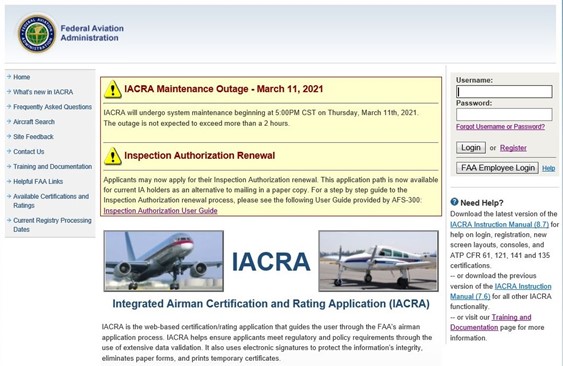
The Tampa FSDO will process IA renewals via IACRA, mail or e-mail.
IACRA is the preferred method and will provide the most efficient and timely method for renewals. The website for IACRA is as follows: https://iacra.faa.gov/IACRA/Default.aspx
If you are mailing/e-mailing in your IA renewal package:
- Two copies of a completed and signed FAA Form 8610-1.
- Evidence the IA holder has completed the appropriate renewal activity for each year (as applicable). Acceptable evidence includes listing the renewal activity on FAA Form 8610-1 and attaching evidence of the activity. For example, if renewal activity is based on:
- Section 65.93(a)(1) through (3) (annual inspection, major repairs/alterations, and progressive inspection): Submit an activity list or log showing the aircraft the activity was performed on.
- Section 65.93(a)(4) refresher course: Submit the course completion certificate(s) that include the information listed in subparagraph 5-1312B4), showing 8 hours of refresher training.
- Section 65.93(a)(5) oral test: Submit a letter or other evidence from the FAA showing the applicant has taken and passed an oral test.
- If using the relief provided in SFAR No. 100-2 to extend the IA renewal for 6 calendar months, the applicant must also include documentation showing the date of assignment outside the United States and the date of return to the United States to be eligible.
Mail: 5601 Mariner St., Suite 310
Tampa, FL 33609-3416
E-Mail: 7-ASO-TPA-FSDO@faa.gov
Applications mailed with a post mark date after March 31, 2025, will NOT be processed for renewal.
Applications e-mailed must be received before midnight, March 31, 2025, or they will NOT be processed.
For any other questions or if you require additional information, please contact the Tampa FSDO at (813) 287-4900 or email 7-ASO-TPA-FSDO@faa.gov and include “IA Renewal” in the topic.
The Tampa FSDO encourages the use of Designated Airworthiness Representatives for airworthiness certification. DAR Locator
The Small UAS Rule (Part 107), including all pilot and operating rules, is in effect as of 12:01 a.m. EDT on August 29, 2016.
The Tampa FSDO is not accepting appointments at this time for Remote Pilot Certificates.
- The following link may be helpful for UAS and Remote Pilot Certificate questions:
Unmanned Aircraft Systems (UAS)
- FAA UAS – Everything you need to operate your UAS in the National Airspace System
- Commercial Operator Regulations – 14 C.F.R. Part 107 – Small UAS Rule Regulations
- Recreational Hobbyist Laws – 49 U.S.C. §44809 – Exception for limited recreational operations of Unmanned aircraft
- Low Altitude Authorization and Notification Capability (LAANC) – Automated system for attaining airspace authorizations at LAANC- capable airports. Partners with several smart phone apps (Airmap, Kittyhawk, etc.) to allow operators to attain instantaneous authorization to operate in controlled airspace.
- UAS Facility Maps – Depict the maximum altitudes that a UAS may be operated (with authorization from ATC in controlled airspace) LAANC-capable airports are depicted in green, non LAANC-capable airports are depicted in red
- FAA DroneZone – Register your UAS, attain a waiver from Part 107 regulations, or attain an airspace authorization for non-LAANC capable airspace.
Aiming a laser at an aircraft is a serious safety risk and violates federal law. Many high-powered lasers can completely incapacitate pilots who are trying to fly safely to their destinations and may be carrying hundreds of passengers.
Please refer to laser safety for more details and an informational video on the civil and criminal penalties for pointing a laser at an aircraft.