ENR 7.3 Special Procedures for In-Flight Contingencies in Oceanic Airspace
1.. Introduction
- Although all possible contingencies cannot be covered, the procedures in paragraphs 2, 3, 4 and 6 provide for the more frequent cases such as:
- Inability to comply with assigned clearance due to meteorological conditions (see paragraph 4);
- En route diversion across the prevailing traffic flow (for example, due to medical emergencies (see paragraphs 2 and 3)); and
- A loss, or significant reduction of, the required navigation capability when operating in airspace where the navigation performance accuracy is a prerequisite to the safe conduct of flight operations; or in the event of pressurization failure (see paragraphs 2, 3, and 6).
- The pilot must take action as necessary to ensure the safety of the aircraft.The pilot's judgment shall determine the sequence of actions to be taken in regard to the prevailing circumstances. Air traffic control shall render all possible assistance.
2.. General Procedures
- If an aircraft is unable to continue the flight in accordance with its ATC clearance, a revised clearance shall be obtained, whenever possible, prior to initiating any action.
- If prior clearance cannot be obtained, the following contingency procedures should be employed until a revised clearance is received:
- Leave the cleared route or track by initially turning at least 30 degrees to the right or to the left in order to intercept a parallel, same direction track or route offset 9.3 km (5.0 NM). The direction of the turn should be based on one or more of the following:
- Aircraft position relative to any organized track or route system;
- The direction of flights and flight levels allocated on adjacent tracks;
- The direction to an alternate airport;
- Any strategic lateral offset being flown; and
- Terrain clearance;
- The aircraft should be flown at a flight level and an offset track where other aircraft are less likely to be encountered;
- Watch for conflicting traffic both visually and by ACAS (if equipped), leaving ACAS in RA mode at all times unless aircraft operating limits dictate otherwise;
- Turn on all aircraft exterior lights (commensurate with appropriate operating limitations);
- Keep the SSR transponder on at all times and, when able, squawk 7700, as appropriate;
- As soon as practicable, the pilot shall advise air traffic control of any deviation from assigned clearance;
- Use whatever means is appropriate (i.e., voice and/or CPDLC) to communicate during a contingency or emergency;
- If voice communication is used, the radiotelephony distress signal (MAYDAY) or urgency signal (PAN PAN), preferably spoken three times, shall be used as appropriate;
- When emergency situations are communicated via CPDLC, the controller may respond via CPDLC. However, the controller may also attempt to make voice communication contact with the aircraft;
- Establish communications with nearby aircraft by broadcasting at suitable intervals on 121.5 MHz (or as a backup on the inter-pilot air-to-air frequency 123.45 MHz). Also broadcast where appropriate on the frequency in use: aircraft identification, the nature of the distress condition, intention of the person in command, position (including the ATS route designator or the track code, as appropriate), and flight level; and
- The controller should attempt to determine the nature of the emergency and ascertain any assistance that may be required. Subsequent ATC action with respect to that aircraft must be based on the intentions of the pilot and overall traffic situation.
- Leave the cleared route or track by initially turning at least 30 degrees to the right or to the left in order to intercept a parallel, same direction track or route offset 9.3 km (5.0 NM). The direction of the turn should be based on one or more of the following:
- Actions to be Taken Once Offset from Track:
- If possible, maintain the assigned flight level until established on the 9.3 km (5.0 NM) parallel, same direction track or route offset. If unable, initially minimize the rate of descent to the extent that is operationally feasible.
- Once established on a parallel, same direction track or route offset by 9.3 km (5.0 NM), either:
- Descend below FL 290, establish a 150 m (500 ft) vertical offset from those flight levels normally used, and proceed as required by the operational situation or, if an ATC clearance has been obtained, proceed in accordance with the clearance, or
- Establish a 150 m (500 ft) vertical offset (or 300 m (1000 ft) vertical offset if above FL 410) from those flight levels normally used, and proceed as required by the operational situation, or if an ATC clearance has been obtained, proceed in accordance with the clearance.
FIG ENR 7.3-1Visual Aid for Understanding and Applying the Contingency Procedures Guidance 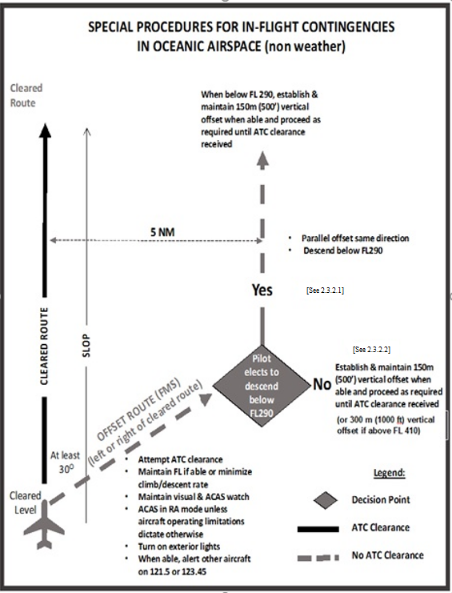
3.. Extended Range Operations by Airplanes with Two-Turbine Power-Units (ETOPS)
- If the contingency procedures are employed by a twin-engine aircraft as a result of an engine shutdown or failure of an ETOPS critical system, the pilot should advise ATC as soon as practicable of the situation, reminding ATC of the type of aircraft involved, and request expeditious handling.
4.. Weather Deviation Procedures
- General.
- When weather deviation is required, the pilot should contact ATC via CPDLC or voice. A rapid response may be obtained by either:
- Stating, “WEATHER DEVIATION REQUIRED” to indicate that priority is desired on the frequency and for ATC response; or
- Requesting a weather deviation using a CPDLC lateral downlink message.
- When necessary, the pilot should initiate the communications using the urgency call “PAN PAN” (preferably spoken three times) or by using a CPDLC urgency downlink message.
- The pilot shall inform ATC when a weather deviation is no longer required, or when a weather deviation has been completed and the aircraft has returned to its cleared route.
- When weather deviation is required, the pilot should contact ATC via CPDLC or voice. A rapid response may be obtained by either:
- Actions to be Taken When Controller-Pilot Communications Are Established:
- The pilot should notify ATC and request clearance to deviate from track or route, advising when possible the extent of the deviation requested. The flight crew will use whatever means are appropriate (i.e., CPDLC and/or voice) to communicate during a weather deviation.
- ATC should take one of the following actions:
- When appropriate separation can be applied, issue clearance to deviate from track; or
- If there is conflicting traffic and ATC is unable to establish appropriate separation, ATC should:
- Advise the pilot of inability to issue clearance for the requested deviation;
- Advise the pilot of conflicting traffic; and
- Request the pilot's intentions.
- The pilot should take one of the following actions:
- Comply with the ATC clearance issued; or
- Advise ATC of intentions and execute the procedures provided in paragraph 4.3.
- Actions to be Taken if a Revised ATC Clearance Cannot Be Obtained:
- If the aircraft is required to deviate from track or route to avoid adverse meteorological conditions, and prior clearance cannot be obtained, an ATC clearance shall be obtained at the earliest possible time. Until an ATC clearance is received, the pilot shall take the following actions:
- If possible, deviate away from an organized track or route system;
- Establish communications with and alert nearby aircraft by broadcasting at suitable intervals: aircraft identification, flight level, position (including ATS route designator or the track code) and intentions, on the frequency in use and on 121.5 MHz (or as a backup, on the inter-pilot air-to-air frequency 123.45 MHz);
- Watch for conflicting traffic both visually and by reference to ACAS, if equipped;
- Turn on all aircraft exterior lights (commensurate with appropriate operating limitations);
- For deviations less than 9.3 km (5.0 NM) from the originally cleared track or route, remain at a level assigned by ATC;
- For deviations greater than or equal to 9.3 km (5.0 NM) from the originally cleared track or route, when the aircraft is approximately 9.3 km (5.0 NM) from track, initiate a level change in accordance with TBL ENR 7.3-1.
- If the pilot receives clearance to deviate from the cleared track or route for a specified distance and subsequently requests but is denied clearance to deviate beyond that distance, the pilot should apply an altitude offset in accordance with TBL ENR 7.3-1 immediately;
- When returning to track or route, the aircraft should be at the previously assigned flight level prior to a point 9.3 km (5.0 NM) from the route centerline.
- If contact was not established prior to deviating, continue to attempt to contact ATC to obtain a clearance. If contact was established, continue to keep ATC advised of intentions and obtain essential traffic information.
TBL ENR 7.3-1Altitude Offset When Denied Clearance to Deviate 9.3 km (5.0 NM) or More Originally Cleared Track or
Route Center LineDeviations
≥ 9.3 km (5 NM)Level Change
EAST
(000_- 179_ magnetic)LEFT
RIGHTDESCEND
90 m (300 ft)
CLIMB
90 m (300 ft)WEST
(180_- 359_ magnetic)LEFT
RIGHTCLIMB
90 m (300 ft)
DESCEND
90 m (300 ft)
- If the aircraft is required to deviate from track or route to avoid adverse meteorological conditions, and prior clearance cannot be obtained, an ATC clearance shall be obtained at the earliest possible time. Until an ATC clearance is received, the pilot shall take the following actions:
5.. Houston/Miami/New York Oceanic CTA/FIR National Winter Storm Operations
- During the winter season, the U.S. Air Force Reserves (AFRES), 53rd Weather Squadron has responsibility for flying winter storm reconnaissance missions. Mission aircraft will fly at altitudes between FL290 and FL350. At designated points, the aircraft will release dropsondes, 16-inch cardboard weather cylinders weighing one pound, each with an attached parachute. When in areas with no direct pilot-controller VHF/UHF communications, at five minutes prior to dropsonde release, the mission aircraft commander will broadcast on 121.5 and 243 the time and position of the intended drop. The dropsonde falls at a rate of approximately 2500 feet per minute.
- Aircraft commanders are directly responsible for or the release of any objects from the aircraft. ATC must provide traffic advisories, when feasible, to the aircraft. ATC will provide separation between the mission aircraft and any nonparticipating aircraft. ATC cannot provide separation between aircraft and the dropsonde.
- NOTAMs will be issued as early as possible prior to each mission. Airspace operators should consider any national winter storm operations during flight planning in the affected area(s) and nonparticipating aircrews should be especially alert to pertinent broadcasts on 121.5 or 243.0 during national winter storm operations.