Sample FAA Categorical Exclusion Document Template
This template is recommended for actions covered by a CATEX that has a greater potential to trigger extraordinary circumstances or otherwise warrant additional documentation. See FAA Order 1050.1 paragraph 5-3d, for more information on additional CATEX documentation. Italicized text and image below provide instruction and examples and should be removed before signing this CATEX document.
DESCRIPTION OF PROPOSED ACTION
Instructions: Provide a detailed description of the proposed action (compared to the baseline, if applicable) below. If the action is subject to rulemaking, this section should be consistent with the Federal Register rulemaking notice. If the proposed action involves the creation or modification of a route, procedure, or airspace, provide graphic(s) depicting how the current situation differs from the proposal, if possible. Include information from the initial environmental review, IER, with other relevant supporting documents such as charts, maps, figures, matrices, tables, etc. (if available) to describe the proposed action.
Example: The LaGuardia (LGA) RNAV procedure will provide a deconflicted approach when weather requires it. Without this procedure, when the weather minimums fall below 1,500 ft AGL, and 3-miles visibility and use of an ILS is required, Newark (EWR), Teterboro (TEB), and LGA cannot operate at the same time. Traffic at one of the three airports must be stopped to permit the other two airports to operate. The FAA expects to use the new RNAV procedure for approximately 1,500 operations annually (0.8% of all LGA landings) to deconflict the New York metro airspace.
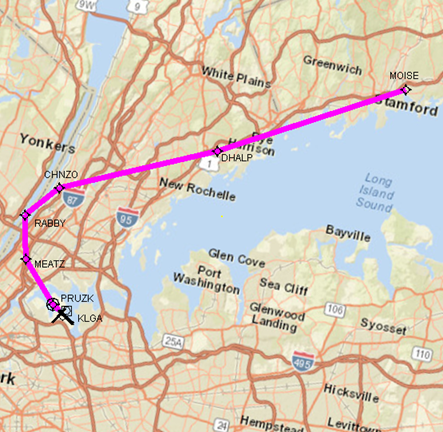
Figure 1 - Proposed LGA RNAV approach procedure
PURPOSE AND NEED
Instructions: Describe why the procedure/action is needed. Relevant information should be copied from the applicable IER and other documents, if available.
PUBLIC PARTICIPATION[if conducted, otherwise omit]
Instructions: Summarize the dates, parties contacted/participated, meeting locations, issues raised, and action items, if any, from any roundtables, public meetings, or community engagement efforts.
Example: February 20, 2015 - An outreach meeting on the topic of the proposed approach procedure for runway XX was held, at the Acme High School. Due to the limited room capacity (100 people), invitations were only extended to public officials. The general public was provided access by telephone and internet (webinar) links. Comments were solicited from all persons, and replies were prepared for each comment. These replies are set forth [include reference to where these may be located].
A second outreach meeting, open to all, on the topic of aircraft overflights in the area, was held on April 30, 2015, at Smallville High School. Opposition to the proposed RNAV procedures was expressed by the residents of Smallville. That opposition is almost entirely based on annoyance caused by the current arrivals to runway XX. Opponents' position is that mitigating the effects of those operations should take priority over implementing new procedures. Every member of the public was provided the opportunity to make comments and/or ask questions. During the three-hour period, 14 Smallville residents made comments and/or asked questions. No questions/comments addressed the proposed runway XX RNAV approach procedures.
LEGAL AUTHORITIES AND APPLICABLE CATEGORICAL EXCLUSION
FAA has determined that the above proposed action qualifies for categorical exclusion under the National Environmental Policy Act, 42 U.S.C. §§ 4321 et seq.; its implementing regulations at 40 CFR Parts 1500-1508, U.S. Department of Transportation Order 5610.1, Procedures for Considering Environmental Impacts; and FAA Order 1050.1, Environmental Impacts: Policies and Procedures. DOT Order 5610.1 and FAA Order 1050.1 set forth the Departmental and FAA's NEPA-implementing policies and procedures, respectively.
Instructions: Explain why the CATEX chosen from FAA Order 1050.1, Chapter 5, is applicable to the proposed action. Reference and cite the full text of the applicable CATEX, and any other documents used to reach the conclusion that the action is eligible for a CATEX. This may include noise studies, AEDT/TARGETS results, emissions studies, and any other relevant results from modeling.
Example: This proposed action qualifies as a rulemaking action that establishes a new air traffic control procedure conducted below 3,000 ft AGL that does not cause traffic to be routinely routed over noise sensitive areas. Although there are noise sensitive areas in the vicinity, this proposed action will not be used on a routine basis; it is expected to be used only when specific, uncommon weather circumstances require it. This procedure is expected to be used for 0.8% of total LGA arrivals. Therefore, Categorical Exclusion 5-6.5i (Establishment of new or revised air traffic control procedures conducted at 3,000 ft or more above ground level (AGL); procedures conducted below 3,000 ft AGL that do not cause traffic to be routinely routed over noise sensitive areas; modifications to currently approved procedures conducted below 3,000 ft AGL that do not significantly increase noise over noise sensitive areas; and increases in minimum altitudes and landing minima. For modifications to air traffic procedures at or above 3,000 ft AGL, the Noise Screening Tool (NST) or other FAA-approved environmental screening methodology should be applied.) is the appropriate category of exclusion from further environmental impact review for this particular action.
BASIS OF DETERMINATION
Instructions: Describe why the action, as it fits the applicable CATEX is not expected to trigger any extraordinary circumstances listed in FAA Order 1050.1, section 5-2. If noise modeling was done as part of the review, explain how the screening or modeling shows that aircraft noise from the proposed action is not expected to reach a significant level. Show graphics depicting the existing procedure, if any, and the proposed procedure. Reportable or significant noise impacts may be shown, if applicable.
Example: This action establishes new air traffic control procedures conducted below 3,000 ft AGL that do not cause traffic to be routinely routed over noise sensitive areas and are unlikely to cause significant environmental impacts as the noise sensitive areas overflown will not experience traffic on a routine basis. Because the action includes changes to procedures above 3,000 ft AGL, an FAA-approved environmental screening methodology was applied to check for significant noise impacts that could warrant extraordinary circumstances. [Provide relevant reasons/rationale/basis for all conclusions. Draw parallels and explain the link to the action and the chosen CATEX.] Noise screening was performed using AEDT and the TARGETS Environmental Screening Tool to determine whether significant noise impacts were likely. A baseline scenario that modeled current operations at LGA was compared to a proposed action case, in which 0.8% of LGA arrivals were flown using the proposed RWY XX procedure. Noise screening indicated that usage of the proposed procedure at the specified levels would cause no significant or reportable noise impacts.
This project is not expected to adversely affect air quality because it is presumed to conform to applicable State Implementation Plans as an action that results in no emissions increase or increases in emissions that are clearly de minimis. Such actions are specifically identified under Category 14, Air Traffic Control Activities and Adopting Approach, Departure and Enroute Procedures for Air Operations, and are further defined at 70 Federal Register 41565-41578, July 30, 2007. Project-related aircraft emissions released into the atmosphere above the inversion base for pollutant containment, commonly referred to as the “mixing height” (generally 3,000 ft. AGL), do not have an effect on pollutant concentrations at ground level. Therefore, air traffic control actions above the mixing height are presumed to conform. Air traffic actions below the mixing height are also presumed to conform when modifications to routes and procedures are designed to enhance operational efficiency (i.e., to reduce delay), increase fuel efficiency, or reduce community noise impacts by means of engine thrust reductions.
In accordance with FAA Order 1050.1, paragraph 5-2, regarding Extraordinary Circumstances, the FAA has reviewed this action for factors and circumstances in which a normally categorically excluded action may have a significant environmental impact requiring further analysis. The FAA has determined that no extraordinary circumstances exist that warrant preparation of an environmental assessment or environmental impact statement.
NATIONAL HISTORIC PRESERVATION ACT, SECTION 106 CONCURRENCE [include if applicable]
Instructions: First, check paragraph 32-4-2 of FAA Order 7400.2 to see if the action is among those not requiring consultation. If this is the case, cite the applicable subpart [a. – f.] here. Otherwise, describe the preservation office's concurrence with the FAA's findings and any additional comments raised during the process. The letter to the SHPO, or other applicable office, should include a copy of the draft CATEX and a copy of the description of the procedure. The letter itself and the reply from the SHPO or applicable office should be referenced or attached. Unless an action is the type of activity that does not have the potential to affect historic properties, Section 106 consultation must be initiated and concluded prior to making a CATEX determination.
Example: Consultation or review with applicable State Historic Preservation Offices (SHPO), Tribal Historic Preservation Offices, Indian Tribes, and Native Hawaiian Organizations is required to satisfy NHPA § 106. On January 1st, 2019, the FAA sent a letter to the XYZ SHPO, describing the proposed implementation of the RNAV arrival procedure. The FAA indicated that no potential impacts were expected to historic properties or cultural resource areas in the vicinity. The XYZ SHPO concurred with this assessment, and a letter indicating this concurrence was received on February 14th, 2019.
DECLARATION OF EXCLUSION
FAA has reviewed the proposed action described above and determined that it qualifies for categorical exclusion under the National Environmental Policy Act (42 U.S.C. §§ 4321 et seq.) and its implementing regulations at 40 CFR Parts 1500-1508, and in accordance with FAA Order 1050.1, Environmental Impacts: Policies and Procedures, paragraph [fill in the selected CATEX from Chapter 5], which categorically excludes from further environmental impact review.
In accordance with FAA Order 1050.1, paragraph 5-2, regarding Extraordinary Circumstances, the FAA has reviewed this action for factors and circumstances in which a normally categorically excluded action may have a significant environmental impact requiring further analysis. Accordingly, the FAA has determined that no extraordinary circumstances exist that warrant preparation of an environmental assessment or environmental impact statement.