Chapter 32. Environmental Matters
Section 2. Environmental Processing
32-2-1. THE PROCESS
The ARTCC, TRACON, and ATCT facilities, in coordination with the Service Center and Service Center Environmental Specialist, must conduct environmental compliance actions for any proposed air traffic action under their jurisdiction with the potential to impact the human environment. Examples of air traffic actions include, but are not limited to, flight procedure changes that create new flight tracks over noise sensitive areas, flight procedure changes that alter existing flight tracks over noise sensitive areas, lowering altitudes of routes or procedures utilized by aircraft, establishment or modification of certain SUA, and actions affecting operational changes (for example, changes in runway use percentages or headings). Environmental documentation for such actions must be completed prior to approval and implementation. (See Appendix 1, Environmental Study Process Flow Chart, for the steps from action concept to implementation.)
- Questions to ask when considering the potential environmental impact of flight procedures or other air traffic actions may be, but are not limited to:
- Are there aircraft currently flying over the area of change?
- Are route altitudes increasing or decreasing?
- Are the routes moving laterally, and if so, how far from the baseline route?
- Will the number of operations increase?
- Are there projected changes in runway use?
- Will the types of aircraft change?
- Will nighttime operations increase?
If the FAA is not the proponent of the proposed air traffic action (for example, the Department of Defense or an Airport Sponsor [the proponent] requests the FAA to take the action) then the proponent is responsible for funding and preparation of environmental documentation associated with the proposed action. FAA Order 1050.1G, Part 5 – Procedures for Applicant‐Prepared NEPA Documents, discusses the responsibility for preparation of EAs or EISs (respectively) where FAA must approve the project. Signature authority for the environmental documents discussed in this section must be in accordance with paragraph 32-1-4, Delegation of Authority, of this chapter.
The FAA or non‐FAA proponent must prepare and submit the associated environmental documentation in conjunction with the proposed air traffic action, as follows:
- Determination of Appropriate Level of Environmental Documentation.
- The appropriate level of environmental documentation required must be determined by the Service Center Environmental Specialist after all portions of a proposed action have undergone the Air Traffic Initial Environmental Review (IER) (see Appendix 5). The IER form must be completed for all projects that:
- Require the use of computer-based noise screening or modeling tools, or
- Require Headquarters-level funding for completion of environmental impact analysis and documentation.
- For those projects not requiring the use of computer‐based noise screening or modeling tools or that are not being funded at the Headquarters level, completion of the IER is optional. Facility personnel and the Service Center Environmental Specialist must coordinate completion of the IER form.
- If someone other than the Service Center Environmental Specialist completes the IER form, the completed IER form, along with a recommendation as to whether the proposed action warrants no further environmental review, a CATEX, or preparation of an EA or an EIS, must be forwarded to the Service Center Environmental Specialist for review and incorporation of the proposed project information into the NEPA document. Field personnel must consult FAA Order 1050.1 before recommending the appropriate level of environmental review for a proposed action to the Service Center Environmental Specialist.
- For IFP or other actions reviewed through the IFP Environmental Pre‐Screening Filter, the OSG FPT should assist the Environmental Specialist in determining the appropriate level of environmental documentation after reviewing of the results from the Filter. If the Filter results indicate that a CATEX is warranted, the OSG FPT must assist the Environmental Specialist in the preparation of a CATEX by providing information about the action to help ensure that the action is appropriately and thoroughly described in the CATEX. After the CATEX is approved, the action may be implemented.
- AJV-A and designated Approved Non‐FAA Service Provider initiated maintenance actions under the oversight of AFS, described in paragraph 8-3-4 of FAA Order 8260.19, that result in no change to the charted flight paths (tracks) and have little or no potential to trigger extraordinary circumstances, as defined in FAA Order 1050.1, may be processed using simple documentation as defined in FAA Order 1050.1. Documentation must include a simple written record that a specific CATEX was determined to apply to the Proposed Action on a series 8260 form, but is not required to be processed through the pre‐screening filter tool and does not require completion of an IER Form or additional review by a Service Center Environmental Specialist.
- For an amended flight procedure to qualify for processing without further environmental review by a Service Center Environmental Specialist, the procedure must meet all of the following criteria:
- any changes included in the amendment are limited to one or more of the following. Actions listed generally qualifying for CATEX B-2.5i, B-2.5j, or B-2.5k:
- changes to and/or additional Lines of Minimum (FAA Order 8260.19, paragraph 8-6-11) (B-2.5i);
- altitude increases (B-2.5k);
- instrument flight rules (IFR) takeoff minimums (B-2.5i);
- textual Obstacle Departure Procedures (ODPs) (only applies to close‐in obstacle notes and/or no track changes) (B-2.5i);
- Minimum Safe Altitudes (B-2.5i);
- holding pattern and circling changes that do not result in a new obstacle evaluation area (e.g., larger pattern/radii, inbound course change, new holding turn/circling direction) (B-2.5i);
- Visual Climb Over Airport (VCOA) (B-2.5i);
- missed approaches and/or missed approach holding patterns (B-2.5j);
- name changes (airport, fix, procedure, etc.) (B-2.5k);
- adding, amending, or removing notes to procedures (B-2.5k);
- Magnetic Variation (MagVar) adjustments (B-2.5k);
- coding changes with no track/altitude changes (B-2.5k), and;
- cancellation of IFPs not currently being flown (B-2.5k).
- the amendment is not a smaller subset of a larger action.
- the amendment does not result in changes to published lateral flight paths/ground tracks.
- the amendment does not result in a decrease in altitude or decrease in glideslope angle (including as a result of relocation of fixes along the same flight path).
- any changes included in the amendment are limited to one or more of the following. Actions listed generally qualifying for CATEX B-2.5i, B-2.5j, or B-2.5k:
- The appropriate level of environmental documentation required must be determined by the Service Center Environmental Specialist after all portions of a proposed action have undergone the Air Traffic Initial Environmental Review (IER) (see Appendix 5). The IER form must be completed for all projects that:
- The following are specific sections of FAA Order 1050.1G that must be reviewed:
- Advisory Actions, § 1.1(a)(6)(ii)(B). A memorandum to the file may be the only documentation necessary.
- Emergencies, § 3.12.
- Extraordinary Circumstances, Appendix B-1.
- Categorical Exclusions (CATEXs), and Extraordinary Circumstances, Appendix B-1. Only those categorical exclusions listed in FAA Order 1050.1 may be cited. However, the categorical exclusion referenced in AEE's Guidance Memo #5 dated December 6, 2012, Guidance for Implementation of the Categorical Exclusion in Section 213(c)(1) of the FAA Modernization and Reform Act of 2012 (known as CATEX 1), (see FAA Order 1050.1G, B-2.5q) may also be used.
A review of Categorical Exclusion Documentation, § 1.4(f)(3), will assist in determining the appropriate level of environmental documentation required for a CATEX (see Appendix 6 of this order for a “Sample Categorical Exclusion Declaration”).
- § 1.5 of FAA Order 1050.1G addresses EAs and FONSIs. A review of this chapter will assist in determining when to prepare these documents. The FAA may adopt, in whole or in part, an EA prepared by another Federal agency. Consult FAA Order 1050.1 § 1.7(b) to determine if the other agency's EA meets the criteria for FAA adoption.
- Part 2 of FAA Order 1050.1G addresses EISs and RODs. A review of this chapter will assist in determining when and how to prepare these documents.
- A review of FAA Order 1050.1, Appendix C, will assist in determining whether a noise analysis is warranted and if so, what type of analysis should be conducted. A noise analysis requires several different types of input data including radar data. This data is available to FAA and other Federal Government personnel. Request for the data should be made through the Service Center Environmental Specialist assigned to the proposal.
- NAS data may contain sensitive information and must be handled accordingly.
- Requests made to the FAA to release NAS data, to other than Federal agency personnel, including but not limited to radar track data, must be processed in accordance with FAA Order 1200.22, External Requests for National Airspace System (NAS) Data, or via the Freedom of Information Act (FOIA) process.
- Requests from the Department of Defense for NAS data supporting the mission of the NAS Defense Programs (NDP) (defined as communications, surveillance or aircraft movement in FAA Order JO 6000.198, FAA Maintenance of NAS Defense Facilities and Services) must be submitted to the NDP. Requests to the NDP can be sent to AJW‐B7‐ORG‐MGR@faa.gov.
- Preparation of Environmental Documents. The following are various levels of environmental review and documentation that may be prepared:
- Actions Not Subject to NEPA Review. See FAA Order 1050.1G, § 1.1, for a list of actions that do not require an environmental study.
- No Further Environmental Review Required. Some air traffic actions are subject to NEPA review, but require no further environmental action after the initial environmental review (IER) is completed. These actions involve modifications to airspace and/or procedures and may fit some or all of the following criteria. Special purpose environmental requirements may still apply to airspace and/or procedures that fit some or all of these criteria. No further environmental review is required if the proposed change:
- Is over 18,000 ft above ground level (AGL). Currently, there is no need to analyze aircraft noise above 18,000 ft AGL.
- Is over 7,000 AGL for arrivals, and/or over 10,000 ft AGL for departures and/or overflights.
- Any decision to analyze aircraft noise over 10,000 ft AGL is an exception and should be coordinated with the ATO Rules and Regulations Group at FAA headquarters at the earliest possible time.
- Proposed flight procedure changes between 10,000 ft and 18,000 ft AGL should be analyzed for potential impacts when there is a national park or wildlife refuge in the study area that has a quiet setting that is a generally recognized purpose and attribute, and also in situations when the flight procedure change is likely to be highly controversial.
- Is over a non‐noise sensitive area(s).
- Does not alter the current noise footprint.
- Does not cause the following noise level change over noise sensitive areas, as defined in FAA Order 1050.1G, Appendix A: +1.5 dB for 65 DNL and higher.
For IFP actions reviewed through the IFP Environmental Pre‐Screening Filter, most of these determinations will be made automatically based on the information input into the Filter.
- Actions Not Requiring a Noise Analysis. (See FAA Order 1050.1G, Appendix C, paragraph C-1.)
- Following review and consultation, the field facility manager and Service Center Environmental Specialist may agree that no further environmental review is required. When this occurs, the originating facility must prepare a memorandum to the file and attach any supporting documentation, which indicates the basis for the determination (such as a copy of the proposed action that includes references to the above criteria, results of the noise review, etc.).
The memorandum must include, if applicable, references to the provisions of FAA Order 1050.1 that support the determination (for example, whether the proposed action is administrative or advisory in nature).
- Actions Requiring Environmental Modeling for NEPA Compliance. FIG 32-2-1 shows the levels of environmental screening and modeling that are required for NEPA compliance.
FIG 32-2-1Levels of Environmental Screening and Modeling for NEPA Compliance 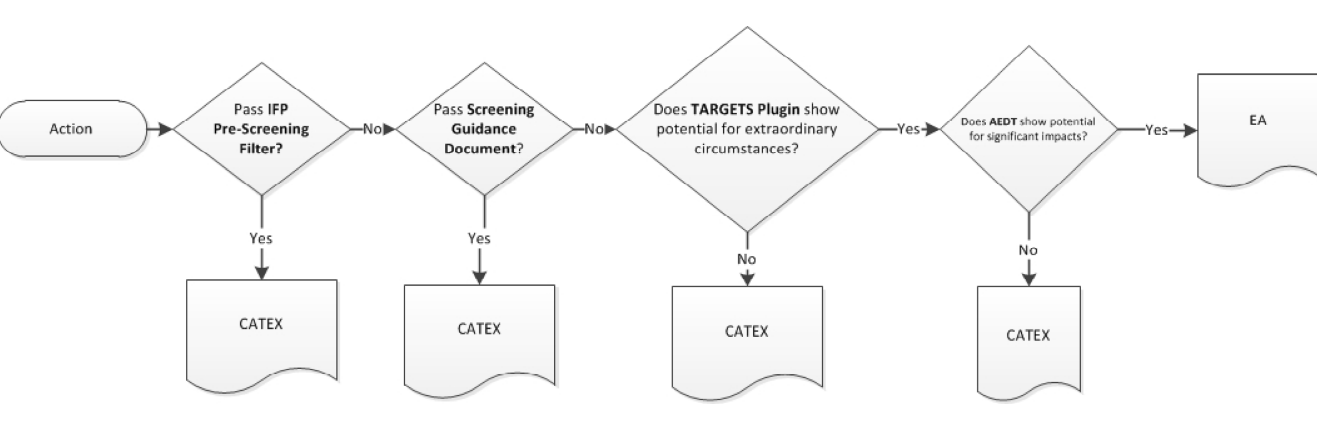
- Non‐FAA proponents and third party developers. To meet the requirements of NEPA and other applicable environmental requirements, potential environmental impacts of flight procedures submitted by third party procedure developers must be considered. A proposed procedure development package submitted by a third party developer to an environmental specialist must include (at a minimum) the following information:
- Draft Initial Environmental Review (IER) in accordance with process outlined in Appendix 5 of this this Order.
- Documentation from the responsible FAA facility to the proponent indicating concurrence with the proposed procedure(s).
- The Service Center Environmental Specialist will review the proposed action to determine if a categorical exclusion is applicable. If the proposed action qualifies for a categorical exclusion, the Environmental Specialist will prepare a CATEX declaration in accordance with the requirements of FAA Order 1050.1G, § 1.4. Use of the Categorical Exclusion Declaration in Appendix 6 is recommended.
- If necessary, the Service Center Environmental Specialist must use the MITRE Screening Guidance Document referenced in paragraph 32-3-3, below, to assist in determining if the CATEX is applicable.
- The Service Center Environmental Specialist must contact the proponent if any additional information is needed to support the CATEX.
- If the Guidance for Noise Screening of Air Traffic Actions indicates that additional review is required, the Service Center Environmental Specialist will use one of the following tools, as appropriate, to perform the next level of screening to determine if the CATEX is applicable:
- Terminal Area Route Generation Evaluation and Traffic Simulation (TARGETS) tool with the Environmental “Plug‐in,” or other FAA approved noise screening tool.
- If that level of screening indicates that a CATEX is applicable, the Environmental Specialist will prepare a CATEX declaration (Appendix 6 of this order) with results from the above screening tool(s) attached.
- If screening of a flight procedure(s) indicates that a CATEX is not applicable, then an Environmental Assessment (EA) should be completed. Flight procedures requiring an EA will be returned to the proponent for additional information that will enable the Service Center Environmental Specialist to conduct an EA level of environmental impact analysis and documentation.
- A “focused” EA with required noise analysis may be appropriate in this situation. In coordination and consultation with the Service Center Environmental Specialist, preparation of the EA and any related environmental analysis will be the responsibility of the proponent, and must be completed in accordance with all applicable environmental regulations and requirements.
- The Service Center Environmental Specialist is responsible for providing advice and assistance to the proponent during the EA preparation; independent review and EA completion; and preparation and completion of a FONSI or decision that an EIS is required.
- Categorical Exclusions. If someone other than an EPS completes an IER (when applicable), the completed IER form, and any other documentation describing the proposed action, must be forwarded to the Service Center Environmental Specialist for review and incorporation into the NEPA document.
- The Service Center Environmental Specialist must then document the analysis that supports the application of a CATEX in accordance with FAA Order 1050.1G, § 1.4(f). Appendix 6 is recommended for use in documenting this analysis. If the IFP Environmental Pre‐Screening Filter is used, then the environmental data is gathered electronically instead of through the IER and is forwarded to the appropriate next step in the IFP process.
- A CATEX does not apply to a proposal if extraordinary circumstances, as described in FAA Order 1050.1G, Appendix B, paragraph B-1, exist.
- Environmental Assessments. Although the facility manager must make a recommendation on the level of environmental review, the Service Center Environmental Specialist must make the final determination as to whether the proposed action warrants preparation of an EA or an EIS. For proposed actions that warrant an EA level of review, the Service Center Environmental Specialist may need to request additional resources, funding, and information to support the proposal.
- Consultation with the Rules and Regulations Group regarding projects at this stage is recommended.
- If an independent contractor is to prepare the EA, the Service Center Environmental Specialist must oversee the preparation to ensure compliance with FAA Order 1050.1G, § 5.1 Procedures for applicant‐prepared environmental documents.
- § 1.5 of FAA Order 1050.1G summarizes requirements for EAs.
- All EAs must be focused and concise in accordance with AEE guidance.
- FAA Order 1050.1G § 1.5(b)(ii) An EA must include “brief discussions” of the need for the proposed action, alternatives to the proposed action, and the potential environmental impacts of the proposed action and alternatives.
- FAA Order 1050.1G contains guidelines regarding the importance of reducing paperwork and reducing delay. (See § 1.2(b)(4), § 1.5(f) and § 2.5 regarding reducing paperwork and deadlines).
- These concepts are also emphasized in DOT and FAA orders, and guidance for implementing NEPA actions. To achieve a focused and concise EA, the following must be considered:
- Where there are anticipated effects to a resource, but those effects are clearly below thresholds of significance as defined in FAA Order 1050.1, briefly document that fact with an explanation that thresholds would not be reached or exceeded.
- Do not address impact categories that the action has no potential to impact, such as construction, farmland, and water quality.
- Scale the NEPA review process to the nature and level of the expected environmental impact. Include only what is absolutely necessary in the document and include any additional required supporting data in an appendix.
- Do not include information in the document (not even in an appendix) that can be incorporated by reference to a related proposed action analyzed in a previous NEPA document, and made available on a publicly accessible website.
- Findings of No Significant Impact. If an EA reveals that a proposed air traffic action would not cause significant adverse impacts, the Service Center Environmental Specialist must prepare a FONSI.
- FAA Order 1050.1G, § 1.6 Findings of No Significant Impact, summarizes requirements for FONSIs.
- FAA Order 1050.1G, § 1.6(a) should be reviewed in detail prior to completion of a FONSI to assist in determining the type of document to prepare.
- If the FONSI is not combined with, or attached to an EA, it must include a summary of the EA and note any other environmental documentation related to it.
- If the FONSI is attached or included with the EA, the FONSI does not need to repeat any of the discussions in the EA but may incorporate them by reference.
- All documentation relied upon must be made available to the public upon completion of the environmental process.
- If mitigation of potential impacts is included as a requirement in the FONSI, the appropriate follow-up actions must be taken to ensure that the required mitigation is implemented. The Service Center preparing the FONSI is responsible for ensuring that the required mitigation actions are implemented.
- Environmental Impact Statement. If a proposed action requires preparation of an EIS, the Service Center Environmental Specialist must advise the Area Director when there is a need to seek funding and/or resources for the EIS. Consultation with the Rules and Regulations Group regarding projects at this stage is highly recommended.
- The FAA, or a contractor it selects, will prepare an EIS for projects that potentially may cause significant environmental impacts.
- If an independent contractor is to prepare the EIS, the Service Center Environmental Specialist must oversee the preparation to ensure compliance with FAA Order 1050.1G, Part 2—Environmental Impact Statements.
- Record of Decision. For all proposed air traffic actions that have been the subject of an EIS, the Service Center Environmental Specialist must prepare a ROD in accordance with FAA Order 1050.1G, § 4.2.
- For proposed air traffic actions for which a FONSI is prepared, the Service Center Environmental Specialist should consider preparing a ROD in accordance with FAA Order 1050.1G, § 4.2.
- If an independent contractor prepares the EIS, that contractor may also support preparation of the ROD; the ROD documents the agency's decision on the Federal action and remains the responsibility of the FAA.
32-2-2. ENVIRONMENTAL REVIEW OF FLIGHT PROCEDURES AND OTHER AIR TRAFFIC ACTIONS
- “Procedures.” The term “procedures” in FAA Order 1050.1 refers to published flight procedures (conventional, PBN IFPs, visual, and others appearing in the FAA's Instrument Flight Procedures (IFP) Information Gateway web page) and radar tracks, which are the actual flight paths.
- Performance‐Based Navigation (PBN) Procedures: Refers to satellite‐based navigation procedures known as Area Navigation/Required Navigation Performance (RNAV/RNP) procedures. Establishing and implementing a new or revised PBN Instrument Flight Procedure (IFP) constitutes a federal action under NEPA. Accordingly, the FAA must consider environmental impacts before it can take steps to implement a PBN IFP. There are several CATEXs in FAA Order 1050.1G, Appendix B, that may apply to these flight procedures and other air traffic action, which preclude the need to prepare an EA or EIS for new or revised PBN IFPs.
- Categorical Exclusions for Flight Procedures and Other Air Traffic Actions: FAA Order 1050.1 includes several CATEXs that normally apply to flight procedures (provided no extraordinary circumstances apply). See FAA Order 1050.1G, Appendix B-2.5g, B-2.5i, and B-2.5p. These CATEXs apply to procedures that:
- Use overlays of existing flight procedures (B-2.5g).
- Are conducted at 3,000 feet AGL or more (B-2.5i).
- Are conducted below 3,000 feet AGL, but do not cause traffic to be routinely routed over noise-sensitive areas (B-2.5i).
- Are modifications to currently approved IFPs conducted below 3,000 feet AGL that do not significantly increase noise over noise-sensitive areas, or involve increases in minimum altitudes or landing minima (B-2.5i).
- Are new flight procedures that routinely route aircraft over non‐noise‐sensitive areas (B-2.5p).
- Are published flight procedures, but do not change existing tracks, create new tracks, change altitude, or change concentration of aircraft on these tracks (B-2.5k).
- Conducting Environmental Review of Proposed Flight Procedures. Additional environmental analysis is needed in some cases to determine the appropriate level of NEPA review for proposed flight procedures. A determination of whether a proposed flight procedure that would normally be categorically excluded, but requires an EA or EIS, depends on whether the proposed action involves “extraordinary circumstances.” (See FAA Order 1050.1G, Appendix B-1, Extraordinary Circumstances).
- If additional analysis shows that extraordinary circumstances do not exist, then the procedure can be categorically excluded from further environmental review under NEPA.
- If analysis shows that extraordinary circumstances exist, then the procedure does not qualify for a CATEX, and an EA or EIS is required. Extraordinary circumstances exist when the proposed action involves any of the conditions described in FAA Order 1050.1, paragraph 5-2, and also may have a significant effect on the environment.
- Circumstances listed in FAA Order 1050.1G that are most likely to require additional analysis with respect to a proposed procedure include:
- An impact on noise levels of noise‐sensitive areas (Appendix B, paragraph B-1(b)(7)).
- Effects on the quality of the human environment that are likely to be highly controversial on environmental grounds (Appendix B, paragraph B-1(b)(10)).
- An adverse effect on cultural resources protected under the National Historic Preservation Act of 1966, as amended (Appendix B, paragraph B-1(b)(1)).
- An impact on properties protected under section 4(f) of the Department of Transportation Act (Appendix B, paragraph B-1(b)(2)).
- If any of the circumstances described in FAA Order 1050.1G, Appendix B, paragraph B-1(b), exist for a proposed new or modified flight procedure, additional analysis is required to determine the potential for significant environmental effects.
- Cancellation of Procedures No Longer Used (i.e., no traffic will be shifted to other procedures). Given that there will be no shift of traffic due to the cancellation, there will also be no environmental impacts from the cancellation. However, the cancellation must be documented, and the procedure removed from the list of published procedures. Environmental documentation can be accomplished within the instrument flight procedures Environmental Pre‐Screening Filter Tool or by writing a CATEX document that cites CATEX B-2.5k from FAA Order 1050.1G. Service Center EPSs should provide documentation to the Service Center's flight procedures team (FPT) for processing.
- Cancellation of Procedures Currently Being Used (i.e., traffic will be shifted to existing, new, or revised procedures). The EPS must evaluate the environmental impacts of moving traffic from the canceled procedure(s). The procedure cancellation and the changes to the existing, new, or revised procedures should be considered connected actions for the purpose of NEPA. The EPS should consult with procedure developers and ATC to determine how air traffic and NAS stakeholders will be affected by the canceled procedure (e.g., moving traffic onto one, or more, existing, new, or revised procedures). Environmental impacts should be assessed, and the result of the environmental review must be documented using the instructions included within this Chapter. Service Center EPSs must provide documentation to the Service Center's FPT for processing.
- Noise Focusing. The term used to characterize the concentration of noise is “noise focusing.” The actual flight tracks of aircraft flown on conventional IFPs using ground‐based Navigational Aids (NAVAIDs) show broad dispersion around the trajectory of the defined flight procedures. The aircraft noise dispersion is typically based on the performance characteristics of individual aircraft types and pilot technique. In contrast, FAA's experience with satellite‐based navigation procedures shows that actual flight tracks and RNAV/RNP PBN procedures converge to a much greater degree. Therefore, aircraft flying RNAV/RNP procedures and the associated noise are concentrated over a smaller area than would be the case for the same operations using conventional, non‐RNAV/RNP IFPs.
- Screening Requirements. Due to concerns with noise focusing as described above, it is particularly important to conduct appropriate noise screening to determine whether or not extraordinary circumstances exist that warrant preparation of an EA or EIS for PBN IFPs that would normally be categorically excluded.
- Noise screening must be done for PBN IFPs over noise‐sensitive areas below 10,000 feet AGL to determine the potential for extraordinary circumstances that may preclude use of a CATEX.
- PBN IFPs that are not over noise‐sensitive areas do not require noise screening; however, a CATEX declaration should be prepared in accordance with subparagraph 32-2-1e9(a).
- Noise screening is also required between 10,000 feet and 18,000 feet AGL if a procedure would result in operational changes at an altitude that could increase aircraft noise in an area within a national park, national wildlife refuge, historic site (including a traditional cultural property), or similar area where quiet is an attribute and the noise increase is likely to be highly controversial. (See FAA Order 1050.1G, Appendix C, paragraph C-1.5.) Such screening is used to determine if aircraft flying these procedures would cause increased noise over noise‐sensitive areas, and if so, the magnitude of the increase.
- There are several tools that the FAA has developed to screen for the level of change in noise exposure between the existing condition and a proposed procedure (see paragraph 32-3-3).
- Obstacle Departure Procedures (ODPs). According to FAA Order 8260.46, Departure Procedure (DP) Program, paragraph 2-1-2.c, there are two types of ODPs: Textual and Graphic. They are defined as:
- Textual ODP. A relatively simple ODP may be published textually unless a graphical depiction is required for clarity. Textual ODP instructions that exceed a maximum of one turn, one altitude change, and one climb gradient must be published graphically.
- A Textual ODP does not define a specific route nor have a name or computer code assignment, but only advises the operator how to avoid potential obstacles.
- This type of action is not considered a major Federal action under NEPA; therefore, FAA Order 1050.1G, § 1.1(a)(6)(ii)(B) - Advisory Actions, applies.
- Graphic ODP. Complex ODPs require a visual presentation to clearly communicate the departure instructions and desired flight paths. If the ODP is depicted graphically, it must be clearly stated on FAA Form 8260-15A, Takeoff Minimums and Textual Departure Procedures (DP), in the Departure Procedure section; for example, “USE JONES DEPARTURE.” The decision to graphically publish ODPs rests within Aeronautical Information Services (AIS).
- A Graphic ODP has a repeatable ground track, has the same naming conventions and computer code assignments, looks almost the same on a chart, and is processed the same as a standard instrument departure (SID). (See FAA Order 8260.46, Departure Procedure (DP) Program, Appendix A).
- A Graphic ODP is considered a major Federal Action under NEPA just like an SID. FAA Order 1050.1G, Appendix B, paragraph B-2.5, Categorical Exclusions for Procedural Actions, should be reviewed to determine if a CATEX applies. FAA Order 1050.1G, Appendix C, paragraph C-1.1, Aircraft Noise Screening, should also be reviewed to determine if noise screening or analysis would be required.
- Textual ODP. A relatively simple ODP may be published textually unless a graphical depiction is required for clarity. Textual ODP instructions that exceed a maximum of one turn, one altitude change, and one climb gradient must be published graphically.
32-2-3. ENVIRONMENTAL REVIEW OF SPECIAL USE AIRSPACE (SUA) ACTIONS
- The purpose of this section is to ensure that air traffic personnel, FAA Environmental Protection Specialists (EPSs), and SUA proponents are aware of the need to comply with NEPA requirements for evaluating the environmental impacts of proposed SUA use actions. See FAA Order 1050.1G § 1.5(c)(14). This section supplements the airspace processing requirements contained in Chapters 21–28 of this order.
- Normally, SUA is designated to support DoD requirements. The FAA/DoD Memorandum of Understanding (MOU) in Appendix 7 sets forth procedures and responsibilities for the evaluation of the environmental impacts of DoD SUA proposals. Among other things, the MOU designates when DoD is the lead agency and when FAA is the cooperating agency for NEPA compliance on SUA proposals for which FAA may designate SUA. Additionally, SUA proposals (see Chapter 21, Section 3) may be initiated by another Federal agency.
- Appendix 8, FAA Special Use Airspace Environmental Processing Procedures, establishes air traffic environmental processing procedures for proposed SUA actions. In the case of SUA proposals submitted by non‐DoD Federal agencies, the responsibility for preparation of an EA or EIS, if required, rests with the proponent (i.e., the requesting Federal agency). The proponent is responsible for providing information, analysis, and a completed NEPA document to FAA for review and adoption in accordance with FAA Order 1050.1G, § 1.7. FAA retains responsibility under NEPA to ensure that its SUA actions are supported by adequate environmental documentation.
- In accordance with FAA Order 1050.1G, § 1.7 - Lead and cooperating agencies, the responsible FAA official must independently evaluate the information contained in the EA or EIS and take full responsibility for the scope and content that address FAA's SUA action.
32-2-4. CFR PART 150 STUDIES
- Airport sponsors (Operators) may choose to conduct a 14 CFR part 150, Airport Noise Planning, Land Use Compatibility Guidelines study to analyze the operation of an airport, identify compatible and and non-compatible land uses, and assess the costs and benefits of noise mitigation techniques.
- Noise Compatibility Programs that result from part 150 studies often recommend modifications to air traffic routes and/or procedures to accomplish noise abatement. The FAA does not normally make changes in air traffic routes and/or procedures solely for the purpose of noise abatement.
- Under part 150, the FAA can approve flight procedures to reduce noise that are recommended in a Noise Compatibility Plan.
- If modifications to air traffic routes and/or procedures are recommended, air traffic will evaluate those recommendations as to feasibility and provide input to the appropriate organization in the Office of Airports.
- Preparation of a part 150 study does not necessarily invoke NEPA; however, the potential implementation of recommended noise abatement measures, such as alternative air traffic procedures, is subject to the environmental review process by the air traffic program.
- During the part 150 process, facility managers must keep the Airports Division or Airports District Office representative and the Service Center Environmental Specialist advised of any alternative air traffic control procedures that have the potential to require a NEPA review.
- Facility managers are responsible for ensuring that current operational data and assumptions (furnished to the entity completing the part 150 process) are accurate and that future operational data and assumptions reflect reasonable conditions. (Operational data in this context relates to flight track and profile data and/or documentation.)
- The facility environmental representative and the Service Center Environmental Specialist must coordinate with the Airports Division or Airports District Office representative throughout the part 150 process. This coordination should ensure that assumptions and data used are reviewed at each phase and results can be verified early in the process. Early coordination will allow for adjustments to any operational assumptions prior to completion of the study.
- The Service Center Environmental Specialist must coordinate with the Airports Division or Airports District Office personnel to furnish any data necessary for use in the part 150 study. Additionally, air traffic participation in the process does not constitute air traffic approval for a part 150 action.
- During other noise studies conducted by the airport sponsor, facility managers and Service Center Environmental Specialists must work with the airport sponsor and the Office of Airports personnel on the exchange of information as described above.
32-2-5. ENVIRONMENTAL REVIEW OF LETTERS OF AGREEMENT AND OTHER AIRSPACE AND AERONAUTICAL DOCUMENTS
Letters of Agreement (LOA), correspondence, records, reports, and other airspace and aeronautical documents, as described in FAA Order JO 7210.3, Facility Operation and Administration, Chapter 4, Correspondence, Conferences, Records, and Reports, regarding proposed airspace or aeronautical action by the FAA or other agencies who propose to use FAA‐controlled airspace (such as SUA), are subject to NEPA review and documentation, and must be reviewed by the relevant Service Center EPS to:
- Conduct and document a NEPA review of the proposed air traffic action as described in correspondence and aeronautical documents, including LOA, in coordination with the relevant facility and airspace planning requirements. The Service Center EPS will determine whether the subject of the document concerns air traffic procedures, either new or modified or other air traffic actions that could potentially result in environmental impacts, as defined in FAA Order 1050.1.
- Ensure that the description of the proposed action in the relevant NEPA document's Description of Proposed Action and Alternatives is consistent with the description of the action as provided in the LOA and/or other relevant aeronautical documents.
- Ensure that the actions described in the airspace correspondence and other relevant aeronautical documents, including LOA, undergo the appropriate level of NEPA analysis and documentation (CATEX, EA, or EIS) as required by FAA Order 1050.1, and Chapter 32 of this order.
- For correspondence documents (including LOAs as described in FAA Order JO 7210.3, Chapter 4, Sections 1 and 3) regarding establishment of, or modifications to, air traffic actions; the proponents, or flight procedure developers, or Flight Procedures Teams (FPTs) of the air traffic action may apply initial air traffic screening tools in accordance with paragraphs 32-2-2, Environmental Review of Flight Procedures and Other Air Traffic Actions, and 32-3-3, Environmental Screening and Modeling Tools, to determine the level of NEPA review required for the air traffic action. The Service Center EPSs will review and confirm all NEPA documentation determinations.
- Ensure that all relevant portions of correspondence, records, reports, and other airspace and aeronautical documents, including LOA, that describe the proposed action, are properly incorporated into the NEPA document, and that such documents are appropriately referenced in the NEPA document's reference section.