

Still can't find what you are looking for? Please feel free to contact the UAS Support Center for general questions and comments.
Frequently Asked Questions
Find answers to your FAA questions.
No. The certificate does not expire. Completion of the appropriate online ALC training course renews the pilot’s recency of aeronautical knowledge for 24 calendar months. You must be able to show a copy of your certificate of completion as proof of currency.
No. The Federal Motor Carrier Safety Administration’s (FMCSA) Clearinghouse is a database that contains information pertaining to violations of DOT controlled substance and alcohol testing under 49 CFR part 382 for holders of commercial driver’s licenses (CDLs). The Clearinghouse does not apply to an FAA-regulated employee that performs safety-sensitive functions listed under 14 CFR part 120.
If you are an FAA-regulated employer, you are only obligated to enter a violation into the Clearinghouse if your employee holds a CDL to operate a motor vehicle and you conduct testing under 49 CFR part 382. If you do not employ an individual that meets these criteria, you are prohibited from entering information into the Clearinghouse. For questions about or assistance with the Clearinghouse, please contact the FMCSA at FMCSAdrugandalcohol@dot.gov or 202-366-2904.
In accordance with 49 CFR § 40.25, you must request the drug and alcohol testing information from a motor carrier if you are hiring an individual to perform aviation-related functions and the individual previously performed covered duties for a motor carrier. You are prohibited from querying the Clearinghouse to obtain drug and alcohol information, and the motor carrier is obligated under § 40.25(h) to immediately release the requested information to you after reviewing the written release. According to the FMCSA's frequently asked question, the motor carrier is prohibited from referring you to the Clearinghouse to obtain the information.
If you have any further questions or need additional guidance that is more specific to your situation, please contact the FAA Drug Abatement Division at (202) 267-8442 or drugabatement@faa.gov.
Please visit our website to learn more about the program.
Applicable regulations:
49 CFR § 40.25
14 CFR § 120.105
14 CFR § 120.215
49 CFR part 382
A NOTAM is not required under Part 107 flights. They are only required if you have a Certificate of Authorization (COA) to fly under Part 91 as a public aircraft and part of the COA has a requirement to issue a NOTAM.
Still can't find what you are looking for? Please feel free to contact the UAS Support Center for general questions and comments.
Yes, pilots must show their logbook, on request, to:
- An FAA official
- An authorized representative from the National Transportation Safety Board
- Any federal, state, or local law enforcement officer
You can find the complete regulation in 14 CFR 61.51(i).
Public agencies can operate either under a remote pilot certificate (Part 107) or as a public aircraft operator (Part 91).
Still can't find what you are looking for? Please feel free to contact the UAS Support Center for general questions and comments.
No. To obtain a student pilot certificate you must pass the medical exam discussed earlier. (Before the first solo, you must pass a written exam administered by your flight instructor (14 CFR section 61.87). To obtain a higher certificate you must pass a knowledge and practical test. The knowledge test is administered by computer and is good for a period of two years. The practical test examines your flying skills and ability against a published standard during an examination flight with a Designated Pilot Examiner (DPE) in the category and class of aircraft in which you are getting your pilot certificate. Part of the practical test is an oral examination administered by the DPE.
Yes. A deaf pilot's certificate will include the limitation, "Not Valid for Flights Requiring the Use of Radio" (14 CFR section 61.13).
Yes, Both the medical certificate and the Statement of Demonstrated Ability (SODA) will have the limitation "Not valid for flying where radio use is required." Additional limitations may be placed on the medical certificate and SODA by the Aeromedical Certification Division as appropriate to the class of medical certificate.
Yes, a deaf pilot is required to submit the results of a hearing exam to the medical examiner or the FAA in order to satisfy the medical exam. He or she must also take a Special Medical Flight Test in the later stages of flight instruction to demonstrate the following:
- Recognition of engine power loss or engine failure by a change in vibration and by instrument scan;
- Recognition of approaching stall by aerodynamic buffet and visual cues; and
- Recognition of retractable gear emergencies by observation of gear warning lights (if applicable).
Upon the successful completion of the Special Medical Flight Test, the FAA will issue a second-class or third-class medical certificate and a Statement of Demonstrated Ability (SODA). This can be done at a Flight Standards District Office (FSDO) of choice.
Each small UAS or drone will have different mechanical failure rates based on a multitude of factors. Most small drones are not issued an airworthiness certificate. It is the operator's or waiver applicant's responsibility to determine their specific drone’s mechanical failure rate, based on where and how it is operated, and how it is maintained.
Still can't find what you are looking for? Please feel free to contact the UAS Support Center for general questions and comments.
If you are operating under a part 145 certificate and elect to conduct your own federal testing to perform safety-sensitive functions for an employer (including a part 121 or 135 or 91.147 operator), you must obtain an Operations Specification paragraph (A449) by contacting your FAA Principal Maintenance Inspector (PMI). You must provide the PMI the following information that is outlined in 14 CFR §§ 120.117(d) and 120.225(d):
- Company name,
- Certificate number,
- Telephone Number,
- Address where your drug and alcohol testing records are kept, and
- Whether you have 50 or more safety-sensitive employees, or 49 or fewer safety-sensitive employees.
You must certify in your A449 that you will comply with 14 CFR part 120 and 49 CFR part 40. Once your A449 is active, you must implement your testing program prior to your employees performing any safety-sensitive functions, directly or by contract (including subcontract at any tier) for a 14 CFR part 121 or 135 or § 91.147 operator.
Your A449 serves as your certification and authorization to conduct federal drug and alcohol testing under 14 CFR part 120. Although some repair station companies are authorized for a specific rating, this limitation does not affect the A449 or the repair station’s ability to conduct their own federal drug and alcohol testing program.
While we allow a repair station to obtain a program registration, that option is limited to an individual or corporation that owns and operates multiple repair station certificates or facilities throughout the territories of the United States and conducts testing under one program. For example, a corporation owns and operates six different repair station certificates throughout Texas and wants to conduct a single drug and alcohol testing program. The corporation would obtain a registration that covers all six of its repair station certificates and employees. If you are a repair station that operates under a single certificate and in multiple states, you are not eligible to register the program and you would conduct testing under your A449.
If you have any further questions or need additional guidance that is more specific to your situation, please contact the FAA Drug Abatement Division at (202) 267-8442 or drugabatement@faa.gov.
Please visit our website to learn more about our program.
Applicable Regulations:
- Yes, a pilot who is serving as a tow pilot may log the flight time when they are towing. As stated in FAR Part 61, Section 61.51(e)(1), pilot-in-command flight time may be logged for that flight time during which that person is the sole manipulator of the controls of an aircraft for which the pilot is rated.
- There are no rules that would prevent counting that time toward currency or a rating or certificate. As stated in Federal Aviation Regulation (FAR) Part 61, Section 61.113(g), a private pilot who meets the requirements of FAR Part 61, Section 61.69, may act as pilot in command of an aircraft towing a glider.
Yes, a person who holds at least a private pilot certificate and who meets the requirements of Federal Aviation Regulation (FAR) Part 61, Section 61.69, may tow gliders whether there is a fee being charged by the towing operator or not. You can find additional information in FAR Part 61, Section 61.113(a) and (g).
Yes, an entire city can be under one COA, but the city needs to understand that anyone or any machine flying under that COA is the responsibility of the COA holder (the city in this example). The responsible person of the COA holder is responsible for exercising proper oversight and control over all who fly under that COA.
Still can't find what you are looking for? Please feel free to contact the UAS Support Center for general questions and comments.
No person may operate a small unmanned aircraft or drone in Class B, Class C, or Class D airspace or within the lateral boundaries of the surface area of Class E airspace designated for an airport unless that person has prior authorization from Air Traffic Control (ATC). Drone pilots planning to fly in controlled airspace must get permission from the FAA. You can submit requests for authorization to fly in controlled airspace near airports via these two systems:
1. Low Altitude Authorization and Notification Capability (LAANC)
2. FAADroneZone
Still can't find what you are looking for? Please feel free to contact the UAS Support Center for general questions and comments.
No. No form of in-flight notification may be used to notify pilots and flight attendants of random testing. According to the Federal Aviation Administration's (FAA's) drug and alcohol testing regulation (14 CFR part 120), an employer shall require that random testing is unannounced and each safety-sensitive employee who is notified of selection for random drug testing is to proceed to the collection site immediately. The opportunity to report for testing immediately does not exist while in-flight; therefore, the use of in-flight notification is considered advance notification and is not permitted under our regulation.
Additionally, the FAA stated in the preamble to the January 12, 2004 final rule (69 Federal Register, page 1848) that "such advance notification is inherently unfair because pilots and flight attendants are only two of the eight categories of safety-sensitive employees. In other words, six categories of employees are not accessible by ACARS advance notification. In addition to the unfairness issue, ACARS advance notification has been linked, through enforcement cases, to dilutions, substitutions, and adulterations. ACARS notification could provide the employee with an opportunity to consume large quantities of fluid immediately before the test, which may dilute the specimen. Also, ACARS notification could provide the employee with an opportunity to substitute a specimen or to obtain access to adulterants to subvert the testing process."
If you have any further questions or need additional guidance that is more specific to your situation, please contact the FAA Drug Abatement Division at (202) 267-8442 or drugabatement@faa.gov.
Please visit our website to learn more about our program.
Applicable Regulations:
14 CFR § 120.109(b)(8)
14 CFR § 120.217(c)(8)
Preamble to the January 12, 2004, Final Rule
Yes. Section 67.409 under 14 CFR sets forth the appeal process within the FAA for applicants who are denied medical certification.
Within 30 days after the date of the denial, you may apply for reconsideration to:
Federal Air Surgeon
Attention: Manager, Aerospace Medical Certification Division, AAM-300
Federal Aviation Administration
P.O. Box 25082
Oklahoma City, Oklahoma 73126
Yes, you can appeal if you are denied medical certification. You can find information about the appeal process on our website.
Yes. Routine 1st class ECGs can be attached to your exam transmission using the Attach ECG tab. All other documentation can be attached with the Upload Document tab. (Each feature is also available in the Actions column of the Pending Exam screen.)
Attach ECG
- AMCS requires an ECG be attached to a 1st class exam when a pilot reaches age 35 and annually beginning at age 40.
- 3 MB
- 1 per exam
Upload Document
- 3 MB per file
- PDF, DOC, DOCX, JPEG, JPG, or XPS
- 25 per exam
Documents will not be visible to the FAA until after you transmit.
If you are the AME of record, you can also attach a repeat ECG or supporting documentation after you transmit. You can do this from the Search Applicants screen. You will find the Attach ECG and Upload Document icons in the Actions column of the Search Applicants screen.
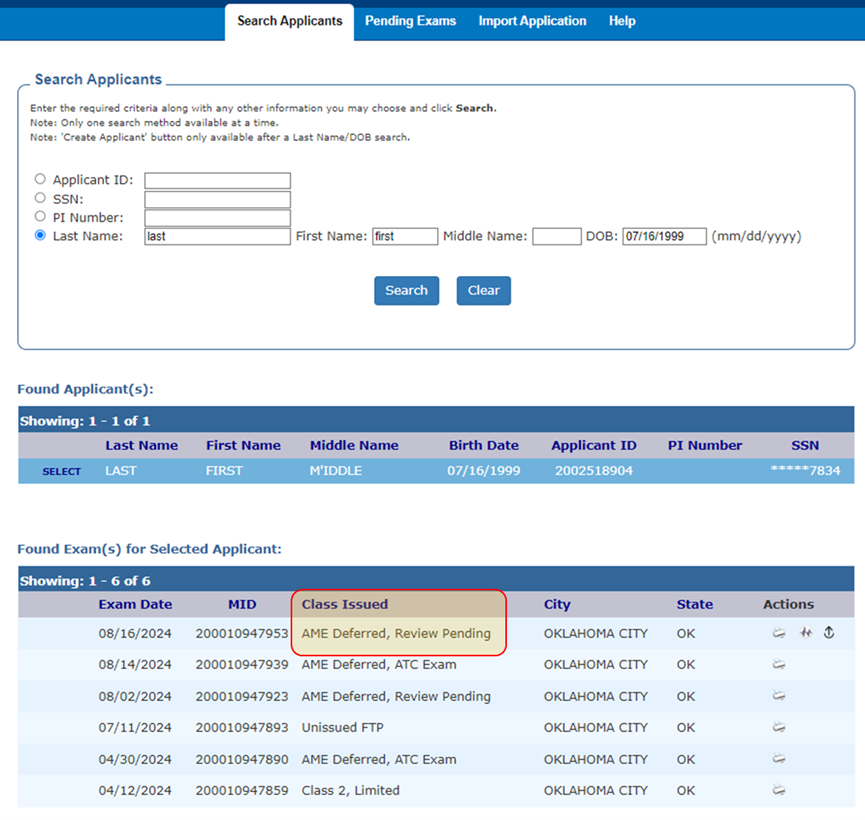
Yes. Go to the AMCS Search Applicants screen and search for the airman. Once you find the airman, look at the Found Exam(s) for Selected Applicant section located at the bottom of the screen. The Class Issued column displays the current medical certification status for that exam. In the example below, the exam was deferred to the FAA. The class issued status will update when a determination is made.