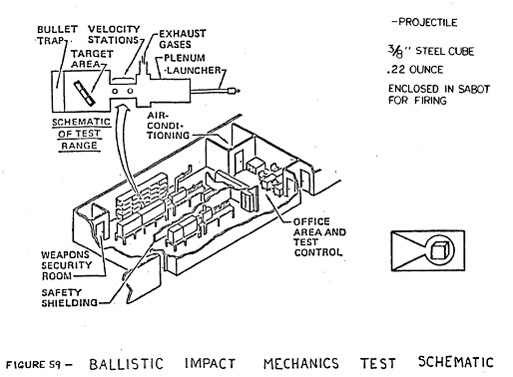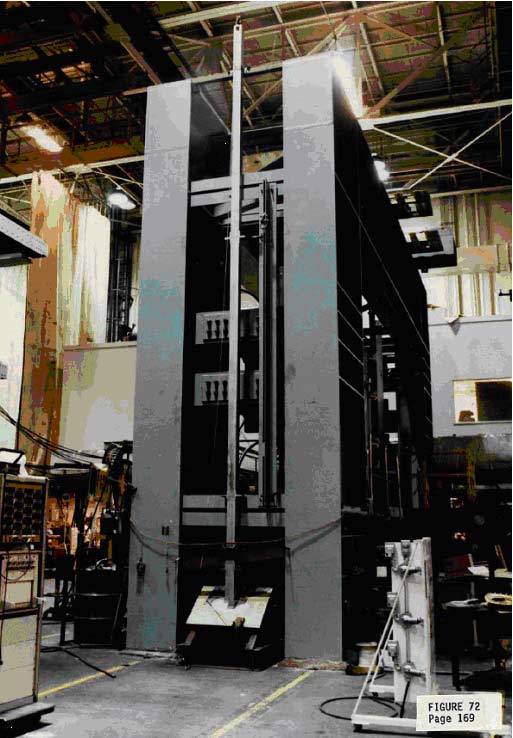


Schematics/Pictures from Boeing test to determine ability of various panel designs to withstand impacts equivalent to tire and engine failures
Excerpt from Boeing Document:
Impact Energy
Due to the numerous incidents of fuel tank door failures on 737, 747 and 707 caused by impacts from tire burst and engine rupture, the newly developed aluminum honeycomb door was extensively tested for impact.
Impacted doors from the Honolulu 747 and from the Manchester 737 incidents were taken into consideration.
Tire Burst Impact Simulation Test
Testing was done to simulate the impact on fuel tank doors by chunks of rubber resulting from tire bursts.
The first step was to recreate the effects of past incidents. Several cast aluminum doors were impacted at various energies until the damage appeared comparable to that of in-services incidents. The next step was to strike the new technology doors at this same energy.
Tire burst impact testing was performed in a drop-test facility at the Boeing Company. The projectile used was a chunk of rubber, similar to tire material, attached to a lead filled pipe. Tank doors were mounted in an actual piece of wing skin and canted at 35 deg from horizontal in order to accurately simulate projectile trajectory.
The energy used was 440 ft/lb, equivalent to an actual tire burst condition during takeoff or landing. The aluminum die-cast door failed at an impact energy estimated to be comparable to the actual airline service incident. The newly developed aluminum honeycomb door was capable of withstanding an impact of up to 1400 ft/lbs.
Engine Rupture Impact Simulation Test
In order to simulate effects of small engine burst projectiles on aluminum wing skin and fuel tank doors, several new-technology fuel tank doors and wing skin portions were impacted by ballistic methods. For these tests, the projectile was a 3/8-in. steel cube. This cube was placed inside a sabot so that the orientation was completely random at impact. Velocity of each shot was measured accurately by electronic means. The velocity at impact could not be accurately predicted at the velocity range used for the test, as this depends on quality, burn rate, packing of the powder, and equipment tolerances. A series of shots was fired at a 0.2-in.-thick 2024 T3 aluminum plate to determine the maximum velocity that would not penetrate. Doors were then shot at 0 deg and 70 deg. Next a 0.14-in.-thick 2024 T3 aluminum plate was shot to determine maximum nonpenetrating velocity. Doors were shot again at 70 deg.
The aluminum cast door withstood 160 ft/sec, and the aluminum honeycomb door (strike zone version) was able to withstand 700 ft/sec.
Related Photos/Schematics