


The eIPP: Accelerating AAM into American Skies
A first-of-its-kind program, the FAA’s Electric Vehicle Takeoff and Landing (eVTOL) Integrated Pilot Program (eIPP) creates one of the largest testing environments for next-generation aircraft that have the potential to generate new jobs, connect communities, and strengthen American leadership in aviation.
The eIPP gives us a real-world environment to safely test and integrate the next generation of aircraft into our airspace system. From urban and rural transportation to lifesaving medical and search-and-rescue missions, these aircraft have virtually unlimited potential, and we’re grateful for the partnerships that are helping turn that potential into reality.
-FAA Administrator Bryan Bedford
Why the eIPP was Created
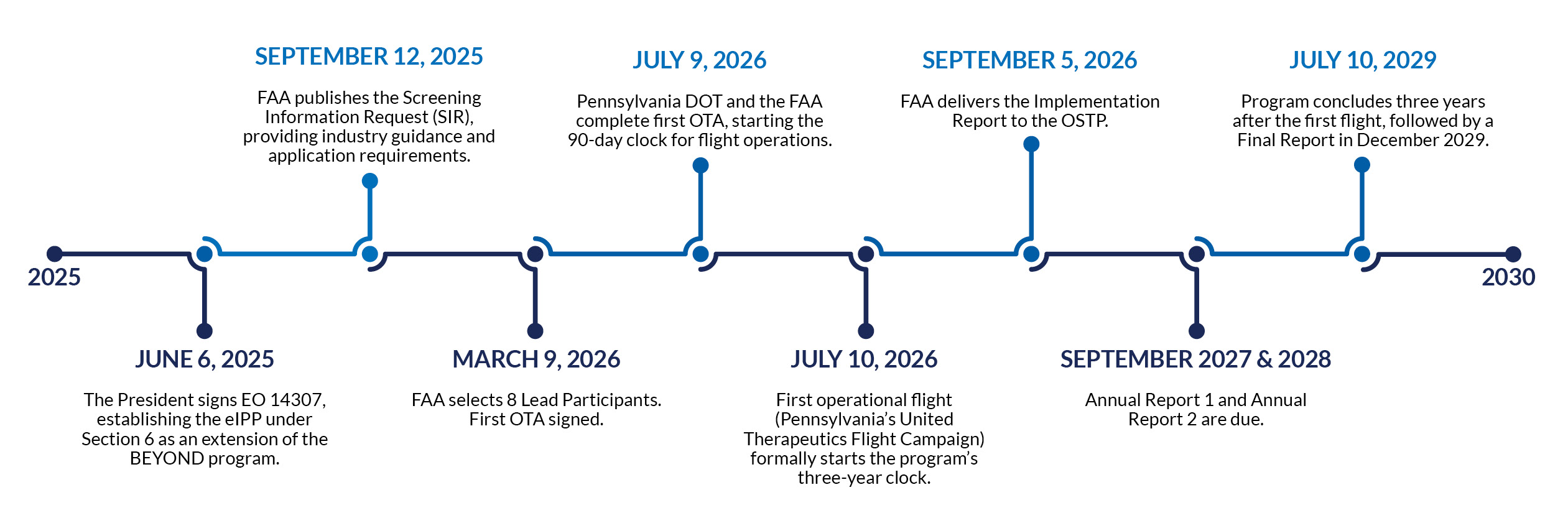
On June 6, 2025, Executive Order 14307, Unleashing American Drone Dominance, directed the Nation to accelerate the safe integration of eVTOL aircraft and other AAM vehicles into the National Airspace System. The eIPP is the vehicle for that work.
The eIPP establishes public-private partnerships between state, local, tribal, and territorial (SLTT) governments and American industry to deploy next-generation aircraft in real communities, under full FAA oversight, for real missions: moving people above congested roads, delivering cargo to hard-to-reach places, connecting rural America, and speeding medical and emergency response when minutes matter.
Built on a Decade of American Leadership
Aviation has always been forward-looking, and the FAA’s job is to safely enable the exciting innovations that change the way we travel. AAM is the latest development in a long history of aviation firsts.
The eIPP builds directly on that record. The Integration Pilot Program, established in 2017, advanced the use of more complex drone operations. The BEYOND program that followed made beyond-visual-line-of-sight operations scalable and repeatable, conducting more than 70,000 flights — nearly 48,400 of them beyond visual line of sight. BEYOND laid the regulatory groundwork for the eIPP, which now extends to a far more ambitious class of aircraft.
How the Program Works
Eight public-private projects spanning 28 states were selected on March 9, 2026. Each Lead Participant — a state, local, tribal, or territorial government — has an agreement with the FAA, coordinates with its industry partners, and maintains a project plan that defines objectives for each operational phase.
Participants bear their own costs. No federal funding is required. Operational data collected during these flights flows to the FAA to inform future policy and safety decisions —turning private investment into a shared national asset.
Lead Participants use a phased approach: as lessons are learned, operational complexity increases in phases. Each participant committed to launching an eIPP flight within 90 days of signing its agreement, and every selected project uses aircraft already in an active FAA type-certification project.
The Eight Lead Participants
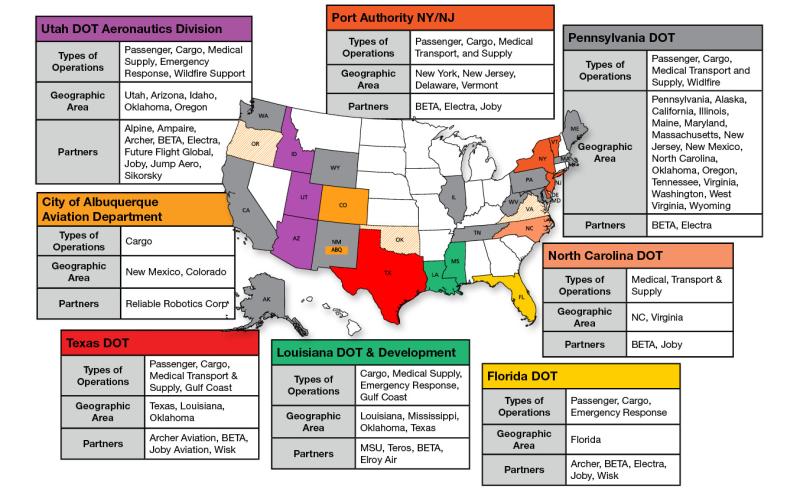

- Port Authority of New York & New Jersey — Twelve operational concepts across New England, including eVTOL passenger operations at the Manhattan heliport, demonstrating AAM in one of the world’s most complex airspaces
- Texas Department of Transportation — Regional flights connecting Dallas, Austin, San Antonio, and ultimately Houston, with air-taxi networks expanding outward from each metro area
- Utah Department of Transportation — “uFLY: America’s AAM Crossroads to the West,” a multistate testbed spanning the Pacific Northwest, the Rocky Mountains, and the Oklahoma Plains
- Pennsylvania Department of Transportation — The NASAO AAM Multistate Collaborative is working across 17 states to revitalize regional flights
- Louisiana Department of Transportation & Development — Cargo and personnel transport over the Gulf of America to offshore energy sites across Louisiana, Mississippi, Oklahoma, and Texas
- Florida Department of Transportation — A three-phase statewide effort spanning cargo delivery, passenger transportation, automation, and medical response
- North Carolina Department of Transportation — Piloted and autonomous flight operations supporting medical transport and disaster relief
- City of Albuquerque — Near-term autonomous and remotely piloted cargo operations across New Mexico and Colorado
Program Milestones
eIPP Resources
- Press Releases
- Fact Sheet
- Implementation Report to the Office of Science and Technology Policy (September 2026)