


Cris Bosetti - Chief Scientist and Technical Advisor, Flight Meteorological Effects
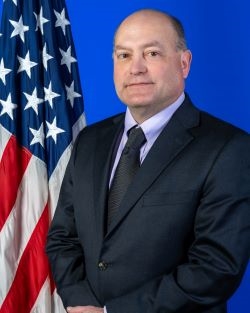 Cris Bosetti is the FAA’s Chief Scientist and Technical Advisor (CSTA) for Flight Meteorological Effects. He serves as the Aviation Safety (AVS) expert for all icing issues that pose a risk to operational safety.
Before joining the FAA, Bosetti spent more than two decades at The Boeing Company, where he led the Configuration Aerodynamics group at Boeing Commercial Airplanes and participated in multi-disciplinary large scale aerodynamic and system design, development, and certification efforts. He held various management roles in Aerodynamics prior to becoming the senior manager for Configuration Aerodynamics, where he led five groups spanning the entire lifecycle of Boeing Commercial Airplane programs and assumed responsibility for strategy, execution, and skill health and development.
Bosetti also held the role as the Flight Sciences Safety and Airworthiness Chief Engineer. He has extensive experience applying a holistic approach to flight-in-icing, including high-lift design, ice accumulation behavior, aerodynamic effects, and aircraft-level integration of electric and pneumatic ice protection systems. In his final position with Boeing, Bosetti served as the Functional Excellence Leader of Configuration Aerodynamics and Technical Fellow of Aerodynamics and Flight-in-Icing, gaining valuable experience developing executable strategies to improve and evolve products and skills.
Bosetti is creator and co-host of the Aircraft Icing Forum, a public forum held by FAA and NASA to connect the icing community. He has previously held leadership roles on the EASA Supercooled Large Droplet Icing Similarity as a Means of Compliance rulemaking team (RMT 0572), the Boeing Commercial Airplanes Technical Council for Design Practices, the Boeing Enterprise Executive Wind-Tunnel Steering Board, the BCA Icing Steering Team, and the Manufacturers Icing Certification Group.
Bosetti gained his bachelor’s and master’s degrees in aerospace engineering from Pennsylvania State University. He holds six patents and has authored several influential publications in his technical discipline, pioneering many contributions in the field.