

Checklist: An Update to Your Forecasting
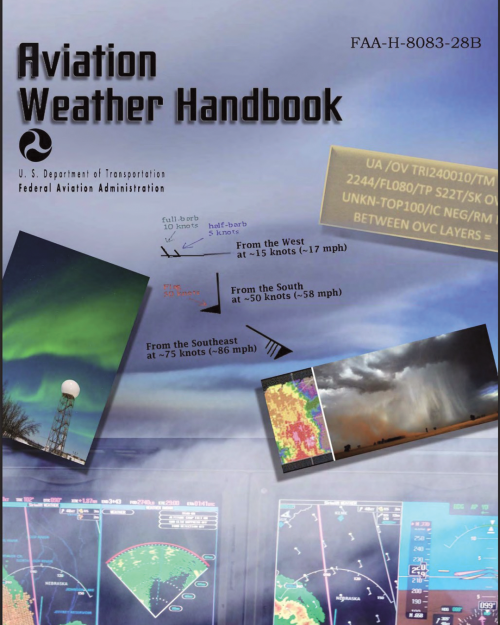
The FAA places significant emphasis on providing detailed handbooks on a variety of aviation-related subjects. Weather is, of course, included. The Aviation Weather Handbook (AWH) was updated this spring, making it the perfect reason to revisit it in this weather-focused issue of FAA Safety Briefing. Just as pilots should routinely get updated forecasts before flight, it’s advisable to refresh your basic weather knowledge, too.
This issue serves as an excellent refresher on several aviation weather topics, but space limitations mean that it may not have the depth on any one topic that pilots may desire. The AWH offers an overview of how weather services are provided by various government agencies and private organizations, and describes the basics of what information is provided and how to obtain it.
The AWH also covers the theory behind weather systems and the atmospheric structure. It addresses some of the underlying principles that drive larger trends, such as heat, temperature, and water vapor. These concepts, along with how heat is transferred in the atmosphere and beyond, form a bedrock layer that underpins many of the more advanced concepts that can create weather traps for pilots.
Building on these concepts, the AWH discusses a key component of Earth's atmosphere: atmospheric heat imbalances. Many natural systems are driven by the need to equalize, and how that equalization takes place can drive systems like the weather. Whether it’s heat or pressure (two key weather drivers), the natural desire to balance can be seen in microscale examples. Mixing hot and cold water results in a warm or tepid result. Opening a soda can or bottle will result in a pop or hiss as the high pressure inside the vessel escapes into the surrounding environment. While important as examples, these simple demonstrations don’t capture the complex systems that drive our weather.
Further chapters build on the foundation to dive into aspects of weather that directly impact pilots. Aspects such as winds, fronts, and air masses add further complexity to our system. Those middle layers provide more support for direct impacts such as cloud formation and precipitation. Along with wind, clouds and precipitation are probably the most closely watched factors by pilots when making go/no-go decisions. For a pilot, dealing with wind conditions can either lead to minor inconveniences, like increased fuel burn/lower ground speeds, or to potential safety concerns from wind speeds that exceed the aircraft’s crosswind component. Clouds and precipitation can create instrument meteorological conditions (IMC) and potentially dangerous weather, such as thunderstorms, hail, and tornadoes. Even for instrument-rated pilots, these conditions can pose challenges warranting a no-go decision, underscoring the need to understand them for flight safety. There is also a chapter dedicated to weather radar. As weather radar information has moved from the preserve of business and airline aircraft with onboard systems to being a widely available tool, it is critical to understand what the information the pilot is seeing means and how they can use it.
The AWH next moves into more situational weather that may not impact pilots directly but can be a crucial resource to understand before they encounter it. Mountain weather may not be applicable to a Florida pilot, and tropical weather might not apply to a Montana pilot, but these chapters are worth reviewing before venturing into those new environments. Another environment that almost every pilot will never encounter is space. But space has weather, and it can affect us on Earth, especially with regard to communication and space-based navigation like GPS. Space weather covers processes that occur outside of the Earth's traditional atmosphere and are primarily driven by the sun. It includes phenomena like solar flares, solar winds, and coronal mass ejections (CME).
We hope this article inspires pilots to sharpen their weather skills and explore the newly updated AWH. By staying current with weather, pilots play a crucial role in enhancing airspace safety.