


Flight Path to a Just Culture

As a wide-eyed, eager, and oh-so-naïve helicopter student pilot, Leah Murphy, FAA Safety Team Representative, walked into her flight school one afternoon, prepared for a ground lesson, when she noticed an unusual energy among the instructors. The chief pilot’s door was shut, but muffled shouting leaked through the walls. Gaggles of instructors and students whispered to each other, glancing nervously toward the office. As she set her backpack down, she wandered over to a small group and asked what was going on.
A flight instructor, Joe (not his real name), had an engine overspeed.
With no more than twenty hours in her logbook, she didn’t fully understand what that meant. But she understood enough from the room’s tension that it wasn’t good, and that whoever “Joe” was, his day was not going too well. The instructors’ hushed tones and the chief pilot’s raised voice made one thing abundantly clear: mistakes were punished, not learned from. That moment was her earliest exposure to negative safety culture, and it shaped her understanding of how deeply culture influences safety outcomes in helicopter operations.
Today, industry has evolved far beyond those closed-door reprimands and whispered post-incident rumors. One of the most significant drivers of this shift has been the implementation of a structured safety management system (SMS), not only as a best practice, but now as a regulatory requirement. In 2023, the FAA expanded the
14 CFR part 5 SMS requirements to tour operators flying under section 91.147 and charters operating under part 135.
SMS implementation marks a deliberate move toward a proactive, data-driven approach to helicopter safety. It formalizes processes to ensure hazards are identified early and addressed systematically rather than reactively. At its core, SMS comprises four key components: Safety Policy, Safety Risk Management, Safety Assurance, and Safety Promotion. Together, they create an environment where you do not wait for an accident or incident to reveal weaknesses in training, procedures, or communication.
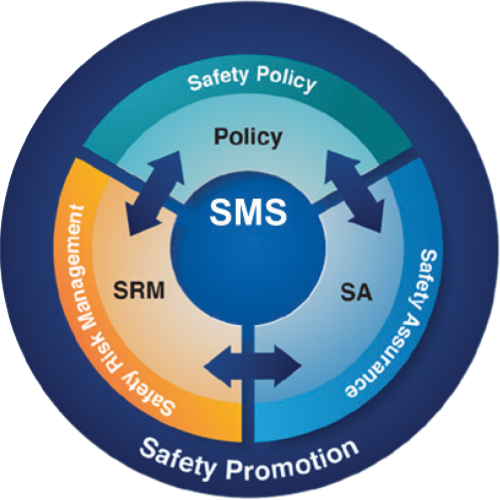
Safety Policy establishes organizational expectations, leadership accountability, and a just culture — something that was starkly absent in the “Joe” scenario. The required SMS implementation means leaders can no longer rely on fear-based management or inconsistent responses to errors. They must define clear policies that support reporting, transparency, and constructive learning.
Safety Risk Management provides operators with a structured process to identify hazards and assess associated risks before they escalate into an event. Under the FAA’s requirements, SRM is no longer optional or informal; it must be continuous, documented, and integrated into every operational decision.
Safety Assurance verifies that risk controls are working through trend analysis, audits, data collection, and feedback loops. For helicopter operators, this can include monitoring approach profiles, reviewing recorded flight data (if equipped), analyzing maintenance discrepancies, or tracking procedural compliance.
Safety Promotion reinforces the cultural transformation. Training, communication, and shared lessons learned help normalize reporting and reduce the stigma associated with errors. In a required SMS environment, operators must ensure that every employee understands the SMS and their role within it. This would have completely changed the culture I witnessed as a student pilot; instead of a closed-door scolding, there would have been an open discussion, a teaching moment, and a safety bulletin or debrief for the greater learning of the school.
The FAA is building systems that actively hunt for hazards, verify the effectiveness of their controls, and, most importantly, foster an environment where reporting an error, such as Joe's preventable engine overspeed incident, is seen as a contribution to collective safety, not a career-ending mistake. Ultimately, the successful implementation of SMS is what makes helicopter operations not only compliant but fundamentally safer.
Learn More