


Mitigating Airport Risks from Foreign Object Debris
From ‘FOD Walks’ to the latest debris detection technology, one man’s trash is an airport surface hazard
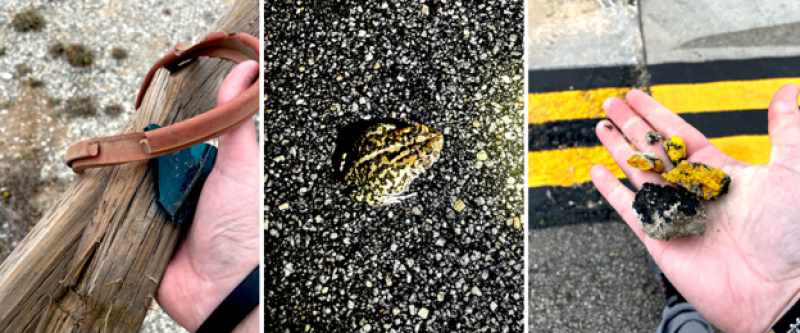
If you’re driving down the highway at 70 mph, the last thing you’d want to encounter – and have to swerve around to avoid – are tire treads, rogue tools, potholes or the occasional roadkill. Debris on the road is a major hazard.
On runways, it poses an even greater hazard.
Foreign Object Debris (FOD) can cause catastrophic damage to aircraft that are landing or taking off, and its removal is a critical safety element of airport safety and operations.
“In the grand scheme of airport operations, FOD may seem like a nuisance or a minor detail, but when it comes to the safety of an airport the only thing that should be touching an active runway are the tires of an aircraft taking off or landing safely,” said Caroline Bonynge, an Airport Certification Safety Inspector in the Airport Safety & Standards Division.
Who’s in Charge of FOD Maintenance?
FOD is any object, live or not, located in an inappropriate location in the airport environment that has the capacity to injure airport or air carrier personnel and damage aircraft.
With around 520 commercial air carrier airports across the U.S., who is responsible for mitigating and managing FOD?
The FAA’s Advisory Circular on Airport FOD Management notes that airport operators are responsible for implementing a FOD management program and action plans to ensure safe airport operations, following a continuous four-step cycle:
- Prevention: Stopping debris from getting on the pavement.
- Detection: Finding the debris quickly.
- Removal: Cleaning it up.
- Evaluation: Figuring out where it came from to prevent it from happening again.
Airport solutions are unique to their environments and include tools such as fencing, netting or other barriers, and advanced technologies.
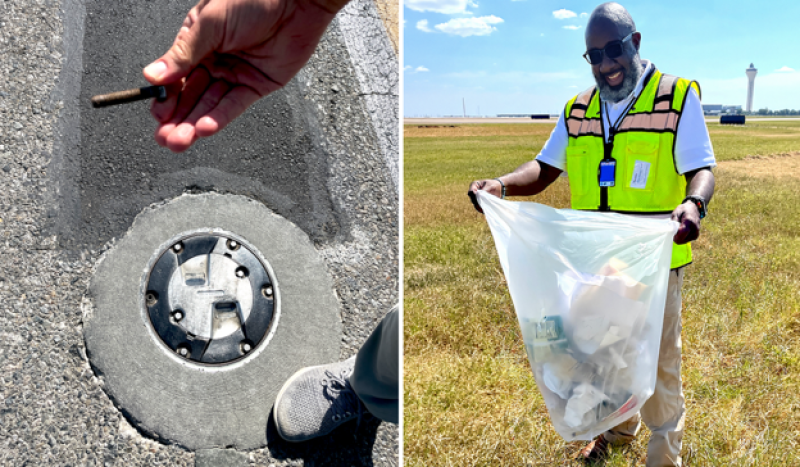
Recurring ‘FOD walks’ are hands-on inspections of the airfield to find, collect and remove debris. These walks can include team members from the airport, airlines, maintenance and ground handlers. To minimize the impact to operations, the airports coordinate with the air traffic control tower as FOD walkers conduct the inspections.
“During these inspections, safety is our utmost priority,” said Bonynge. “FOD walkers are under escort by airport authority vehicles to ensure their safety as they move about inspection areas.”
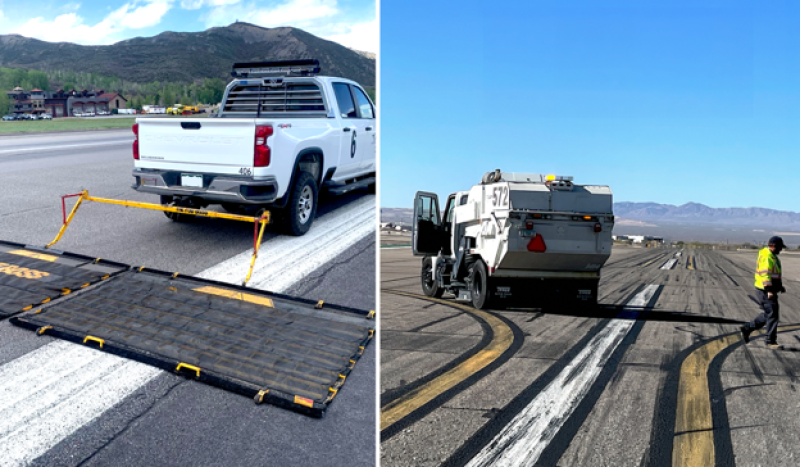
Airports also use advanced tools including specialized mechanical sweepers, high-powered blowers, magnetic bars, and FOD mats —resembling the sweepers used on baseball infields—to quickly clear away metal and plastic debris.
FAA's Role and Certification of Safety
The FAA's Foreign Object Debris Program focuses on research and development of detection equipment, including technologies like drones, surface-safety technology, and autonomous ground vehicles, which could enhance FOD detection without closing airport surfaces.
The FAA has evaluated four types of automated FOD detection systems at four U.S. airports: Rhode Island T.F. Green, Boston Logan, Chicago O’Hare, and Chicago Midway.
These evaluations have provided valuable information for airports to determine which technology would work best in their context. Solutions include electro-optical/infrared cameras, radar units and optical tracking sensors, runway edge sensor systems, and sensors on airport operation vehicles.
“Through ongoing research and development, and testing of detection technologies, the FAA can continue to support airports in their efforts to enhance safety measures in all aspects of the operations, especially on the ground,” said Kelvin Ampofo, branch manager for Airport Operations.