


Rocky Mountain Metropolitan Airport (BJC)
Rocky Mountain Metropolitan Airport (BJC) is located 20 miles west of the Denver International Airport. Situated on the northwestern edge of the metropolitan area, BJC provides a convenient alternative for business and general aviation pilots visiting the Denver area. BJC has a complex airport layout coupled with the wide diversity of pilot experience and aircraft performance. View a printable Pilot Handbook of the BJC information found on this Web page.
Know Before You Go
BJC ATCT Operates: 0600L-2200L daily
Administrative Office Open: 0700L to 1530L M-F
Business Phone: 720-633-8600
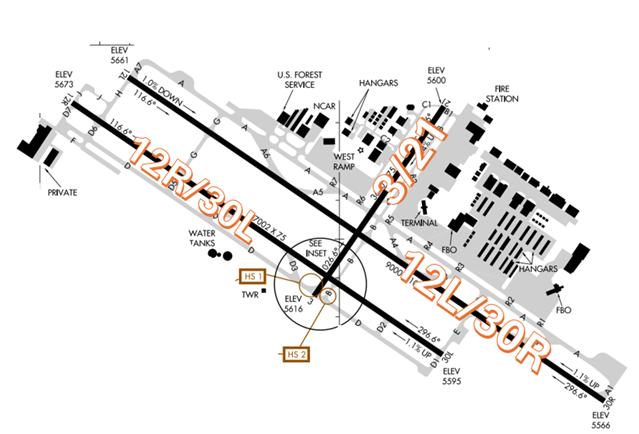
The RWY configuration consists of RWYs 3/21, 12L/30R and 12R/30L
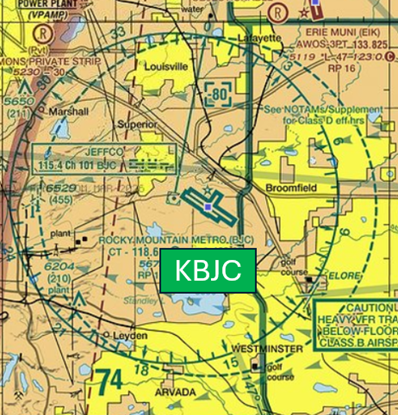
The airspace at BJC is Class D and partially underlies Denver Class B airspace (Refer to Sectional Chart)
Hot Spots
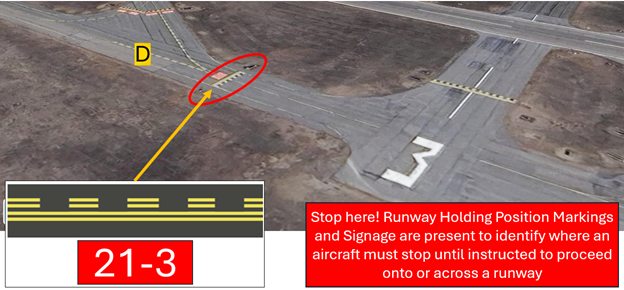
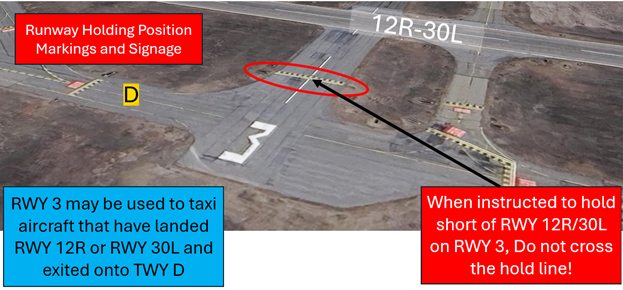
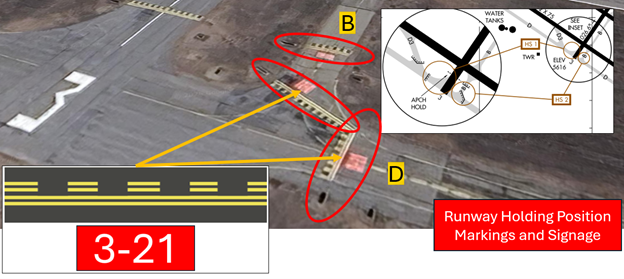
HS 1: Pilots taxiing south on TWY D and instructed to cross RWY 3 mistakenly turn onto RWY 3. Pilots taxiing on RWY 3 and instructed to hold short of RWY 12R/30L fail to hold short. Hold line immediately after the turn onto RWY 3.
HS 2: Multiple hold lines in close proximity. Hold line on TWY B south of RWY 12R/30L is prior to TWY D. Pilots should use caution and hold short when instructed by ATC.
- Aircraft instructed to taxi via TWYs D, B, hold short of RWY 12R, will cross two sets of Hold Short Lines for RWY 3/21 before reaching RWY 12R/30L. This has been a source of confusion. If in doubt, hold short and ask.
Surface Movement Area Cautions
Pilots instructed to hold short of RWY 12L/30R on RWY 3 or on TWY B, sometimes cross the hold short line even after acknowledging the hold short instructions.
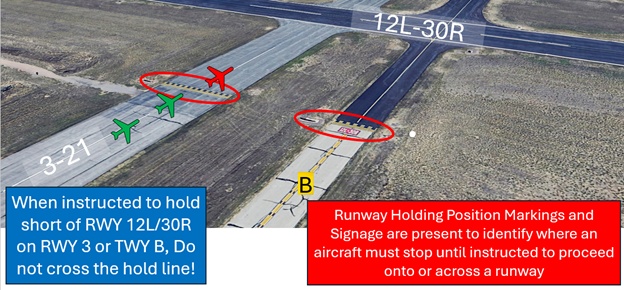
- For all the above Hot Spot/Surface Movement Area Cautions, pilots should review the taxi clearance before starting to taxi.
- Actively scanning to locate and identify RWY signs, markings, lighting and deferring all heads down activities until holding short at the appropriate location will help eliminate these errors.
- If you are unsure of your position or instructions, ask the tower.
- View the From the Flight Deck - Complex Airfield Geometry#7: Hold Short Lines In Unexpected Places for additional information.
Wrong Surface Landing Risk
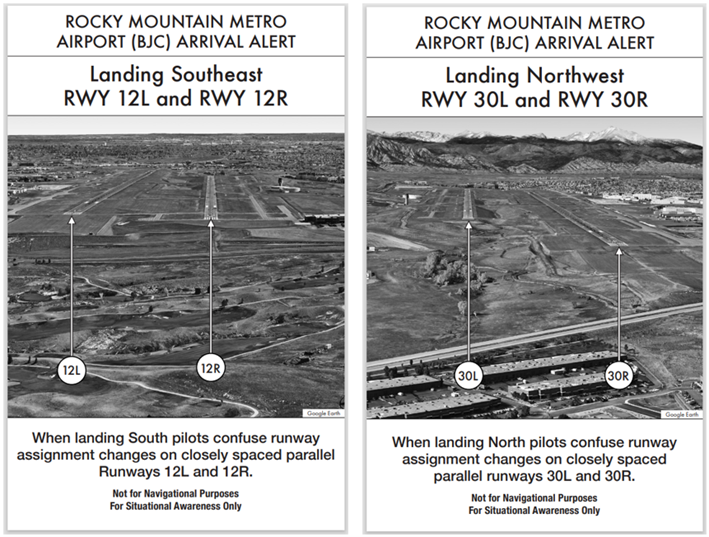
See Arrival Alert Notices
- Wrong Surface Landing risk exists due to closely spaced parallel runways.
- All of the runways at BJC have full-length parallel taxiways. Whenever a taxiway runs parallel to a runway, the risk of landing on a taxiway increases.
- If available, back up all visual approaches with an instrument approach/GPS Waypoint to help ensure that you are lined up for the correct surface.
- Remember, RWY markings are white. Markings on surfaces not used for takeoff/landing like TWY markings, chevrons, RWY shoulder and RWY turn-on markings etc., are yellow.
- View the From the Flight Deck - Wrong Surface Landings video for additional mitigation strategies.
General
- Initial calls on all frequencies should include full call sign with type, position, intentions or requests.
- Be specific on the type of pattern work requested, rather than asking for “pattern work” or “patterns.”
- Runway crossings should all be done expeditiously.
- If there is ever confusion with any ATC instruction, ask for reissuance of the instructions by stating “say again” or just state you do not understand the instructions.
Traffic Patterns
- Always keep the aircraft you are following in sight to the maximum extent possible. If you lose sight of your sequence, immediately ask tower to call the traffic so that you may identify your sequence to the runway. Do not turn base if you lose sight of your traffic sequence in the pattern. Advise ATC immediately.
- The traffic pattern is 6500’ MSL.
- Once completed with traffic pattern and holding short between the active runways, never switch frequencies until instructed by ATC.
Ground Control (GC)
- Due to increased Local Control (118.6) frequency congestion, BJC ATCT has adopted Standard Operating Procedures for Ground Control (GC) to sequence all aircraft to the line.
- After initial call to GC, pilots can expect to be given a runway assignment and taxied to the designated run-up area using the following phraseology:
- “N1234 (Runway Assignment) (Taxi Route) Advise Run-Up Complete.”
- After advising GC that the run-up is complete, pilots can expect to be sequenced into line and told to monitor Tower.
- Any pilot not requesting a run-up, should expect sequencing instructions from GC and should remain on GC frequency until advised.
- It is helpful if pilots state the following on initial call: Callsign, location, ATIS Code, and Intentions. Example: “Metro Tower, N1234 at R4 with Juliet requesting North Departure. Run-up required”
- After completing the run-up, advise GC “run-up complete.” GC will then taxi you into line and instruct you to monitor Tower.
- These procedures are viewable in NOTAMS in the Letter to Airmen LTA-BJC-10 Ground Control Sequencing.
Takeoff/Departure
- Verify proper heading prior to starting takeoff roll on all departures.
- BJC utilizes “Line Up and Wait” (LUAW) to instruct a pilot to taxi onto the departure RWY and hold position until cleared for takeoff. It is not authorization for takeoff. For mitigation strategies, view the From the Flight Deck-Line Up and Wait video.
Arrival/Landing
- BJC has seen a notable surge in TCAS resolution alerts and close proximity incidents. A contributing factor to this increase has been a lack of route structure for aircraft entering, exiting, and transitioning the airspace.
- Due to mountainous terrain and the Denver Class B airspace, aircraft around BJC are funneled through a north-south orientation to transit the Denver Metro Area. This increasingly complex airspace has created the need to develop uncharted VFR transition routes.
- Pilots can familiarize themselves with the routes by reviewing NOTAMS for the Letter to Airmen LTA-BJC-11 VFR Arrival/Departure Transition Routes.
Additional Information
- See Special Notices – Extensive Helicopter Flight Training. USAF 306 Flight Training Group Flight Training Areas, vicinity of Colorado Springs and Pueblo Colorado.
- Noise abatement procedure in effect. Noise office 303-271-4850.
- Pilots are requested to avoid flight due to nesting eagles:
- Below 6500’ MSL – BJC 025/2.7
- Over Standley Lake below 8000’ MSL – BJC 150/3
- TWY C1 and TWY D marked with reflectors.