


Oakland County International Airport (PTK)
Oakland County International Airport (PTK) is a compact, multi-use airport located thirty miles northwest of Detroit, Michigan. PTK is the second busiest airport in the state of Michigan, behind Detroit (KDTW). The taxiway system provides access to business and services located in multiple areas of the airfield. View a printable Pilot Handbook of the PTK information found on this Web page.
Know Before You Go
PTK Tower Operates: 0600L-0000L
Admin Office: Open 0830L-1700L M-F
Airport MGMT Office: 248-666-3900
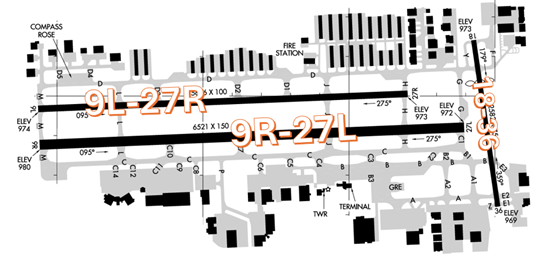
The airport configuration consists of RWYs 9L/27R, 9R/27L and RWY 18/36.
Multi-phase taxiway construction is underway. Pilots should review Letter to Airmen: LTA-PTK-10-Airfield Construction for facility issued information. Always check NOTAMS!
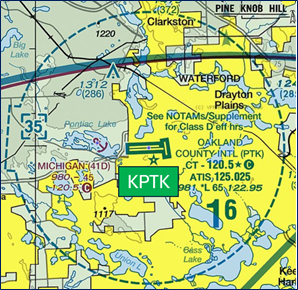
The airspace at PTK is Class D and underlies Detroit Class B airspace. (Refer to Sectional Chart)
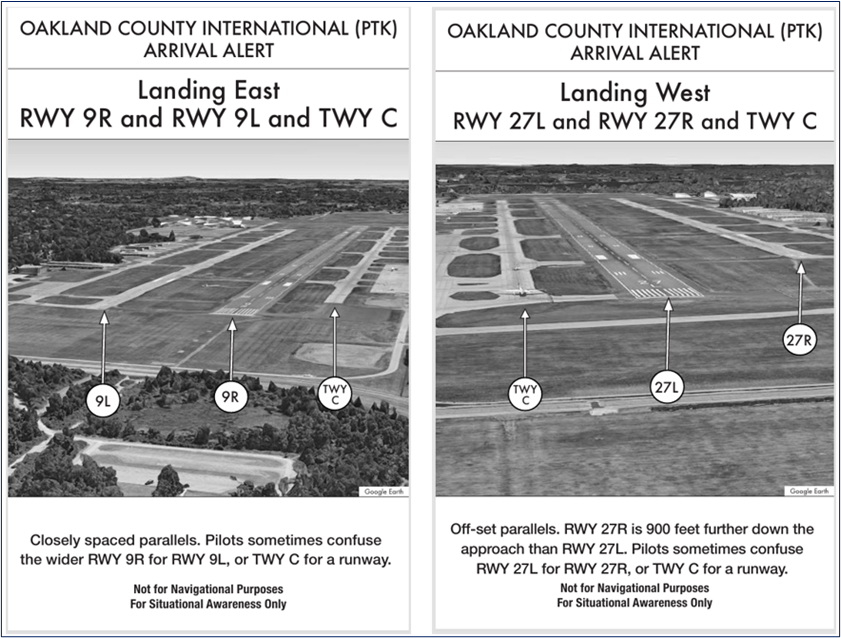
Wrong Surface Landing Risks
See Arrival Alert Notices
- Parallel RWYs, especially with staggered thresholds, increase wrong surface landing risks. The first RWY that becomes visible may not be your assigned RWY.
- Whenever a TWY runs parallel to a RWY, the risk of landing on a TWY increases.
- If available, back up all visual approaches with an instrument approach or GPS Waypoint to help ensure that you are lined up for the correct surface.
- Remember, RWY markings are white. Markings on surfaces not used for takeoff/landing like TWY markings, chevrons, RWY shoulder and RWY turn-on markings etc., are yellow.
- View the From the Flight Deck-Wrong Surface Landings video for additional mitigation strategies.
Wrong Surface Intersection Takeoff Risk
- Pilots must be aware that an intersection departure presents the risk of taking off in the wrong direction.
- Prior to entering the RWY and again when lining up on the RWY, check your Magnetic Compass and your Horizontal Situation Indicator (HSI), if installed, to verify that you are pointed in the correct direction.
- View the From the Flight Deck-Wrong Direction Intersection Takeoffs video for more information and mitigation strategies.
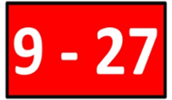
Use the above "Generic" RWY Marking.
If you are cleared to take off on RWY 9, from an intersection, you would turn RIGHT onto the RWY.
For a RWY 27 intersection takeoff, you would turn LEFT onto the RWY.
Apply this to your specific situation.
General
- PTK has extensive pilot training operations.
- Pilots must state their callsign in every transmission.
- RWY 18/36 is unlit and is unavailable between sunset and sunrise.
- RWY 27R/9L is closed and unlit during non-towered hours.
- Wildlife in the vicinity of the airport and surrounding lakes.
Traffic Patterns
- Traffic patterns typically match assigned RWY (27L/9L left traffic, 27R/9R right traffic).
- Expect extended downwind and high pattern volume (often 5+ aircraft).
- Scan and keep traffic that you are directed to follow in sight.
- Use caution for opposite-base traffic on the parallel runway.
- If you want a short approach, advise the TWR prior to takeoff or prior to starting crosswind turn.
Movement / Non-Movement Areas
- The Non-Movement Area is the part of the airport that is not controlled by ATC (e.g., ramps, aprons, and taxi-lanes).
- The Movement Area (TWYs and RWYs) is controlled by ATC, and you must have clearance prior to entering any Movement Area.
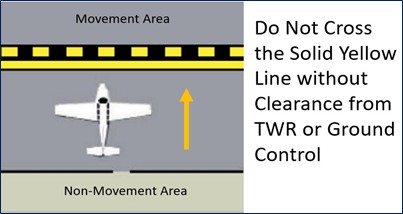
Surface Risk – Movement Area Cautions
- Be alert for extensive helicopter operations around the airport, especially to/from the midfield ramp and the southeast corner of the field.
- TWY D and TWY C are near the parallel RWYs. Be aware of and scan for aircraft exiting the RWYs.
- RWY 18/36 is frequently used to taxi aircraft without having to cross active runways and intersects the RSA of RWY 9R/27L.
- When there is traffic on RWY 9R/27L.
- Expect to be held “on the numbers” when taxiing south on RWY 18.
- Expect to hold short on TWY B when taxiing north on RWY 36.
- Use caution near RWY 18/36 due to proximity to TWYs and FBOs.
RWY Crossings
- The airport layout allows aircraft to cross from the north side of the airport to the South side (and vice versa) via TWYs M, L, J, H, G, and RWY 18/36.
- Pilots may be instructed to taxi on RWY 18/36 to get to the other side of the field during periods of busy traffic.
- All crossings are expected to be without delay. Controllers often emphasize “no delay” in the crossing clearance. It is uncommon for the controller to be able to cross both RWYs at the same time. Do not allow a sense of urgency to cross one of the parallel RWYs distract you from holding short of the other RWY.
- Because controllers need to build space for crossings, pilots can expect short delays during high volume traffic periods.
RWY Holding Position Markings
- The Runway Safety Area (RSA) for RWY 27R/9L intersects with TWY G. RSA Information.
- Multiple hold lines near TWY G require sequencing instructions from ATC. Expect the controller to instruct pilots to hold short of TWY G before proceeding to RWY 27L.
- Expect to cross first two sets of lines (RSA 27R/9L) and hold short of the third (RWY 27L).
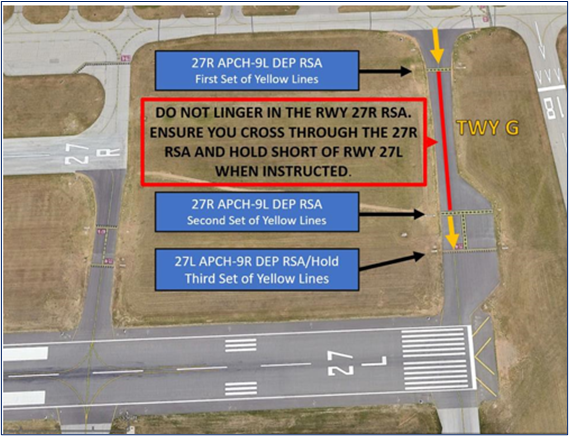
Departure/Takeoff
- VFR departures are commonly cleared to turn on course, however, if traffic does not allow for a turn on course, the controller will instruct the pilot to fly straight out.
- Pilots are expected to pull up to the RWY Holding Position Marking and contact the TWR without undue delay.
- Normally, departures will contact TWR on frequency 120.5. When PTK is in a dual TWR configuration, pilots departing RWY 9L/27R will contact TWR on frequency 123.7 and pilots departing RWY 9R/27L shall contact TWR on frequency 120.5.
- After departure, the TWR controller may instruct you to contact the other TWR frequency if you need a turn through the other controller’s airspace.
Communications
- Frequency congestion is common; however, pilots must read back all runway assignments and hold short instructions with callsign.
Arrival/Landing
- Normally, aircraft inbound will contact TWR on frequency 120.5.
- When PTK is in a dual TWR configuration, pilots inbound from the north will contact TWR on frequency 123.7 and pilots inbound from the south will contact TWR on frequency 120.5.
- Pilots are expected to exit the RWY at the first available TWY when practical.
- When exiting a RWY, ensure that your entire aircraft is beyond the yellow RWY Holding Position Marking.
- Sometimes you may have to enter a TWY when clearing the RWY. The controllers are aware of and manage aircraft on the TWY accordingly.
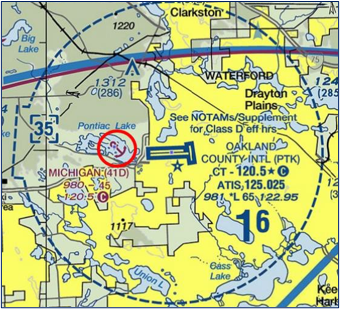
Avoidance Areas
- Extensive seaplane operations from Pontiac Lake (41D) Seaplane Base immediately west of the airport and lakes surrounding the airport.
- Highly active practice area northeast of PTK—use caution for opposite direction traffic when arriving and departing.
- Avoid flying near the final approach corridor for RWY 9R/27L at or below 3500’ MSL.
Weather
- During cold weather operations, the priority for snow removal is RWY 9R/27L, the associated turn-offs, and TWY C. All other areas of the field have lower priorities.
- On initial contact, advise controllers where you intend to park. They can coordinate with the snow team to clear a path to your hangar/FBO.
- When able, give the controller a PIREP and/or braking action report if relevant.
Controller Preferences
- Advise run-up needs early and avoid blocking RWY access.
- Frequency changes are approved, without coordination, upon exiting Class D airspace, unless instructed otherwise by ATC.
- Pilots are strongly encouraged to remain on, or monitor tower frequency, when operating within 10 NM of PTK at or below 3500’ MSL.