


Safety Briefing
Best Glide Speed and Distance
The General Aviation Joint Steering Committee (GAJSC) has determined that a significant number of general aviation fatalities could be avoided if pilots were better informed and trained in determining and flying their aircraft at the best glide speed while maneuvering to complete a forced...
Angle of Attack Awareness
The General Aviation Joint Steering Committee’s (GAJSC) loss of control workgroup believes that a lack of awareness, with respect to angle of attack (AOA), has resulted in the loss of aircraft control and contributed to fatal GA accidents. The GAJSC also maintains that increasing a pilot’s...
Aircraft Performance and Calculations
Accident investigations have discovered causal factors resulting from unreasonable expectations of aircraft performance – especially when operating at the edges of the aircraft weight and balance envelope. That’s why the Loss of Control Work Group suggests improvement in pilots’ understanding...
Aircraft Performance Monitoring
The General Aviation Steering Committee (GAJSC) System/Component Failure Working Group asserts that pilots continue to hold unreasonable expectations of their personal performance, and the performance of their aircraft, which has contributed to fatal GA accidents. Reasonable performance...
Fly Safe Fact Sheets

See the latest Fly Safe Fact Sheets on our Blog.
Aerodynamics
- Aircraft Performance Monitoring (PDF)
- Aircraft Performance and Calculations (PDF)
- Angle of Attack Awareness (PDF)
- Best Glide Speed and Distance (PDF)
Aeromedical
- Are You Fit to Fly? (PDF)
- Avoiding Adverse Drug Interactions (PDF)
- Flight After Use of Medication with Sedating Effects (PDF)
- Pilots and Medication (PDF)
- Spatial Disorientation (PDF)
Aeronautical Decision Making
- Aeronautical Decision Making (ADM) (PDF)
- Compliance Program (PDF)
- Flight Data Monitoring (PDF)
- Flight Risk Assessment Tools (FRAT) (PDF)
- Introduction to Safety Risk Management (PDF)
- Managing Distractions (PDF)
- Managing Unexpected Events (PDF)
- Personal Minimums (PDF)
- Single-Pilot Crew Resource Management (PDF)
- Startle Response (PDF)
Controlled Flight Into Terrain
- CFIT/Automation Overreliance (PDF)
- Controlled Flight Into Terrain (PDF)
- CFIT and Plan Continuation Bias (PDF)
Expanding Your Horizons
- Aftermarket Safety Equipment (PDF)
- General Aviation Survival (PDF)
- Mountain Flying (PDF)
- Pilot Proficiency Training (PDF)
- Stall, Spin and Upset Recovery Training (PDF)
- Training and Preparing for a New Flight Environment (PDF)
Flight Training and Proficiency
- Aircraft Performance Monitoring (PDF)
- Avoiding Pilot Deviations (PDF)
- Emergency Procedures Training (PDF)
- Enhanced Vision Systems (PDF)
- Experimental/Amateur-Built Flight Testing (PDF)
- Flight Training after Period of Inactivity (PDF)
- Fly the Aircraft First (PDF)
- Managing Unexpected Events (PDF)
- Maneuvering Flight (PDF)
- Pilot Proficiency Training (PDF)
- Runway Safety (PDF)
- Single-Pilot Crew Resource Management (PDF)
- Stall, Spin and Upset Recovery Training (PDF)
- Startle Response (PDF)
- Transition Training (PDF)
- Vmc Scenario Training (PDF)
- WINGS Pilot Proficiency Program (PDF)
Mechanical, Maintenance, and Systems
- Advanced Preflight After Maintenance (PDF)
- Approval for Return to Service (PDF)
- Engine Maintenance and Performance Monitoring (PDF)
- Fuel Monitoring (PDF)
- General Aviation Survival (PDF)
- Ignition Systems/FADEC (PDF)
- Maintenance Placards (PDF)
- Managing Component Failures (PDF)
- Regulatory Roadblock Reduction(PDF)
- Smart Cockpit Technology (PDF)
- Safety Wire (PDF)
- Service Bulletins and the Aircraft Owner (PDF)
- Understanding Owner/Mechanic Roles and Responsibilities (PDF)
Takeoff and Landing
- Aircraft Performance and Calculations (PDF)
- Aircraft Performance Monitoring (PDF)
- Pattern Precision (PDF)
- Stabilized Approach and Landing (PDF)
Weather
- Personal Minimums and Weather Cameras (PDF)
- Personal Minimums for Wind (PDF)
- Use of Weather Information (PDF)
- Weather Technology (PDF)
Watch GA Safety Enhancement Training Videos
FAA Safety Briefing January/February 2022
The FAA Safety Policy Voice of Non-commercial General Aviation
Aerospace Medicine and You | January/February 2022
The January/February 2022 issue of FAA Safety Briefing focuses on aerospace medicine. Articles discuss the pilot medical certification process and the various...
FAA Safety Briefing - September/October 2021
The September/October 2021 issue of FAA Safety Briefing focuses on airports and airspace, which are integral parts of the National Airspace System’s (NAS) infrastructure. Articles in this issue explore the value of our nation’s vast array of public-use airports and their importance to the...
Test Advanced Article
This is a test
FAA Safety Briefing Magazine
The FAA Safety Policy Voice of Non-commercial General Aviation
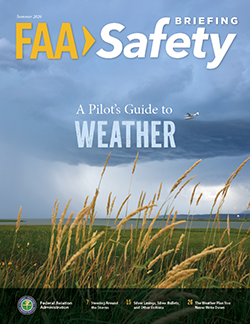
A Pilot's Guide to Weather
The Summer 2026 issue of FAA Safety Briefing magazine focuses on aviation weather and its critical effect on safe GA fly