

Kids' Corner

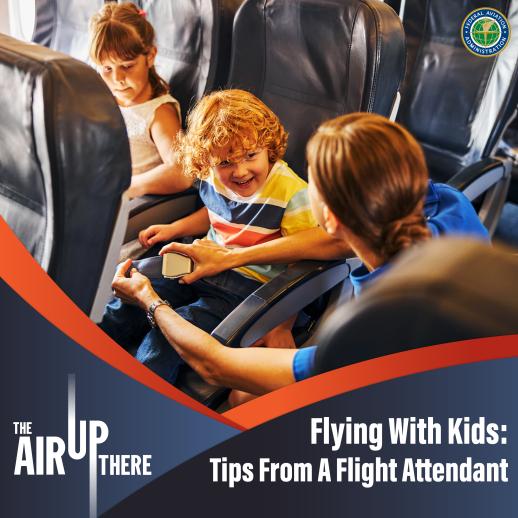
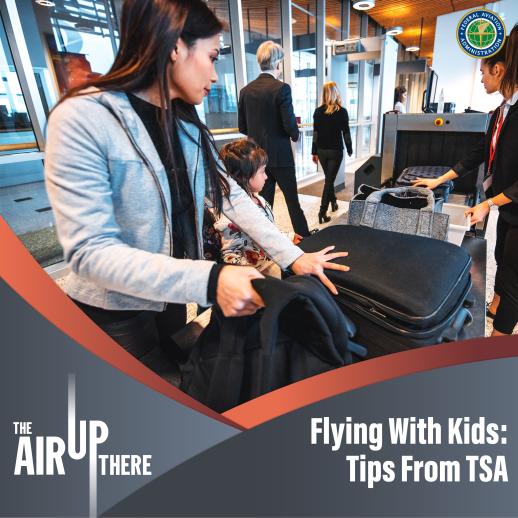
Getting yourself ready for travel is a task all in itself; traveling with kids can seem overwhelming, but it doesn’t have to be with the proper preparation. The FAA has curated a list of key logistics and safety tips to help kids, parents and fellow passengers alike enjoy their flights.
Help Your Children Know What to Expect
Join Cloudy and Skyler as they learn how flights stay safe in our skies.
In this video, our friend Cloudy explains what turbulence is, what pilots and air traffic controllers are doing to avoid it, and what you can do to be safe.
Taking a big trip on an airplane for the first time can be exciting and scary for little ones. Cloudy is here to help your children prepare for this new adventure and know what to expect at the airport and on the flight.
Tips for Parents
The safest place for your child under the age of two on a U.S. airplane is in approved child restraint system (CRS) or device, not in your lap. Your arms aren't capable of holding your in-lap child securely, especially during unexpected turbulence. ‘Unrestrained lap children are prone to in-flight injuries, particularly during meal service or turbulence,’ according to a 2019 study by the National Institutes of Health.
The FAA strongly urges you to secure your child in an approved CRS or other approved device for the entirety of your flight. Buying a ticket for your child is the only way to guarantee that you will be able to use a CRS for your child under two years old. For children two years old and older, if you decide to travel with a CRS, or a CARES device (they are certified for air travel only, see below), ensure it comes with the required label indicating “certified for use in aircraft” and your child’s weight and size do not exceed the manufacturer’s device limits. It's the smart and right thing to do so that everyone in your family arrives safely at your destination. Buckle up your child for the car ride to the airport, on the plane, and when you arrive at your destination.
A child restraint system (CRS) is a forward- or rear-facing hard-backed child safety seat. For motor vehicles, car seats are self-certified by the car seat manufacturer to meet federal safety standards, including strict crash performance standards. The National Highway Traffic Safety Administration (NHTSA) rates car seats based on ease-of-use so you can make an informed decision about the right seat for your child.
A CRS must be certified for use in aircraft. Confirm your child’s seat has “This restraint is certified for use in motor vehicles and aircraft” printed on it or it is approved by a foreign government and bears the required label or marking.
Required label for CRS Manufactured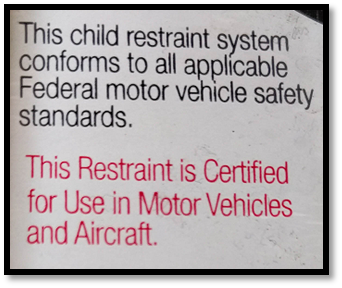 to U.S. Standards
Read the user’s manual to confirm that your CRS can be secured properly in an airplane seat. Otherwise, you may be asked to check the CRS as baggage.
A CRS must be installed in a aircraft seat, according to manufacturer's instructions. This includes placing the CRS in the appropriate forward- or aft-facing direction as indicated on the device label for the size of the child.
The FAA prohibits passengers from using baby carriers, booster seats, or backless CRS during ground movement, take-off, or landing.
AmSafe’s Child Aviation Restraint 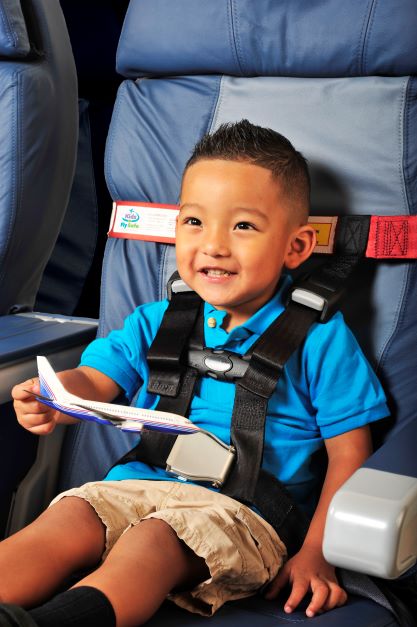 System (CARES) device is FAA-certified for children who are up to 40 inches tall and who weigh between 22 and 44 pounds. The device provides for those who are capable of sitting upright alone in a forward-facing position and who occupy their own seat. This supplemental restraint is used with the existing aircraft seatbelt for improved child safety. CARES is lightweight and adjusts to fit virtually all economy-, business-, and first-class airline seats. This device provides an alternative to using a hard-backed CRS. CARES is approved for use during all phases of flight—movement on the surface (taxi), take-off, landing, and turbulence, and is approved only for use on aircraft, but not for use in motor vehicles. If you're using a CARES device, make sure it has "FAA Approved in Accordance with 14 CFR 21.8(d), Approved for Aircraft Use Only" or "FAA Approved in Accordance with 14 CFR 21.305(d), Amd 21.50 6-9-1980, Approved for Aircraft Use Only" on it.
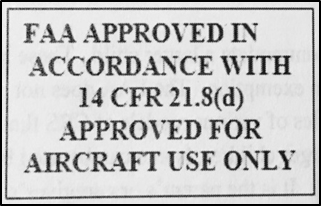
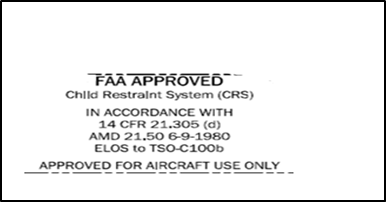
Beware of CARES counterfeits sold online. Buy direct from the manufacturer to be sure the CARES device you use is authentic and manufactured with the same industrial-strength webbing as aircraft seat belts. The FAA is aware of disreputable third-party retailers who offer reproduction devices that resemble CARES for sale but that have not been engineered to the highest aviation-safety standards by AmSafe®. Learn more about CARES.
Although children who have not reached their second birthday are permitted to travel as lap children, the FAA strongly discourages this practice and recommends that you secure your child in an approved CRS in their own seat for the entire flight. While there is no regulatory prohibition from using a lap-held restraining device such as a baby carrier or harness-type vest (or other non-approved devices) during the cruise portion of the flight, airlines have policies which may or may not allow the use of those devices. Check with your airline.
Children Under 18 with Special Needs
Many companies manufacture CRSs approved for use on aircraft that are specifically designed for larger children with physical challenges and who need the support and security of a CRS or device so they can travel safely on an airplane.
Airlines must allow a child who is under the age of 18 to use an approved CRS that is properly labeled and is appropriate for the child’s weight, when the child is properly secured in the CRS.
Adults with Special Needs
Adults (18 years or older) who have physical challenges that require the support and security of a CRS or device in order to travel safely on an airplane may request an exemption to the FAA's regulations that require each passenger to be properly secured by a safety belt. This request may also be made by an airline on the passenger's behalf. Several companies manufacture restraint systems for adults with physical challenges.
How to Submit a Petition for Exemption
- Go to regulations.gov: Instructions on Filing a Submission to the FAA
- Select the "Comment Now!" button
- Enter your comment
- Complete required fields
- Provide contact information
- Select category (i.e., to submit a comment on a Docket, choose "Public Comments(s)")
- To attach files/documentation (as part of your submission), select the "Choose file(s)" button. Once desired file(s) are uploaded, select the "Continue" button
- Select the "Continue" button
- Now you will see the "Your Preview" screen. This shows you how your comment will appear on Regulations.gov
- Read and agree to the disclaimer. To submit your petition/comment, check the disclaimer box for "I read and understand the statement above"
- Select the "Submit Comment" button
To review previously granted exemptions on special needs travel, go to the FAA Dynamic Regulatory System and type "7831", "8264" or "9834" in the "Exemption Number" field and hit "enter" and click on "Apply". Click to view the exemption from the result list.
- Information about Family Travel
- Kids Fly Safe: CARES Child Safety Device
- FAQs: Frequently Asked Questions about Flying with Children
- Passengers with Disabilities
- USDOT Airline Family Seating Dashboard
- Print Child Safety Tips
- Turbulence Explained for Kids
The Air Up There Podcast
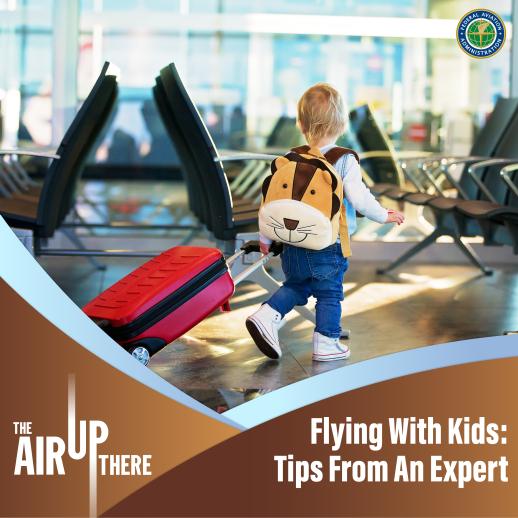
Making plans to fly with your kids? Hear from aviation experts on how to pack your bags and prepare your children for their upcoming aviation adventure.