


Van Nuys Airport (VNY)
Van Nuys Airport (VNY) is a primarily business and general aviation airport located in the city of Van Nuys, California. VNY is situated six miles west of the Hollywood Burbank Airport (BUR), and 15 miles north of Los Angeles International Airport (LAX). The traffic mix consists of general aviation, air-taxi, military, and commercial operations along with multiple flight schools providing both fixed and rotor wing instruction. View a printable Pilot Handbook of the VNY information found on this Web page.
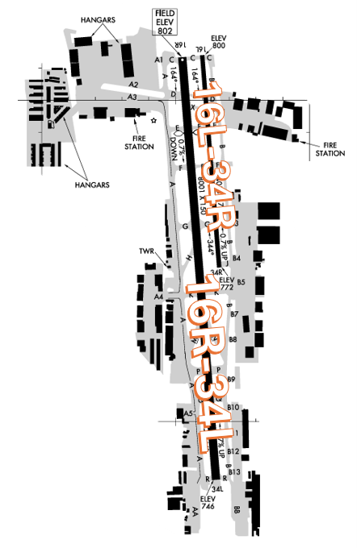
Know Before You Go
VNY Operates: 0600L-2245L
Administrative Office: Open 0700L to 1530L M-F
Business Phone: 818-904-6166
The airport configuration consists of closely spaced parallel RWY’s 16L/34R and 16R/34L.
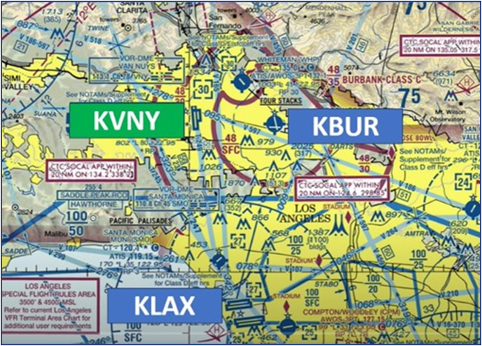
The airspace at VNY is Class D and underlies the Burbank Class C airspace. (Refer to Sectional Chart)
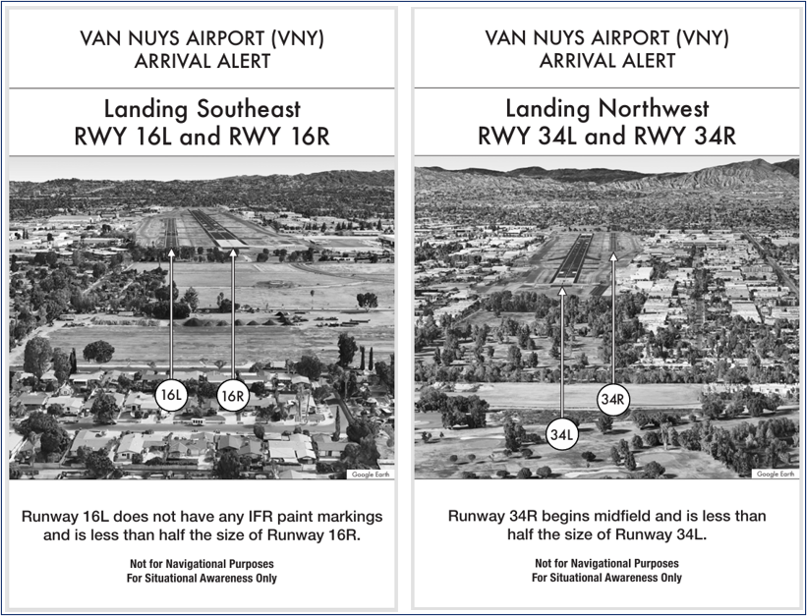
Wrong Surface Landing Risks
- Pilots sometimes confuse RWY 16L/R and RWY 34L/R. See Arrival Alert Notice.
- If available, back up all visual approaches with an instrument approach/GPS Waypoint to help ensure that you are lined up for the correct surface.
- Remember, RWY markings are white. Markings on surfaces not used for takeoff/landing like TWY markings, chevrons, RWY shoulder and RWY turn-on markings etc., are yellow.
- If you are unsure of your position or instructions, ask the controller.
- View the From the Flight Deck-Wrong Surface Landings video for additional mitigation strategies.
Wrong Surface Intersection Takeoff Risks
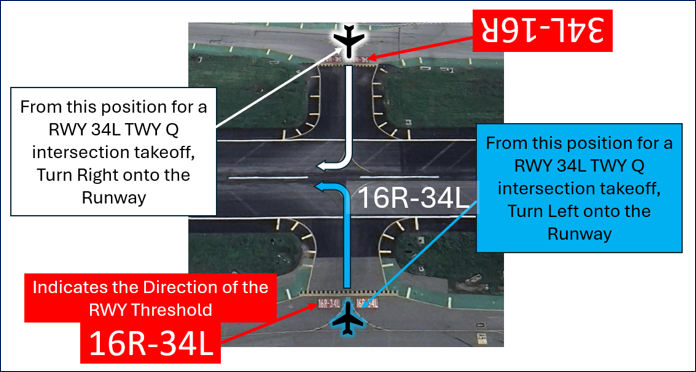
- The most common intersection departures are RWY 16R at TWY D (distance remaining 7350’) and RWY 34L at TWY Q (distance remaining 6500’).
- The illustration below depicts the intersection of RWY 16R/34L at TWY Q (from both sides of the RWY). If approaching the RWY from the opposite direction, the RWY markings will have the numbers reversed.
- Prior to entering the RWY and again when lining up on the RWY, check your Magnetic Compass and your Horizontal Situation Indicator (HIS), if installed, to verify that you are pointed in the correct direction.
- All jet aircraft must use the full RWY length for departure unless otherwise directed by ATC.
- View the From The Flight Deck – Wrong Direction Intersection Takeoffs video for additional mitigation strategies.
Surface Risk – Movement Area Cautions
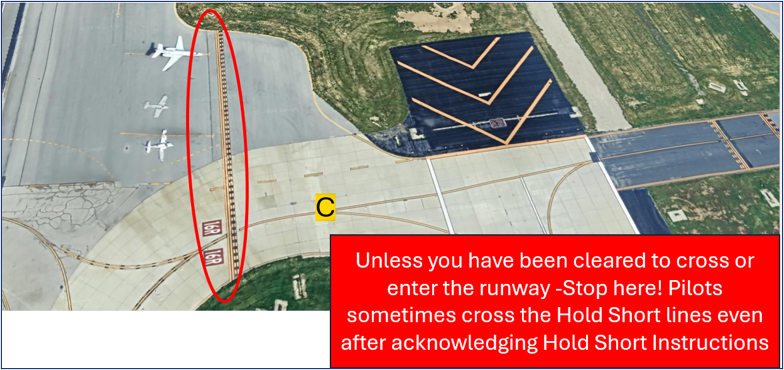
- Pilots instructed to hold short of either runway sometimes cross the holding position markings even after acknowledging the hold short instructions.
- Though this error can occur at any hold short location on the airport, pilots have crossed the RWY 16R hold line at TWY C more frequently.
- Additionally, pilots conducting a run-up in this area need to be aware of the location of the RWY 16R hold line as it extends across the length of the run-up area.
- Surface painted markings and signage are present to indicate where to hold short of the runway.
- Actively scanning to locate and identify RWY signs, markings, lighting and deferring all heads down activities until holding short at the appropriate location will help eliminate these errors.
- If you are unsure of your position or instructions, ask the tower. View the From the Flight Deck – Complex Airfield Geometry#2: Short Taxi Distance From Ramp or Apron To Runway for additional mitigation strategies.
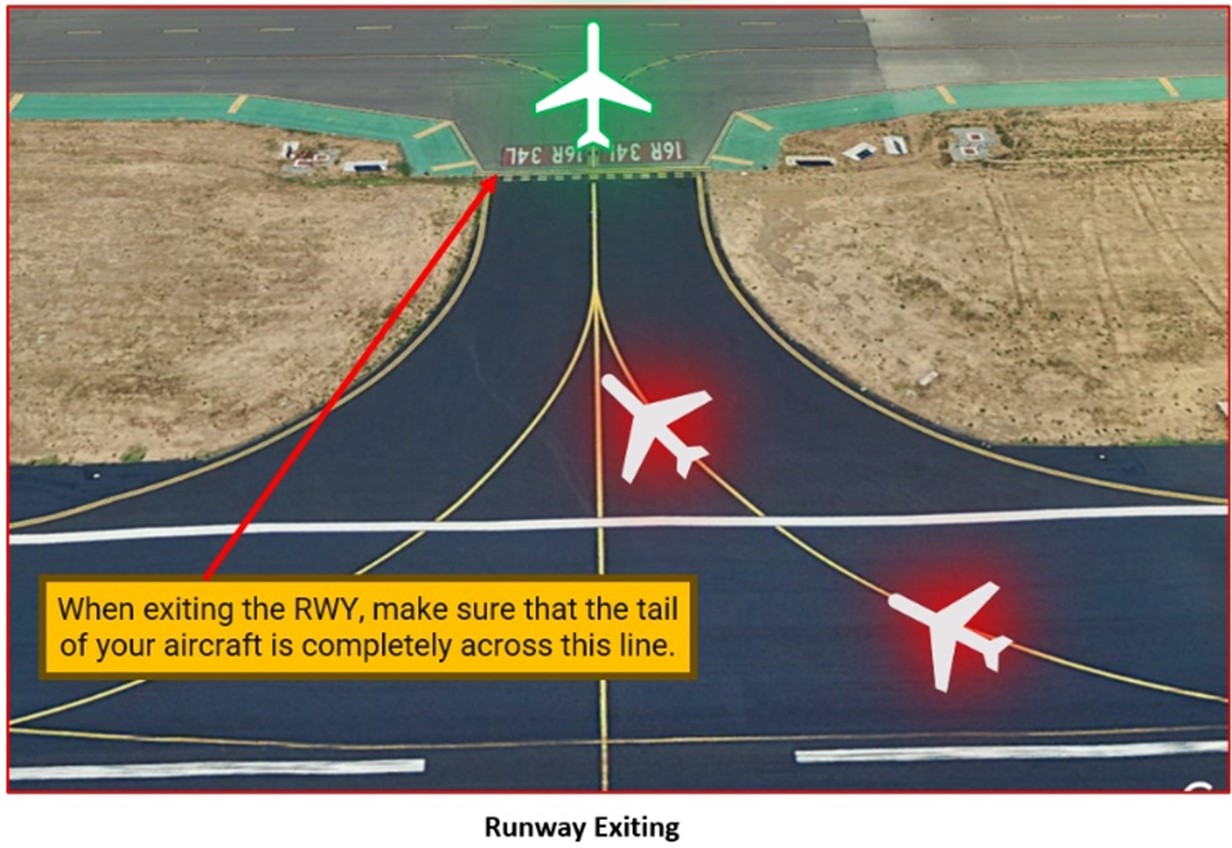
- When exiting a runway, taxi without delay to cross the hold short line in order to clear the runway behind you. Your aircraft is not clear until it is completely across this line.
- A delay in clearing the runway can cause aircraft landing behind you to go around.
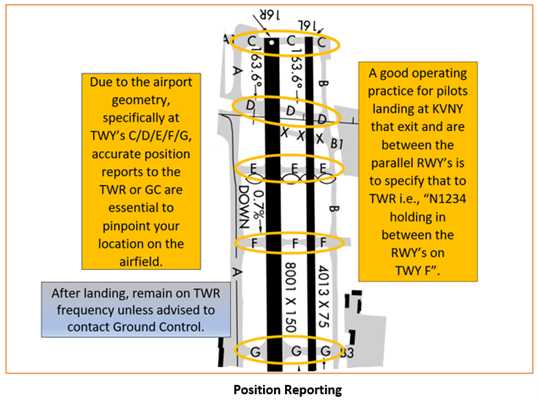
- TWY’s C/D/E/F/G all extend across the parallel runways.
- Accurate position reports are essential when exiting a runway after landing.
- Pay attention to the markings and signage as well as the controller’s instructions.
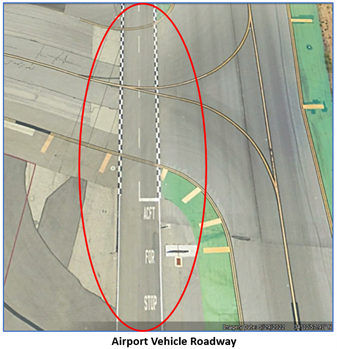 Pilots need to be aware of vehicles operating on the airport vehicle service road.
- Black and white zippered lines or solid white lines identify the roadway.
- Vehicles are instructed to give way to aircraft, but pilots should be aware of these vehicles and always maintain situational awareness while taxiing on the airport surface.
Whiteman Airport (KWHP) Traffic
- Located 4 miles NE of VNY.
- Aircraft departing KWHP to the northeast are not required to communicate with ATC if clear of KWHP or VNY Class D airspace.
- Caution: This traffic may conflict with arrival traffic inbound to VNY 16L/R.
Additional Cautions
- RWY’s 16L/R both have displaced thresholds.
- The portion of RWY behind a displaced threshold is available for takeoffs in either direction or landings from the opposite direction.
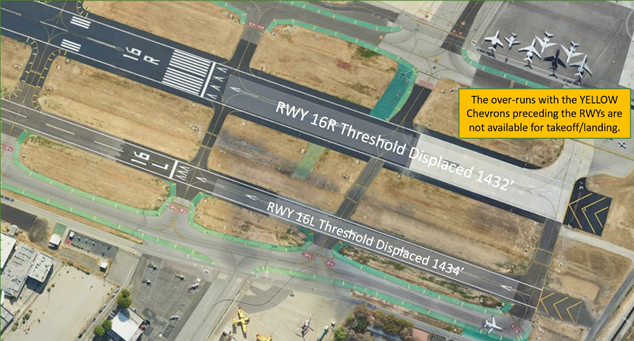
- Bird abatement may occur between runways when TWR is open.
- RWY 16L/34R is closed and unlighted when TWR is closed.
- Helicopters contact TWR for approach/departure routes.
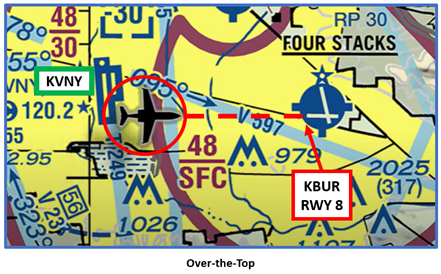
- Due to aircraft on KBUR RWY 8 final receiving TCAS Resolution Advisories, please adhere to Traffic Pattern Altitude and climb gradients.
General
- The VNY airspace is heavily congested.
- Extreme noise sensitive area.
- Remain alert to traffic to the parallel RWY and ensure you do not overfly finals.
- There is no airport sponsored transient parking at VNY.
- Transient parking may be available at the FBO’s near the fuel pit. Contact the FBO in advance for availability and reservations.
Traffic Patterns
- When possible, pattern work will be conducted on RWY 16L/34R.
- Request all early turns and non-standard traffic patterns from the controller.
- VNY is an extremely busy VFR training airport. Be vigilant for student pilots.
- Ensure you remain over your departure runway and do not drift into the departure leg of the parallel RWY.
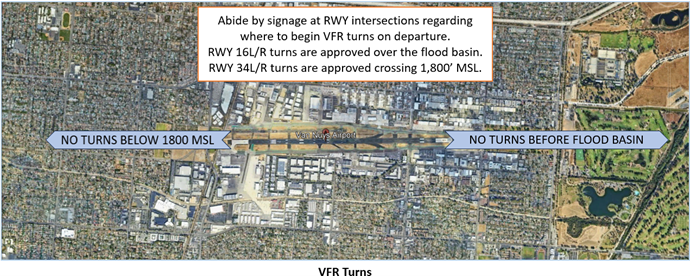
- Aircraft operating in the pattern at VNY should be extremely vigilant to maintain the correct altitude while operating in the VFR Traffic Pattern.
- Base-to-final turns need to be made so as to not cross the extended centerline for the assigned RWY. Overshooting final could result in a conflict with aircraft landing on the parallel RWY.
- East Traffic Pattern Altitude 1800 MSL.
- West Traffic Pattern Altitude 2000 MSL (VFR aircraft departing west of VNY up to 2500 MSL).
Runway Crossings
- Read back all hold short instructions with your callsign in the same transmission.
- Use caution not to inadvertently cross the parallel RWY after landing.
- After landing while holding short of the parallel RWY, remain on the TWR controller’s frequency unless you have been advised to contact Ground Control.
Takeoff/Departure
- Be vigilant of helicopter routes east and west of centerlines at 500’ AGL.
- Jet aircraft assigned RWY 16R via TWY A, ensure that you pull up to the hold bars so other aircraft may enter the runup area.
- Fix crossing restrictions will not be waived.
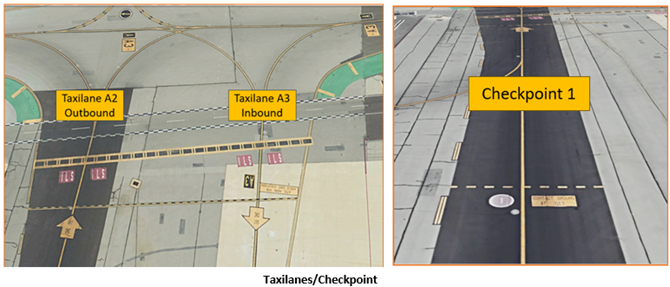
- Taxi lanes (TXL) A2 and A3 are not controlled by ATC.
- TXL A2 used for eastbound taxiing only – one way traffic, follow yellow arrows.
- TXL A3 used for westbound taxiing only – one way traffic, follow yellow arrows.
On-pavement markings outbound on TXL A2 identify Checkpoint 1. Pilots are requested to call for taxi clearance just prior to reaching this location. (See above illustration)
VFR Reporting Points
- Familiarity with VFR Reporting Points, found on the VFR Sectional Chart, will help TWR with traffic sequencing. Commonly used reporting points:
- Cal State Northridge,
- VA Hospital,
- Sepulveda Flood Basin,
- Northridge Mall.
- If you are not familiar, or cannot find these Reporting Points, advise TWR for alternate instructions.
Arrival/Landing
- The Newhall Pass is a high-density traffic area with VFR aircraft transiting northbound and southbound, hang gliders operating north of the pass and a continuous flow of IFR arrivals descending via the ILS RWY 16R approach to VNY.
 Additional Information
- Use caution for over-the-top aircraft on final approach course for KBUR ILS RWY 8. VNY is not in radio communication with these aircraft.
- Use caution for wake turbulence.