


Frequently Asked Questions
Find answers to your FAA questions.
You must complete FAA Form 8400-3. For additional information, email our Civil Aviation Registry.
You must complete FAA Form 8400-3. For additional information, email our Civil Aviation Registry.
The UPP results are expected to provide an understanding of the level of investment required for implementation of the UTM ecosystem. Upon completion, the FAA will evaluate the results and determine the appropriate next steps.
Still can't find what you are looking for? Please feel free to contact the UAS Support Center for general questions and comments.
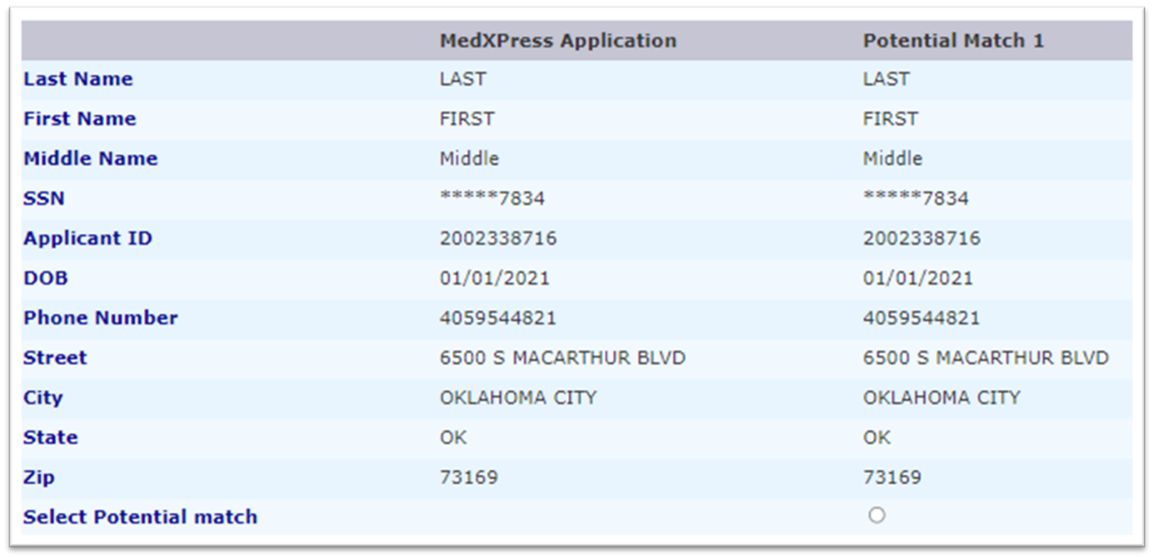
When importing an application from MedXPress to AMCS, your selection determines how that exam enters the FAA’s medical record system. Does the application belong to an existing applicant or is this a first-time applicant? This is usually straightforward; however, because of data entry errors on the application (i.e. transposed names) and/or the use of pseudo Social Security Numbers, it requires a little time for validation.
To help you make an accurate selection, AMCS compares the information from the MedXPress application to records in the FAA medical database (column heading Potential Match). The Import Application screen displays this data in columns. Any mismatches display in red text. You must verify the name and date of birth match. Due to the frequent use of system-generated pseudo SSNs, the SSN will often NOT match. The phone number and address are displayed to provide extra data elements. If you are not sure how to proceed or if you see an error, contact AMCSsupport@faa.gov before you import the application.
Under Title 14 of the Code of Federal Regulations (14 CFR) Part 1, the Federal Aviation Administration (FAA) defines a medical certificate as "acceptable evidence of physical fitness on a form prescribed by the Administrator." The primary goal of the airman medical certification program is to protect not only those who would exercise the privileges of a pilot certificate but also air travelers and the general public.
A person who meets FAA airmen medical standards, based on a medical examination and an evaluation of medical history, is entitled to a medical certificate without restriction or limitation other than the prescribed limitation as to its duration. Individuals required to hold a medical certificate must have it in their personal possession at all times when exercising the privileges for which they are licensed.
A sport pilot certificate allows pilots to operate light-sport aircraft. The medical requirements to use this certificate can be met by either a third class medical certificate or a U.S. driver's license. Restrictions may apply.
You can find more information about sport-pilot certification and light-sport aircraft on our website.
If an airman chooses not to use their true Social Security Number (SSN) on an FAA medical application, a pseudo SSN will be assigned. This happens very frequently, so the SSN is not a reliable search method in AMCS.
ADS-B (Automatic Dependent Surveillance-Broadcast) provides real-time precision and shared situational awareness to pilots and air traffic controllers. It's a foundational NextGen technology. U.S. aircraft must be equipped with ADB-B by January 1, 2020. ADS-B is a Part 91 regulation, and most small UAS or drones operate under Part 107. Some type of remote ID may be required in the future, but how the system would work and the requirements has not been finalized.
Still can't find what you are looking for? Please feel free to contact the UAS Support Center for general questions and comments.
You can find information about clear titles on our website.
Response by the Federal Air Surgeon
Provided you meet the requirements and you are qualified to exercise sport pilot privileges using a current and valid U.S. driver's license, you may do so on September 1, 2004, the effective date of the rule.
Your FAA-designated physician examiners (AMEs) use the AME Guide to decide if they can give you a medical certificate. Check the disposition table for any health issues you have so you know what information or records to bring to your AME exam: https://www.faa.gov/ame_guide
In the U.S., there are no FAA age limits for pilots except for commercial airline pilots employed by airlines certificated under 14 CFR Part 121. These airlines cannot employ pilots after they reach the age of 65.
However, these pilots may stay on with a Part 121 carrier in some other role, such as flight engineer. They can also fly for a company that is not a Part 121 carrier.
The purpose of the UPP is to demonstrate the integration of a prototype enterprise service into the FAA framework to support initial UAS traffic management (UTM) operations. This enterprise service will be used for sharing of intent and situational awareness information between the FAA and UTM operators.
Still can't find what you are looking for? Please feel free to contact the UAS Support Center for general questions and comments.
The following conditions are listed in the regulations as disqualifying medical conditions; however, in many cases when the condition is adequately controlled, the FAA will issue medical certification contingent on periodic reports.
- Angina pectoris
- Bipolar disease
- Cardiac valve replacement
- Coronary heart disease that has been treated or, if untreated, that has been symptomatic or clinically significant
- Diabetes mellitus requiring hypoglycemic medications
- Disturbance of consciousness without satisfactory explanation of cause
- Epilepsy
- Heart replacement
- Myocardial infarction
- Permanent cardiac pacemaker
- Personality disorder that is severe enough to have repeatedly manifested itself by overt acts
- Psychosis
- Substance abuse
- Substance dependence
- Transient loss of control of nervous system function(s) without satisfactory explanation of cause.
Other conditions not specifically listed in the regulations are also disqualifying. For further information refer to the Guide for Aviation Medical Examiners.
The medical standards for each class of medical certificate are set forth in 14 CFR Part 67.
If the UAS or drone you are operating weighs less than 55 pounds, you may apply for a Part 107 waiver to conduct your operation. If your operation involves a UAS or drone that weighs 55 pounds or more, you may apply for an exemption under the Special Authority for Certain Unmanned Systems (U.S.C. 44807).
Still can't find what you are looking for? Please feel free to contact the UAS Support Center for general questions and comments.
You must have the validity of the foreign license and medical certificate or endorsement you hold verified by the Civil Aviation Authority that issued those certificates.
The FAA has devised a form entitled Verification of Authenticity of Foreign License, Rating, and Medical Certification (PDF). You must submit this information, along with a copy of the license you wish to have verified, to:
Airmen Certification Branch
AFS-760
PO Box 25082
Oklahoma City, OK 73125-0082
For more detailed information you should review the information available at the following links:
If you have asthma and are planning to undergo an examination with an Aviation Medical Examiner (AME), start with the Asthma Disposition Table to identify generally what information you should bring to your AME:
- A detailed clinical progress note from your treating physician regarding your history of asthma that addresses history, dates of treatment (including exacerbations leading to hospitalization) over the past 12 months, treatment plan, current medications (dosage, frequency of use, and side effects), prognosis.
- The results of a current pulmonary function test (PFT).
Please note, if your only treatment for asthma is a Short Acting Beta Agonist (SABA) such as albuterol or levalbuterol used only 1-2 times per week, a pulmonary function test is not required, unless deemed necessary by your treating physician. Please ensure your treating physician clearly states the name of all medications and the frequency of use in your detailed clinical progress note.
The FAA requires you to update your program registration, LOA, or Operations Specification when the following information changes:
- Company name
- Certificate number
- Telephone number
- Address where your drug and alcohol testing program records are kept
- Type of safety-sensitive functions you or your employees perform
- Whether your safety-sensitive employee count changes from 50 or more to 49 or fewer)
To make changes to your Operations Specification, please contact your FAA Principal Operations Inspector (POI) or Principal Maintenance Inspector (PMI). To make changes to your LOA, please contact the Flight Standards District Office (FSDO) who issued your LOA and provide the updated information. To change the information on your program registration, please submit your amended registration form to the Drug Abatement Division at drugabatement@faa.gov.
If you have any further questions or need additional guidance that is more specific to your situation, please contact the FAA’s Drug Abatement Division at (202) 267-8442 or drugabatement@faa.gov.
Please visit our website to learn more about the program.
Applicable Regulations:
You need a medical certificate before flying solo in an airplane, helicopter, gyroplane, or airship. We suggest you get your medical certificate before beginning flight training. This will alert you to any condition that would prevent you from becoming a pilot before you pay for lessons.
If you are going to pilot a balloon or glider, you don't need a medical certificate. All you need to do is write a statement certifying that you have no medical defect that would make you unable to pilot a balloon or glider.