


Frequently Asked Questions
Find answers to your FAA questions.
The UPP results are expected to provide an understanding of the level of investment required for implementation of the UTM ecosystem. Upon completion, the FAA will evaluate the results and determine the appropriate next steps.
Still can't find what you are looking for? Please feel free to contact the UAS Support Center for general questions and comments.
You may retake the test after 14 days.
Still can't find what you are looking for? Please feel free to contact the UAS Support Center for general questions and comments.
We know you may get disconnected during the time of transmission, so we have designed AMCS to minimize data loss. AMCS will store the information that has been validated. In the event you are disconnected when using AMCS, you will find the exam and the data that had been previously entered when you next sign in to AMCS.
Specific help for information to be entered on the application can be found by clicking any item row marked with a "+" or the 8500-8 Instructions link (available on each page of the form and under the Help menu). Clicking either of these will bring up additional information for completing the application. You should make every attempt to complete the form to the best of your ability. If you are unsure of the information that is to be entered on the form, consult your AME at the time of your exam. Your AME will be able to make corrections to the information that you provide.
If you forget your password, you can click the "Forgot Password" link on the FAA MedXPress Login page and follow the instructions. You will be required to enter your e-mail address and answer your three security questions. A new temporary password will be sent to your e-mail account.
When importing an application from MedXPress to AMCS, your selection determines how that exam enters the FAA’s medical record system. Does the application belong to an existing applicant or is this a first-time applicant? This is usually straightforward; however, because of data entry errors on the application (i.e. transposed names) and/or the use of pseudo Social Security Numbers, it requires a little time for validation.
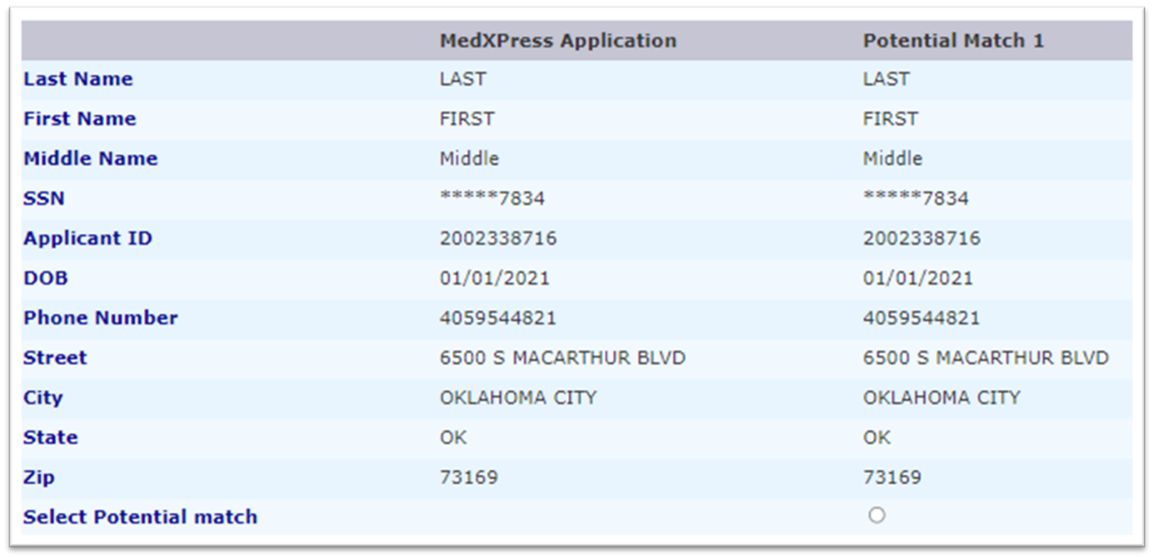
To help you make an accurate selection, AMCS compares the information from the MedXPress application to records in the FAA medical database (column heading Potential Match). The Import Application screen displays this data in columns. Any mismatches display in red text. You must verify the name and date of birth match. Due to the frequent use of system-generated pseudo SSNs, the SSN will often NOT match. The phone number and address are displayed to provide extra data elements. If you are not sure how to proceed or if you see an error, contact AMCSsupport@faa.gov before you import the application.
A “roundtable” in the aviation context is generally a term for an organization designed to address community concerns over a sustained period of time regarding aircraft operations often associated with a nearby airport. Roundtables are typically made of representatives from communities around an airport that may be affected by aircraft operations, the airline industry, and other stakeholders. These representatives often serve in an advisory role or on technical committees and working groups and can offer additional perspectives and expertise.
A roundtable brings together airport, community, and airline industry representatives to collaboratively identify and discuss issues of concern and possible resolutions at the same time. Representatives may elect to make recommendations, including possible changes in operations, to address community noise or other concerns. Ideally, applicable recommendations are first coordinated through the airport, which will forward them to the appropriate entity (e.g., the FAA, airlines, or zoning authority).
To learn more, please visit Community Roundtable Information Sheet
Under Title 14 of the Code of Federal Regulations (14 CFR) Part 1, the Federal Aviation Administration (FAA) defines a medical certificate as "acceptable evidence of physical fitness on a form prescribed by the Administrator." The primary goal of the airman medical certification program is to protect not only those who would exercise the privileges of a pilot certificate but also air travelers and the general public.
A person who meets FAA airmen medical standards, based on a medical examination and an evaluation of medical history, is entitled to a medical certificate without restriction or limitation other than the prescribed limitation as to its duration. Individuals required to hold a medical certificate must have it in their personal possession at all times when exercising the privileges for which they are licensed.
A Metroplex is a geographic area that includes several airports, serving major metropolitan areas and a diversity of aviation stakeholders such as National Airspace System users, the FAA, businesses, and airport operators. Congestion, airport activity in close geographical proximity, and other limiting factors, such as environmental constraints combine to reduce efficiency at busy Metroplex sites.
The FAA and aviation experts analyze the operational challenges of Metroplexes and explore opportunities to optimize airspace and procedures. To learn more about Metroplexes, please visit the Metroplex page.
A noise abatement procedure is a procedure used by aircraft at an airport to minimize the impact of noise on the communities surrounding an airport.
Visit the Airport Noise Compatibility Planning page to learn more.
Noise models are computer models used to predict the levels of aircraft noise exposure produced over a geographic area. Noise models are used to efficiently and accurately evaluate aircraft noise including assessing the potential noise impacts resulting from changes in aircraft operations.
The Aviation Environmental Design Tool (AEDT) is the FAA's required noise and environmental modeling application for all U.S. domestic regulatory analyses requiring FAA review. AEDT replaces several legacy environmental modeling tools, including the Integrated Noise Model (INM), the Noise Integrated Routing System (NIRS) and the Emissions Dispersion Modeling System (EDMS).
A sport pilot certificate allows pilots to operate light-sport aircraft. The medical requirements to use this certificate can be met by either a third class medical certificate or a U.S. driver's license. Restrictions may apply.
You can find more information about sport-pilot certification and light-sport aircraft on our website.
If an airman chooses not to use their true Social Security Number (SSN) on an FAA medical application, a pseudo SSN will be assigned. This happens very frequently, so the SSN is not a reliable search method in AMCS.
ADS-B (Automatic Dependent Surveillance-Broadcast) provides real-time precision and shared situational awareness to pilots and air traffic controllers. It's a foundational NextGen technology. U.S. aircraft must be equipped with ADB-B by January 1, 2020. ADS-B is a Part 91 regulation, and most small UAS or drones operate under Part 107. Some type of remote ID may be required in the future, but how the system would work and the requirements has not been finalized.
Still can't find what you are looking for? Please feel free to contact the UAS Support Center for general questions and comments.
An Environmental Assessment (EA) is a concise public document that provides sufficient evidence and analysis for determining whether to prepare an Environmental Impact Statement (EIS) or a Finding of No Significant Impact (FONSI). The purpose of an EA level of review is to determine whether a proposed action has the potential to significantly affect the human environment. If none of the potential impacts assessed in the EA are determined to be significant, the responsible FAA official prepares a FONSI, which briefly presents, in writing, the reasons why an action, not otherwise categorically excluded, would not have a significant impact on the human environment.
EIS is an acronym for Environmental Impact Statement. An EIS is a clear, concise, and appropriately detailed document that provides the agency decision makers and the public with a full and fair discussion of the significant environmental impacts of the Proposed Action and reasonable alternatives.
An EIS is a detailed written statement required under NEPA when one or more environmental impacts would be significant and mitigation measures cannot reduce the impact(s) below significant levels. Direct, indirect, and cumulative impacts must be considered when determining significance.
Visit the Best Practices for Environmental Impact Statement (EIS) Management page to learn more.
An environmental review is the process of reviewing a project and its potential environmental impacts to determine whether it complies with the National Environmental Policy Act (NEPA) and related laws and authorities.
Environmental reviews are a critical element in FAA's efforts to manage airspace capacity and change aircraft routing while ensuring that environmental impacts, enhancements, and protection considerations are fully and properly analyzed. We provide environmental reviews for all of FAA's airspace redesign and procedure development projects concerning air space use and air traffic. Visit the Environmental Reviews page to learn more.
An unmanned aircraft system is an unmanned aircraft and the equipment necessary for the safe and efficient operation of that aircraft. An unmanned aircraft is a component of a UAS. It is defined by statute as an aircraft that is operated without the possibility of direct human intervention from within or on the aircraft (Public Law 112-95, Section 331(8)).
Still can't find what you are looking for? Please feel free to contact the UAS Support Center for general questions and comments.
The FAA recognizes that the current process needs to be streamlined to allow for more rapid access to the NAS.
Still can't find what you are looking for? Please feel free to contact the UAS Support Center for general questions and comments.
A Categorical Exclusion (CATEX) level of NEPA review is applicable for an established list of actions that do not, individually or cumulatively, have a significant impact on the environment. Additionally, the CATEX analyzes for the potential for extraordinary circumstances that could require more detailed NEPA review.
To find out more about FAA NEPA procedures, visit the Airport Environmental Review Process page.