


NAS Innovation and Emerging Concepts - Laboratory Capabilities
The NAS Innovation and Emerging Concepts (NIEC) Functional Block Diagram, represented in the graphic below shows the building blocks of the NIEC. The light blue area shows the NIEC's core capabilities. The tan area within the light blue area, represents the NIEC's multi purpose area, which has live data feeds Automatic Dependent Surveillance–Broadcast (ADS-B), Traffic Flow Management (TFM), and weather) and a research Traffic Management Unit consisting of Time Based Flow Management (TBFM) and TFM. The medium blue area within the light blue area represents the Distributed Environment for Simulation, Rapid Engineering, and Experimentation (DESIREE) a simulation platform for Air Traffic Control (ATC) ground systems. The green area represents the Research & Development Operating Environment (RDOE) Network, which connects to external facilities and networks such as Defense Research and Engineering Network and System Wide Information Management's (SWIM) NAS Enterprise Messaging Service (NEMS). The pink area provides some of the external facilities that the NIEC can connect to via the RDOE Network. The purple area highlights the Concepts and System Integration (CSI) Research & Development (R&D) labs. The orange area showcases some of the internal Technical Center labs that the NIEC is connected with. The gray area highlights the Target Generation Facility (TGF) simulation capabilities for aircraft, pilots, radar, and ADS-B.
NIEC Characteristics Include:
- A real-time, rapid prototyping and simulation environment that simulates the NAS while integrating new technologies components
- Representation and integration across multiple NAS domains in one facility
- Inclusion and integration of future capabilities
- Technical Center and external laboratory integration capabilities
- Voice Communications capabilities
- Audio, video, and data recording capabilities
- Flexibility to support multiple concurrent studies
- Certified ISO 9001:2015 laboratory
Simulation Engines
TGF
- The TGF is a cross-cutting infrastructure that is capable of simulating air and ground traffic.
- The TGF can drive terminal and en route laboratories as well as developmental laboratories.
DESIREE
- DESIREE provides an Air Traffic automation simulation capability
- Emulates the Graphical User Interface and logic processing used in most ATC systems.
- Able to interface with other NAS systems for inclusion within the simulation environment
- User Interface prototyping of Data Communications functionality
- Support for Area Navigation (RNAV) program, and associated conformance monitoring
- All standard ATC symbology and functionality, e.g. Halos, history tracks, Conflict Alerting
- Expanded Data collection capability
- Support for Supervisor Station including TFM emulation
These simulators work together to immerse the subject into a realistic environment that can emulate the past, present, or future air traffic environments.
Data Collection Capabilities
The NIEC has world-class data collection capabilities for simulations such as:
- Audio, video, and data recordings
- Communications (e.g., the average duration of air-ground communications, communication between controller and pilots)
- Air traffic safety and efficiency parameters (e.g., number of aircraft in the sector)
- Workload ratings (using the Air Traffic Workload Input Technique via the Workload Assessment Keypad device)
- User-system interaction (e.g., number of data entry errors)
- Performance monitoring
| Name | Description | Supplier |
|---|---|---|
| WMSCR | The Weather Message Switching Center Replacement System (WMSCR) collects, processes, stores, and disseminates textual aviation weather products such as pilot reports and Altimeter data. | SWIM R&D NEMS |
| STDDS | SWIM Terminal Data Distribution System (STDDS) provides surface movement data Airport Surface Detection Equipment–Model X (ASDE-X), Runway Visual Range, and a variety of departure event data | SWIM R&D NEMS |
| ITWS | Integrated Terminal Weather System (ITWS) provides a variety of weather information in graphic and textual forms, such as windshear and microburst predictions, storm cell and lightning information, and terminal area winds aloft | SWIM R&D NEMS |
| TFMS | Traffic Flow Management System (TFMS) will provide Aircraft Situation Display (ASDI) data, which will include aircraft scheduling, routing, and positional information | SWIM R&D NEMS |
| SFDPS | SWIM Flight Data Publication Service (SFDPS) will provide a variety of En Route flight data, such as flight plans, beacon codes, and handoff status. SFDPS will also disseminate data regarding airspaces, such as Sector configuration data, route status, Special Activity Airspace status, and altimeter settings. | SWIM R&D NEMS |
| TBFM | TBFM will provide a variety of aircraft metering information, airport configuration, and adaptation data. | SWIM R&D NEMS |
| ADS-B | ADS-B is a precise satellite-based surveillance system. ADS-B Out uses GPS technology to determine an aircraft's location, airspeed and other data, and broadcasts that information plus weather and traffic position information. | Surveillance Broadcast Services Laboratory |
| TFM | The system receives information about scheduled flights, forecasts demand several hours ahead, and helps resolve congestion issues. | TFM Production Center |
| ITWS | Integrated Terminal Weather System (ITWS) Situation display is a legacy system at terminals that provides weather products such as 6-level precipitation out to 200 nm, storm motion, one-hour convective forecast, wind shear, microbursts, etc. | Weather Engineering & Evaluation Branch |
| WARP | Weather and Radar Processor (WARP) is a briefing terminal for En Route weather. | Weather Engineering & Evaluation Branch |
| CoSPA | Consolidated Storm Prediction for Aviation (CoSPA) combines Corridor Integrated Weather System (CIWS) products, ITWS, Convective Significant Meteorological Information, and other weather forecast products for forecasts of convective storms out to 6 hours. | Weather Engineering & Evaluation Branch |
| CSS-Wx | Common Support Services–Weather (CSS-Wx) will modernize, centralize and streamline the distribution of weather within the NAS. CSS-Wx will replace NEMS-based Service-Oriented Architecture Services existing data feeds from ITWS, CIWS, Enhanced Weather Information Network Server Dissemination, WMSCR, and WARP | Weather Engineering & Evaluation Branch |
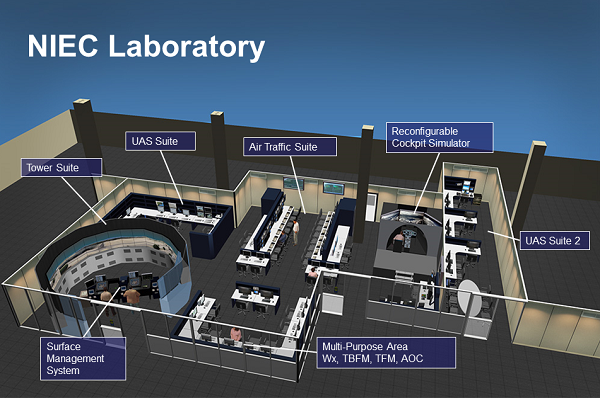
NIEC 3D View Layout
Capabilities of the Five Areas of NIEC
The tower suite consists of the 300-degree, out-the-window view and the surface management system.
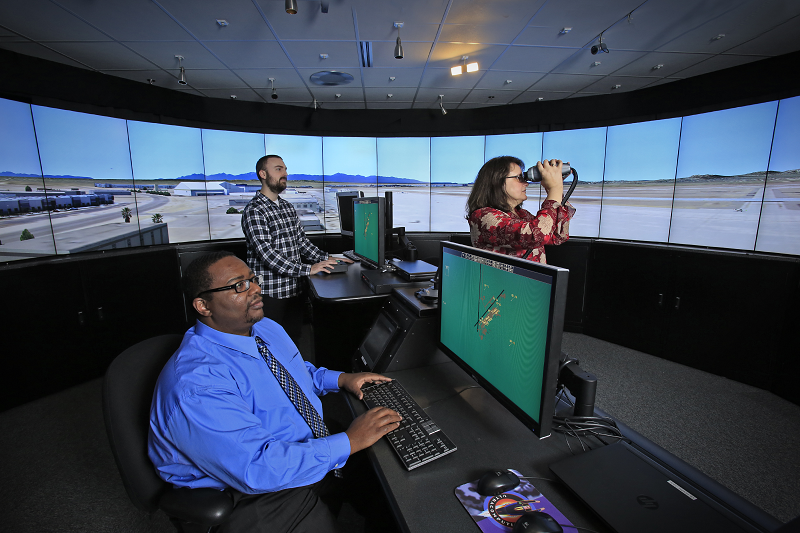
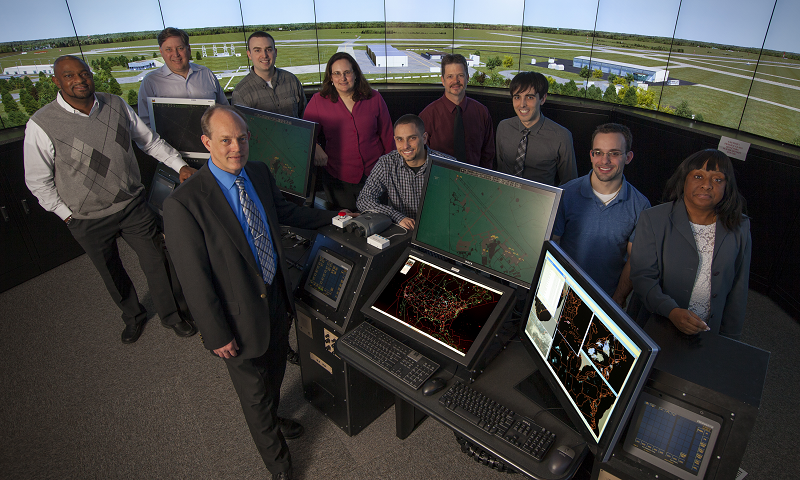
- Surface Management System
The surface management system has emulations of the ASDE-X and Standard Terminal Automation Replacement System (STARS) Tower Display provided by DESIREE. - Virtual Airport Immersion System (VAIE)
The VAIE contains a 300 degree, out-of-the-window view. It is a highly extensible 3D rendering solution for the TGF's high-fidelity air-traffic simulator. The VAIE uses TGF's internally developed DANSIG image generator software which was built from the ground up to be modular and easily customizable. DANSIG uses advanced rendering techniques to efficiently handle many scene lights that produce highly realistic lighting effects that interact with the terrain and other aircraft in the scene.- DANSIG system used for rendering of aircraft and airports.
- Aircraft and Ground vehicle motion projected to a WGS84 coordinate system using TGF's internal algorithms.
- Real-time ephemeris calculations for sky color, lighting conditions, starfield, etc. using SilverLining.
- Real-time shadow rendering based on calculated sun/moon position.
- Real-time aircraft lighting (navigation, taxi, landing, etc.) that affects the environment.
- Real-time weather effects (snow/rain, fog, clouds).
- Particle-system based special effects (fire, smoke, etc.).
The Unmanned Aircraft Systems (UAS) Modeling and Simulation (M&S) capability currently includes UAS ground control workstation simulators, a 4-Dimensional Trajectory enabled Flight Management System simulator, a voice communications simulation platform, ADS-B/radar surveillance, and weather workstations. The UAS M&S capability components interact with systems that are part of the NIEC, including the ATM suite.
The UAS M&S capability also includes fast-time simulation platforms, such as the UAS-NAS integrated model RAMS+/CASTS and Analytical Graphics Satellite Tool Kit.
The UAS currently includes a General Atomics MQ-9 Predator B, Textron AAI Shadow-200, Boeing Insitu ScanEagle, Northrop Grumman Global Hawk, Vigilant Spirit Unmanned Aerial Vehicle Ground Control Software, and a Firescout ground control simulator.
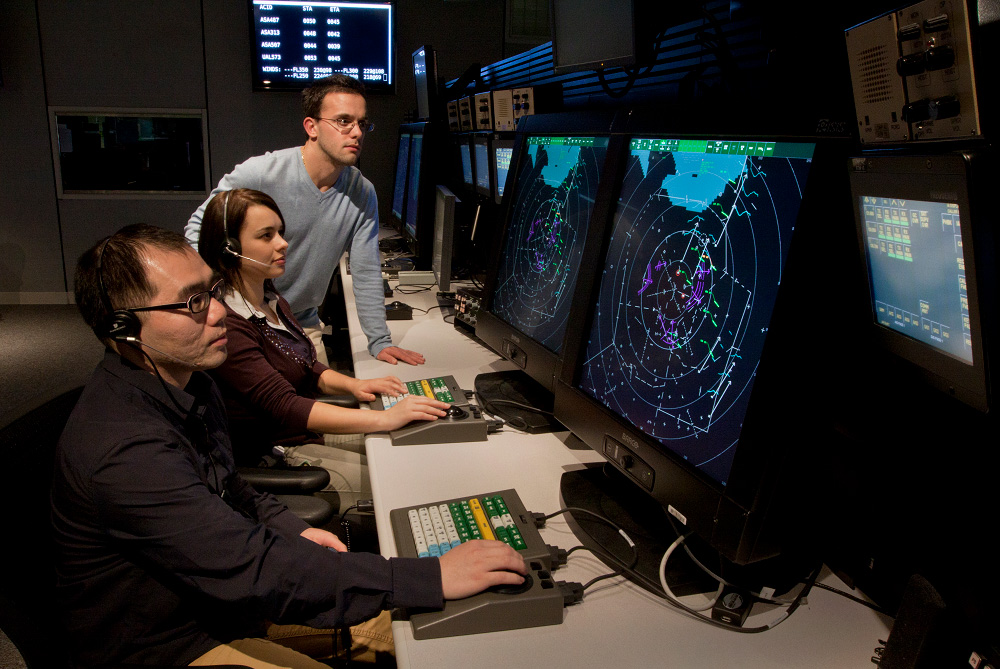
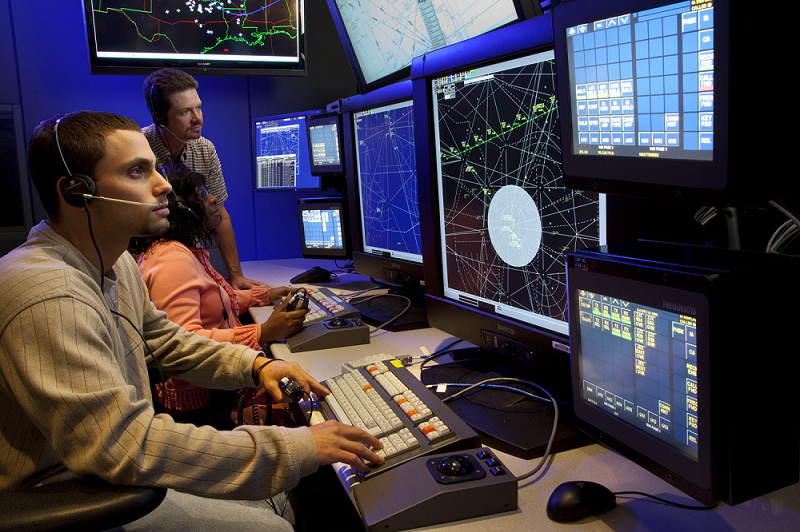
The NIEC contains a reconfigurable ATC suite. It can model up to eight Air Traffic Sectors driven by DESIREE. The stations are reconfigurable, and can be brought up as either Terminal (STARS) or En Route (ERAM) R&D positions. Each position can interact standard fielded ATC peripherals — STARS keyboard/Trackball, STARS Knobs, ERAM Keyboards, DAC, etc. All ATM positions have associated voice communication, push-to-talk equipment.
The reconfigurable cockpit simulator (RCS) is currently set up as an Airbus A-320 series aircraft, but is fully reconfigurable with other aircraft as needed. It has a state-of-the-art touch screen cockpit panel layout with integrated hardware controls that allows pilot commands for inputting and executing commands to the aircraft. The RCS has a full size cockpit layout with crew positions for operating transport category aircraft.
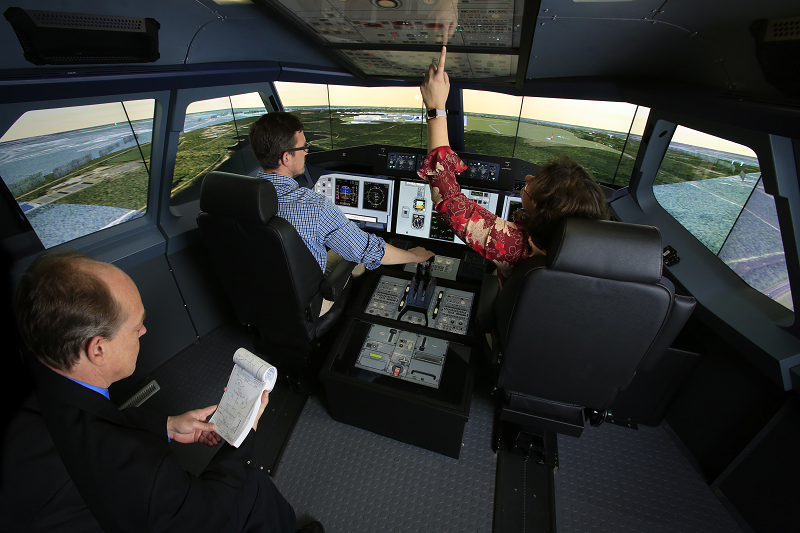
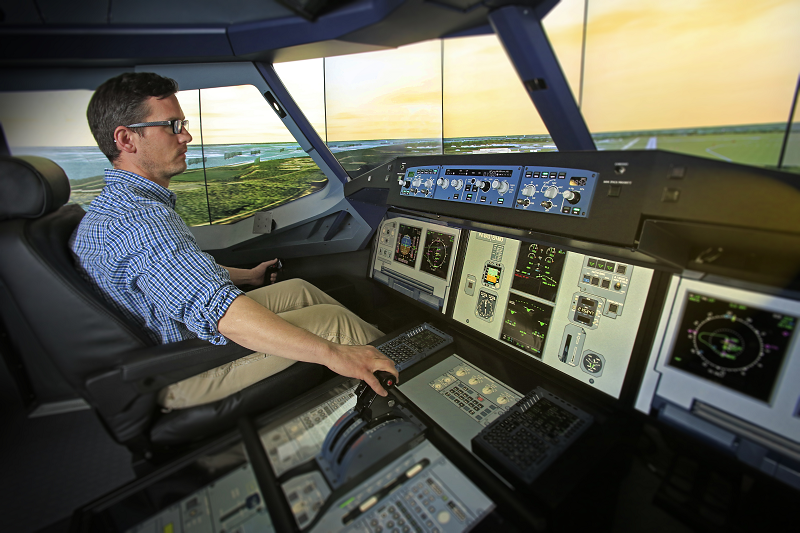
- On-board instructor and observer seating.
- A visual system that provides a 200-degree field of view for simulator pilots operating the aircraft.
- An on-board video camera system that allows outside observers to view cockpit events and surroundings as well as record the flight history.
- Integrated voice communications enables cockpit communications with TGF Simulator pilots as well as with ATC controllers.
- Full aircraft integration with the NIEC tower and ATM suite displays allowing viewing of the aircraft on the runway and in-flight.
- A Flight Management System that allows programming of takeoff runways, departures, en route fixes, arrivals, and landing approaches for the runways in the database.
The multi-purpose area can be used to display weather data, traffic management data, operate as a simulation monitoring station or simulate an airline operations center. The multi-purpose area is where the live data feeds are displayed.

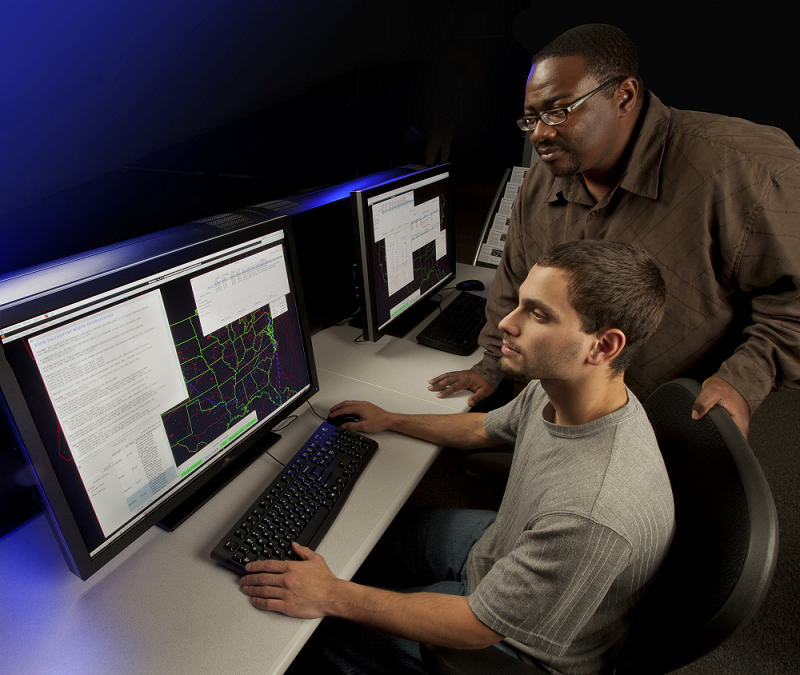
The NIEC receives its weather data from the Weather Engineering & Evaluation Branch. The NWEC supplies weather briefing terminals:
- WARP
- ITWS Situation display
- CoSPA
The NWEC also supplies the NIEC with recorded storm data for use in simulations and demonstrations.
The NIEC receives live air traffic data from TFM Production Center and live ADS-B data from the ADS-B laboratory.
Writeup on generic Airline Operations Capability / dispatch (PDF, 27 KB)
Writeup on NIEC's Research and Development Traffic Flow Management (TFMS) Application Platform (TAP) (PDF, 23 KB)