

First Flight in America
The first flight in America didn’t take place at Kitty Hawk in 1903.
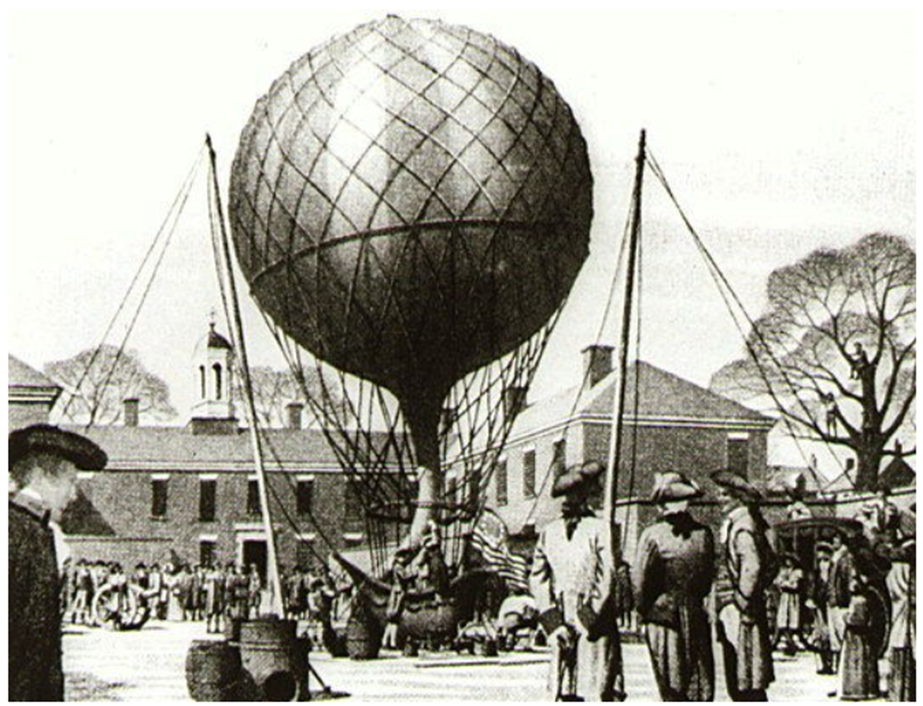
It took place 110 years earlier in Philadelphia, then our nation’s capital. On Jan. 9, 1793, Jean-Pierre Blanchard, the French aeronaut and pioneer of gas balloon flight, took to the air in an untethered, hydrogen-filled, yellow silk balloon from the interior yard of the Walnut Street Prison, before a cheering crowd that included President George Washington and future presidents John Adams, Thomas Jefferson, James Madison and James Monroe. On board Blanchard’s balloon were various scientific instruments and a small dog.
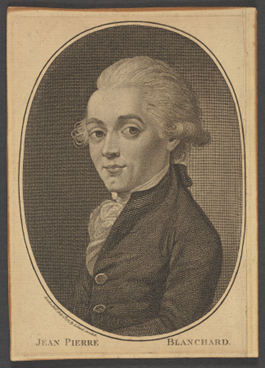
Because Blanchard did not speak English, President Washington provided him with a letter of introduction guaranteeing his safe passage, which was America’s first air-mail delivery. (The text of Washington’s letter is below.)
As he waved a flag, which bore the colors of the United States on one side and those of France on the other, and tipped his feathered cap to the crowd below, Blanchard’s balloon rose to an altitude of approximately “200 fathoms” (1200 feet) and proceeded to drift in a southeasterly direction for 15 miles. Less than an hour later, having made another historic crossing—from the air—of the Delaware River, Blanchard’s balloon landed near the village of Deptford, in New Jersy’s Gloucester County. The adventurer received the help of local farmers and by 6:30 p.m. was back in Philadelphia, sharing the account of his journey with Washington.
Significantly, the interest of our founding fathers in ballooning helped inspire Americans to embrace the possibilities of flight. Ten years before Blanchard’s ascent, on his diplomatic mission to Paris to sign the peace treaty between America and England, Benjamin Franklin keenly witnessed several of histories’ first balloon flights. At one ascent when a spectator questioned the practical value of balloon flight, Franklin famously retorted, “What good is a newborn baby?”
Washington also shared Franklin’s mindset and in a 1785 letter to the Irish politician Sir Edward Newenham recommended that “young men of science and spirit” should be offered “handsome public encouragements…for the risks they run in ascertaining its [the balloon’s] usefulness.”
It was in this spirit that our young nation embraced the age of aviation. Such modern advances as drones and air taxis are indeed rooted in a balloon flight that took place more than 230 years ago. And today the idea of going up, up and away in a beautiful balloon, is now enjoyed by large segments of the public, with the FAA working hard to help ensure the safety of this popular recreational activity.
George Washington’s letter of introduction for Blanchard read:
George Washington, President of the United States of America, to all to whom these presents shall come. The bearer hereof, Mr. Blanchard a citizen of France, proposing to ascend in a balloon from the city of Philadelphia, at 10 o’clock, A.M. this day, to pass in such direction and to descend is such place as circumstances may render most convenient—These are therefore to recommend to all citizens of the United States, and others, that in his passage, descent, return or journeying elsewhere, they oppose no hindrance or molestation to the said Mr. Blanchard; And, that on the contrary, they receive and aid him with that humanity and good will which may render honor to their country, and justice to an individual so distinguished by his efforts to establish and advance an art, in order to make it useful to mankind in general.
Throughout the year, we will continue to recognize America's aviation heroes and heritage in celebration of America’s 250th anniversary and highlight great aviation milestones as we look forward to aviation's promising future.
More Aviation History Stories
A Chair, a Wheelbarrow and Two Flags
How Archie League Helped Pioneer Air Traffic Control
A Legacy of Greatness
How the Wright Brothers Transformed Our World