


Frequently Asked Questions
Find answers to your FAA questions.
The FAA does not maintain a list of acceptable medications. Pilot performance is affected by both the underlying medical condition(s) and medication (s); we must consider both in individual cases.
You should consult with your FAA Regional Flight Surgeon or designated Aviation Medical Examiner (AME) to determine if your condition or treatment precludes flying. You can find contact information for your Regional Flight Surgeon or your AME on our website.
You may not fly if you are taking any of these types of medications. If you aren't sure whether your medication falls into one of these categories, you should check with your AME:
- Tranquilizers, such as but not limited to Valium, Librium, Ativan
- Most antidepressants. PLEASE NOTE: According to new FAA policy announced in the Federal Register on April 5, 2010, some conditions and medications are acceptable. Please see the Federal Register Announcement for the requirements to qualify for a special issuance authorization (waiver).
- Opiates, such as Morphine, Codeine, Lortab, Percodan, Oxycontin
- Muscle relaxants, such as Soma, Sonata, Flexeril
- Anicholinergics, such as Levsin, Bnetyl, Transderm Scop
- Sedating antihistamines, such as Benadryl, Chlorpheniramine, Zyrtec
- Antipsychotics, such as Mellaril, Thorazine, Haldol
- Over-the-counter active dietary supplements, such as Kava-Kava, Valerian
You can also find helpful information in our brochure "Medication and Flying".
The FAA does not require the use of CRS's on commercial airplanes. However, the FAA strongly recommends the use of CRS's or an alternative FAA-approved device based on a child's weight.
You can find more information about flying with children on our website.
A responsible person is not required to hold an airman certificate issued under Part 107 to apply for or be issued a waiver. The responsible person must ensure that the person operating the UAS or drone under the waiver holds the required airman certificate and meets the currency requirements of Part 107.
Still can't find what you are looking for? Please feel free to contact the UAS Support Center for general questions and comments.
Testing of appliances outside of restricted airspace is a challenge. I suggest you look up some current waivers and speak to those who obtained the BVLOS waivers. Many of the successful waiver applicants use a chase aircraft or multiple visual observers.
Still can't find what you are looking for? Please feel free to contact the UAS Support Center for general questions and comments.
As far as the flight rules are concerned, when flying as a public aircraft, the Remote Pilot in Command (RPIC) is responsible (See 91.3(b)). When flying as a civil aircraft, the RPIC is responsible (See 107.19). When flying as a contractor to a public entity, refer to Advisory Circular 00-1.1B, Public Aircraft Operations, which provides information about the process you must go through to get public aircraft status given to you by the entity. The RPIC and responsible person are responsible for compliance with the flight rules to ensure everyone's safety.
Still can't find what you are looking for? Please feel free to contact the UAS Support Center for general questions and comments.
Unfortunately, the Federal Aviation Administration (FAA) does not maintain or distribute a listing of available service agents. We recommend that employers talk to other local aviation employers, search the local yellow pages or the Internet, or visit the Department of Transportation's website.
For lists of qualified MROs, visit the American Association of Medical Review Officers (AAMRO) website or the Medical Review Officers Certification Council (MROCC) website.
If you have any further questions or need additional guidance that is more specific to your situation, please contact the FAA Drug Abatement Division at (202) 267-8442 or drugabatement@faa.gov.
Please visit our website to learn more about the program.
As an employer, you are responsible for ensuring that the urine and/or oral fluid collector, screening test technician (STT), and/or breath alcohol technician (BAT) you use meet the qualifications outlined in 49 CFR §§ 40.15, 40.33, 40.35, and 40.213 to conduct drug and alcohol test collections. While a collector, STT, and/or BAT may provide you with a certificate of training to demonstrate that he or she is qualified, that may not be sufficient if it does not include the proficiency requirements. We encourage you to ask for additional documentation to ensure you and your collection personnel are complying with the federal testing requirements. The following are examples of what you might ask your collector, STT and/or BAT to provide to demonstrate they meet the proficiency requirements:
- For a collector, you may obtain copies of the following:
- Federal Custody and Control Forms (CCFs) completed during the five (5) mock error-free collections to demonstrate the collector conducted two (2) uneventful collections, one (1) insufficient quantity collection, one (1) temperature out of range collection, and one (1) collection involving a donor's refusal to sign or initial the specimen bottle seal.
- Documentation indicating that the five (5) mock collections were monitored by a qualified collector with one (1) year practical experience as a collector, or one (1) year experience training other collectors, or successful completion of a "train the trainer" course.
- Written statement from the person who observed the mock collections and can attest that they were error-free and monitored in person or "real-time". The statement should include the number and type of scenarios/events covered during the mock exercises and other relevant information.
- For an STT and/or BAT, you may obtain copies of the following:
- Alcohol Testing Forms completed during the seven (7) consecutive error-free mock breath alcohol tests or five (5) error-free saliva tests. The mock tests must be performed using the alcohol testing devices that will be used by the BAT/STT and adequately gauge the BAT/STT's knowledge, skill and ability pertaining to the device's messages, commands or displays including error messages or device malfunctions, as well as the procedures for performing air blank and external calibration checks.
- Documentation indicating that the seven (7) mock breath alcohol tests (and/or five (5) mock saliva tests) were monitored by a qualified instructor with one (1) year practical experience performing as a BAT/STT, or one year as a BAT/STT trainer, or successful completion of "train the trainer" course.
- Written statement from the person who observed the mock collections and can attest that they were error-free and monitored in person or "real-time". The statement should include the number and type of scenarios/events covered during the mock exercises and other relevant information.
- Other documents, which may include course materials and descriptions, checklists, etc.
For more information on this topic, please visit the DOT’s website and review the Q&As about the collector and BAT/STT requirements.
If you have any further questions or need additional guidance that is more specific to your situation, please contact the FAA Drug Abatement Division at 202-267-8442 or drugabatement@faa.gov. Please visit our website to learn more about our program.
Applicable Regulations:
You can find information about clear title searches on our website.
You can write:
Aerospace Medical Certification Division, AAM-300
Federal Aviation Administration
Civil Aerospace Medical Institute
P.O. Box 25082
Oklahoma City, OK 73125
You must include your legal name and your date of birth.
You can call (405) 954-4821
You can also contact the Regional Flight Surgeons' offices.
You can search for names of FAA certificated pilots and mechanics on our Airmen Inquiry Site.
If you don’t have enough information to conduct a search, contact your local Flight Standards District Office (FSDO).
The Privacy Act limits the amount of information that may be publicly released.
You can search for names of FAA-certificated pilots and mechanics on our Airmen Inquiry Site.
If you don’t have enough information to conduct a search, contact your local Flight Standards District Office (FSDO).
The Privacy Act limits the amount of information that may be publicly released.
You can find information to replace your lost or destroyed knowledge test report on our website.
For additional information, please email our Civil Aviation Registry.
You can find the TCDS for an aircraft on our website.
You can also contact your nearest Flight Standards District Office, Aircraft Certification Office, or Manufacturing Inspection District Office.
The AMCS Pre-Exam Report allows AMEs to see an overview of an applicant’s FAA medical exam history. The Pre-Exam Report contains details such as the date of the applicant’s previous exam, the certification status of that exam, a list of any Medical History Items previously marked as “Yes,” any Physical Exam findings marked abnormal on previous exams, and the most recent ECG information.
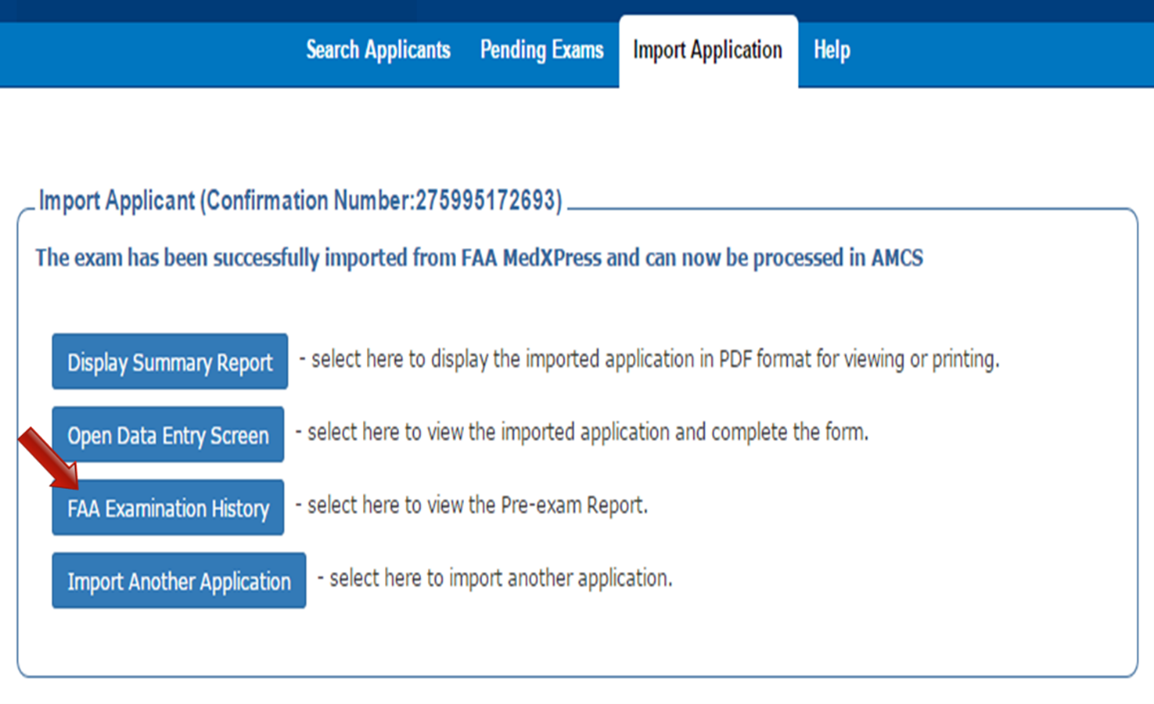
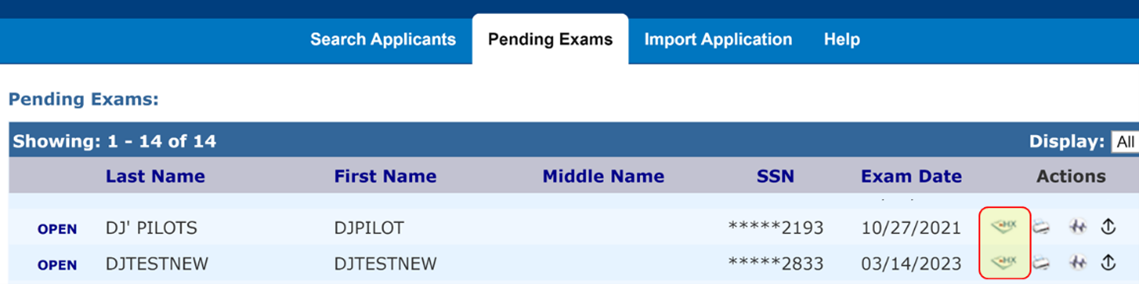
The Pre-Exam Report is available immediately after importing an application from MedXPress and it remains available until you transmit the exam to the FAA. You can access the Pre-Exam Report by clicking the FAA Examination History button on the import confirmation screen. You can also access it by clicking on the Hx icon in the Actions column of the Pending Exam screen.
Under the Small UAS Rule (part 107), operators must pass an aeronautical knowledge test to obtain a Remote Pilot Certificate. This test will quiz prospective operators on how to use aeronautical charts to determine airspace classifications.
Still can't find what you are looking for? Please feel free to contact the UAS Support Center for general questions and comments.
Response by the Federal Air Surgeon
Over the past 3 years, the number of denials of third-class airman medical certificates has ranged from approximately 2000 to 2500 per year based on approximately 135,000 to 140,000 applications for third-class airman medical certification per year. Most of these denials resulted because of a failure of the applicants to provide sufficient information for the FAA to make a favorable decision.
Waivers are special permissions the FAA issues to authorize certain types of UAS or drone operations not covered under the Part 107 rule. Learn more about applying for waivers to Part 107.
Still can't find what you are looking for? Please feel free to contact the UAS Support Center for general questions and comments.
You can find regulations for agriculture aircraft operations (14 CFR Part 137) on the Government Printing Office's Electronic Code of Federal Regulations. Be sure to select Part 137.
Any domestic physician interested in becoming an AME should contact the applicable FAA Regional Flight Surgeon's (RFS) office listed for your area.
The Aircraft Owners and Pilots Association (AOPA) has a book available on choosing your flight instructor and flight school. The International Deaf Pilots Association (IDPA) has information regarding flight instructors who know how to sign. Generally speaking, you should visit the location to observe the professionalism of the school. You will need to discuss your particular degree of hearing impairment with the flight instructor and establish how to communicate best with each other. Have the flight instructor you select contact the IDPA for additional advice and assistance.