


Frequently Asked Questions
Find answers to your FAA questions.
General aviation operations conducted under 14 CFR Part 91 are not subject to flight and duty time and rest requirements, except flight instruction (14 CFR Section 61.195) and fractional ownership operations (14 CFR Part 91 Subpart K).
Commercial crewmember flight time and duty period limitations and rest requirements are described in 14 CFR Part 135 Subpart F or 14 CFR Part 121, Subpart Q, Subpart R, or Subpart S, depending on the type of operation.
Certificated air carriers and operators should contact their FAA principal inspector for further questions about flight and duty time and crew rest.
-
A student pilot license (certificate) is designed for the initial training period of flying. The student pilot must have a flight instructor present. He or she can solo after appropriate instructor endorsements.
-
A recreational pilot certificate limits the holder to: specific categories and classes of aircraft, the number of passengers which may be carried, the distance that may be flown from the departure point, flight into controlled airports, and other limitations.
-
A private pilot certificate lets the pilot carry passengers and provides for limited business use of an airplane.
-
A sport pilot certificate enables pilots to operate aircraft that meet specific criteria without having to hold a medical certificate.
-
A commercial pilot certificate lets the pilot conduct some operations for compensation and hire.
-
An airline transport pilot certificate is required to fly as captain by some air transport operations.
You can find information on how to get a pilot certificate on our website.
14 CFR part 61 (Certification: Pilots, Flight Instructors, and Ground Instructors) prescribes the hourly requirements for the issuance of pilot certificates and ratings. A person applying for a private pilot certificate in airplanes, helicopters, and gyro-planes must log at least 40 hours of flight time, of which at least 20 hours are flight training from an authorized instructor and 10 hours of solo flight training in the appropriate areas of operation; three hours of cross country; three hours at night, three hours of instrument time; and other requirements specific to the category and class rating sought.
Private pilots in gliders and lighter-than-air aircraft must have logged from an authorized instructor a similar number of hours and/ or training flights, which include both cross country and solo according to category and class rating sought. Though the regulations require a minimum of 40 hours flight time, in the U. S. the average number of hours for persons without a hearing impairment completing the private pilot certification requirements is approximately 75 hours.
There are no minimum or maximum ages for obtaining a medical certificate. Any applicant who is able to pass the exam may be issued a medical certificate.
However, since 16 years is the minimum age for a student pilot certificate, people under 16 are unlikely to have practical use for an airman medical certificate.
In general any temporary or permanent structure, including all appurtenances, that exceeds an overall height of 200 feet (61m) above ground level (AGL), or exceeds any obstruction standard contained in 14 CFR Part 77, should normally be marked and/or lighted. However, an FAA aeronautical study may reveal that the absence of marking and/or lighting will not impair aviation safety. Conversely, the object may present such an extraordinary hazard potential that higher standards may be recommended for increased conspicuity to ensure safety to air navigation.
Normally, outside commercial lighting is not considered a sufficient reason to omit recommended marking and/or lighting. Recommendations on marking and/or lighting structures can vary depending on terrain features, weather patterns, geographic location, and in the case of wind turbines, number of structures and overall layout of design. The FAA may also recommend marking and/or lighting a structure that does not exceed 200 (61m) feet AGL or 14 CFR Part 77 standards because of its particular location. You can find additional guidance in Advisory Circular 70/7460-1M, Obstruction Marking and Lighting.
If the structure is on airport property, contact the nearest FAA Airports’ Regional/Airports District Office.
If the structure is not on airport property, contact Air Traffic Organization Obstruction Evaluation Specialist that services your area.
There are no PIC requirements specific to carrying skydivers. However, a private pilot may not act as PIC or second in command of an aircraft carrying persons or property for compensation or hire. See 14 CFR 61 Section 61.113 and 14 CFR Part 105 for information about parachute operations.
You can find testing requirements for a private pilot certificate in Regulation 14 CFR 61.103(d).
Upon the successful passage of TRUST, the test administrator will issue a certificate to the recreational flyer. The certificate will contain a random, 15-digit alpha numeric token. The first four characters identify the test administrator. The test administrator will provide the 15-digit alpha numeric token to the FAA. Neither the test administrator, nor the FAA, will maintain personally identifiable information about the recreational flyer.
Still can't find what you are looking for? Please feel free to contact the UAS Support Center for general questions and comments.
There are 2 pathways available to pilots with a history of ADHD. Go to www.faa.gov/go/adhd or discuss with your AME requirements for each pathway.
FAST TRACK - FAA ADHD criteria:
- No treatment or use of ADHD medication (for any condition) in the past 4-years;
- No symptoms of ADHD in the past 4-years;
- No instability in academic, occupational, or social functioning in the past 4-years; and
- No other psychiatric condition(s) or diagnosis (current or historical).
If you do not meet the criteria above for FAST TRACK, you will need to provide an evaluation in accordance with the STANDARD TRACK - FAA ADHD Guidelines.
You must be off all ADHD medications and remain symptom-free for at least 90-days prior to the Standard Track Evaluation.
To find specific requirements for a pilot with high blood pressure, you would need to refer directly to the FAA AME Guide. However, generally, if a pilot has high blood pressure, they may need to bring:
- A detailed Clinical Progress Note* from your treating physician, detailing the diagnosis, treatment, and prognosis.
- A list of medications being taken, including dosages and any side effects.
*Performed no more than 90 days before the AME exam.
You can find more information in the AME Guide: CACI - Hypertension Worksheet
To find specific information about what you need to bring to your Aviation Medical Examiner (AME) if you have obstructive sleep apnea (OSA), refer directly to the FAA AME Guide at the provided link. However, if you have been diagnosed with OSA, you will need to provide one of the following:
- A completed and signed OSA Treated Status Report (PDF)
OR all of the following:
- A detailed clinical progress note from your treating physician that answers all items on the OSA Treated Status Report; and
- A signed FAA Compliance with Treatment form (PDF), or equivalent; and
- The results and interpretive report from your most recent sleep study; and
- The most recent download from your PAP device covering 30 days or longer.
For CPAP/ BIPAP/ APAP:
A PAP device report that meets the following qualifications. (1). The initial special issuance request must include a minimum of 30 days PAP usage; renewal of a special issuance MUST cover the last 12 months, not just the last 30 days. (2) It shows the actual time the device was used during this period. (This is different than a report typically generated for insurance providers which only shows if the use is greater or less than 4 hours). (3) Target goal should show use for at least 75% of sleep periods and an average minimum of 6 hours use per sleep period.
For Dental Devices or for Positional Devices:
Once Dental Devices with recording/monitoring capabilities are available, reports must be submitted.
According to the FAA AME Guide, if you have diabetes that is treated with any medication other than insulin, you generally need to provide the following information to your Aviation Medical Examiner (AME):
- A current* Diabetes or Hyperglycemia on Medication Status Report completed by your treating physician or equivalent.
*Performed no more than 90 days before the AME exam.
According to the FAA AME Guide, if you have a drug or alcohol-related offense, you will generally need to provide the following information to your Aviation Medical Examiner (AME):
- Airman Personal Statement which address each item on the FAA Certification Aid- HIMS Drug and Alcohol - INITIAL (page 4)
- BLOOD/BREATH ALCOHOL CONTENT (BAC) from all offenses:
- A copy of the narrative police/investigative report and a copy of the blood/breath alcohol content (BAC) report. NOTE: If you are unable to obtain a copy of the police investigative report, you will need to provide correspondence on official letterhead from the arresting jurisdiction advising that the investigating officer's report is unavailable/unobtainable.
- Complete copies of all court records associated with the offense.
- A complete copy of your current driving record from the Department of Motor Vehicles from any state that you have held a driver’s license, for the past 10 years.
- All records associated with any care, hospital treatment related to your drug or alcohol related offense, or assessments/evaluations for substance abuse or related disorders.
For the most accurate and specific guidance, it is essential to consult the AME Guide directly as requirements may vary based on individual circumstances and the specifics of the offense. You can find out more in the AME Guide: https://www.faa.gov/ame_guide/media/SubstancesAbuseDependenceFAQ.pdf
According to the FAA AME Guide, if you have a history of kidney stones, the information you need to provide to your Aviation Medical Examiner (AME) will vary based on how long ago your most recent episode was and complications. See Kidney Stone(s) (Nephrolithiasis, Renal Calculi) or Renal Colic
If you had a kidney stone within the past 5 years with no complications you will need:
- A detailed clinical progress note from your treating physician regarding your history of kidney stone(s). The progress note should address all items on the CACI worksheet. You may want to bring a copy to your physician. CACI – Retained Kidney Stone(s) Worksheet
If you have a mental health condition that is currently being treated solely with therapy or you have not taken medication for more than two years, the FAA AME Guide generally suggests you bring the following to your Aviation Medical Examiner (AME) appointment:
- Current detailed clinical progress note from your treating mental health professional. This report should include your diagnosis, history of the condition, the course of treatment, and your current status.
- Relevant Medical History: Any other medical records that pertain to your mental health history, including previous evaluations or treatments.
As requirements can vary based on individual circumstances and the specific nature of the mental health condition, find out more in the AME Guide: Anxiety, Depression, and Related Conditions Disposition Table
Preflight your exam describes the process of a pilot preparing for their medical exam by reviewing available resources to determine if the FAA may need additional documentation about their medical status. This is especially important for first-time applicants or a returning applicant with a new or changed medical condition.
We've gathered a list of frequently reported medical conditions to help pilots understand what additional documentation the FAA and/or their AME may need to make a determination.
The FAA does not set fees for the performance of the medical exam and issuance of the medical certificate. Aviation Medical Examiners are allowed to charge the applicant appropriately, as long as it is not more than the usual fee for similar examinations for other purposes. If you are concerned about the cost of the exam, please discuss this with the doctor you are thinking about seeing. The FAA has no additional fees above what the physician charges.
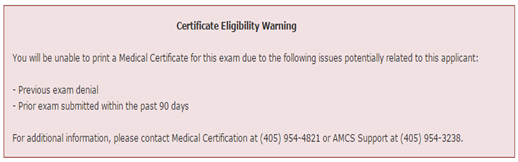
A Certificate Eligibility Warning means you will not be able to print a medical certificate. There are a few reasons this can occur. If you receive a Certificate Eligibility Warning, please contact AMCSsupport@faa.gov for support. If the warning is valid, then you should mark Item 62 as Deferred. This ensures the case will be reviewed by the FAA. We recommend you enter comments in Item 60 to explain if you would have issued the medical certificate if the warning had not prevented certificate printing.
The Federal drug and alcohol testing regulations under 49 CFR part 40 and 14 CFR part 120 require you to maintain the following records for the minimum retention periods noted:
- You must retain the following for a minimum of 5 years:
- Alcohol test results of 0.02 or greater.
- Verified positive drug test results.
- Refusal to test determinations, including substituted or adulterated drug test results.
- Records related to other violations of 14 CFR §§ 120.19 or 120.37, including on-duty use, pre-duty use, or use following an accident.
- Records of notification to the FAA’s Drug Abatement Division of refusals to submit to testing by employees or applicants that hold a part 61, 63, 65 airman certificate.
- Records of notification to the FAA’s Federal Air Surgeon of violations by employees or applicants that hold a part 67 airman medical certificates.
- Documentation of employees' disputes of alcohol test results.
- Referrals to the SAP.
- Return-to-duty records, including the SAP referral, evaluation reports, follow-up testing plan, return-to-duty test result, and all follow-up test results.
- Annual Management Information System (MIS) reports submitted to the FAA.
- All historical drug and alcohol records reported to the Pilot Records Database (PRD) under 14 CFR § 111.255 after reporting the records.
- You must retain records of information obtained from previous employers concerning drug and alcohol test results of employees for a minimum of 3 years.
- You must retain the following for a minimum of 2 years:
- Documents generated in connection with decisions to administer reasonable suspicion alcohol tests.
- Documents generated in connection with decisions on post-accident alcohol tests.
- Documents verifying the existence of medical explanations of the inability of a covered employee to provide adequate breath for testing.
- Materials on alcohol misuse awareness, including a copy of your policy.
- Documentation that demonstrates the distribution of required alcohol educational materials.
- Documentation of training provided to employees and supervisors, and the training materials.
- Records of inspection, maintenance, and calibration of evidential breath testing devices.
- Documentation related to the random selection process, including but not limited to:
- Listing of safety-sensitive employees in the random pool prior to each selection;
- The actual random selection list each time selections are made;
- The employer copy of the custody and control forms from the random testing;
- This may or may not include the verified result, which is maintained based on the result.
- You must retain records of negative and cancelled drug test results and alcohol test results of less than 0.02 for a minimum of 1 year.
You are permitted to maintain your drug and alcohol records electronically; however, they must be easily accessible, legible, formatted, and stored in an organized and reviewable manner. If your electronic records do not meet these criteria, you must convert them to printed documentation in a rapid and readily auditable manner at the request of Department of Transportation (DOT) agency personnel. The DOT’s Q&A reiterates that an employer or service agent is obligated to make the records available expeditiously to a DOT representative, regardless of how the records are maintained.
More information about the Federal drug and alcohol record keeping requirements are explained in the DOT’s Employer Record Keeping Requirements Document.
If you have any further questions or need additional guidance that is more specific to your situation, please contact the FAA Drug Abatement Division at (202) 267-8442 or drugabatement@faa.gov.
Please visit our website to learn more about the program
Applicable Regulations:
14 CFR §120.113(d)(6)
14 CFR §120.219(a)(2)(i) and (ii)
14 CFR 111.255(e)