


General
Show Effective Date
Off
Significant Regulatory Guidance
No
Regional Aviation Noise POC
The FAA's Regional Aviation Noise Ombudsman serves as the public point of contact for issues about aircraft noise questions or complaints.
How to Reach Your Regional Point of Contact
Please select the state where your concern occurred. That region's administrator is your direct point of contact for your concern or inquiry.
Please be prepared to provide details about the location and timing of the concern and inquiry.
What Happens Next
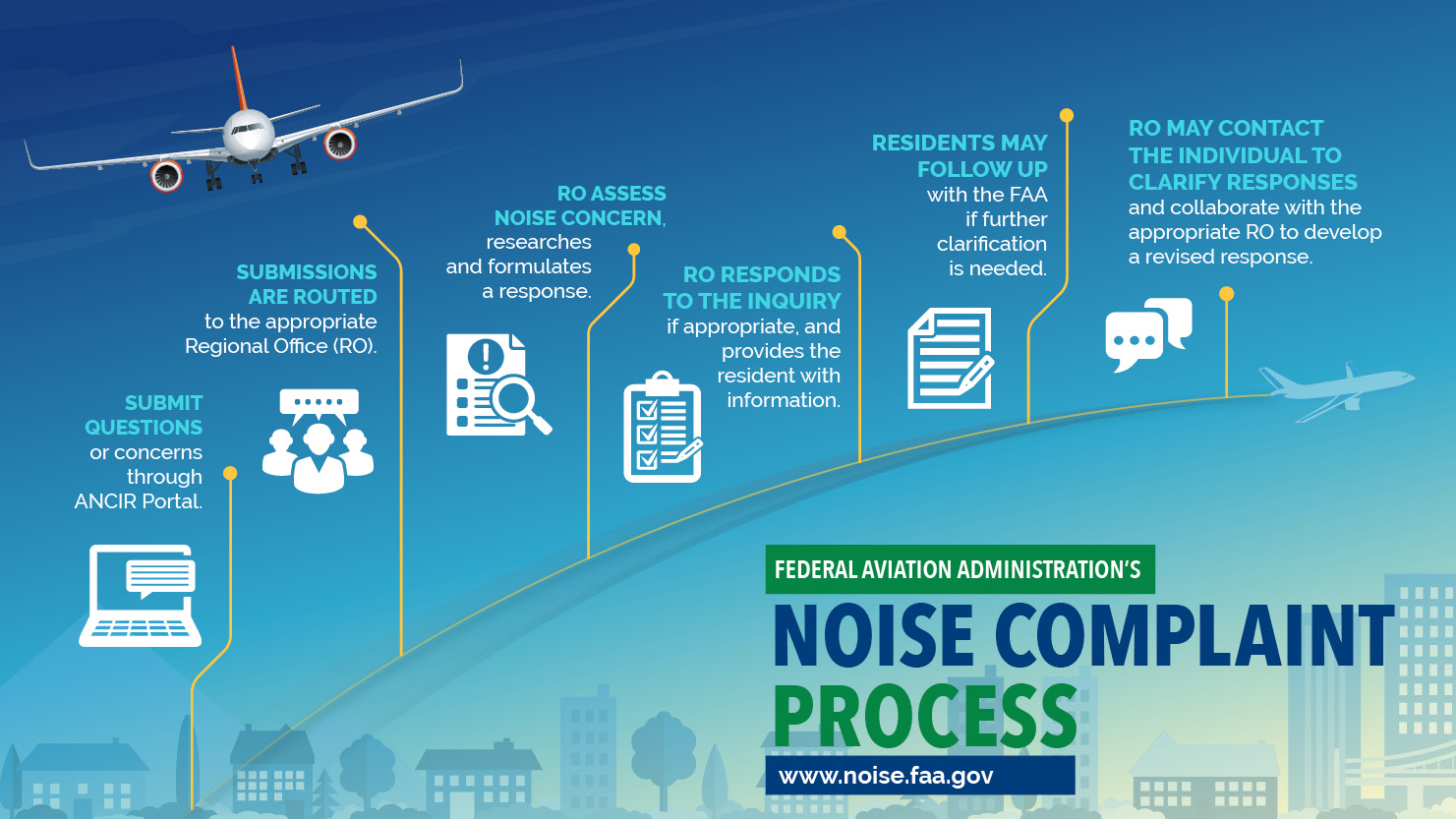
You may be contacted to clarify points about your concern in a follow-up communication.
FAA will provide additional information should more details be requested. Please note that multiple contacts on the same concern will only be registered once.
Fundamentals of Noise and Sound
Sound is energy transferred through the air that our ears detect as small changes in air pressure. The more energy put into making a sound, the louder it will be. Try whispering. Then yell. You can feel how much more energy goes into yelling.
Noise is sound that is unwanted. Some sounds, like a distant train whistle, can be a pleasant sound for some, while being considered noise by others. Other sounds, like a neighbor's barking dog in the middle of the night, are more universally found to be annoying. Even sounds that are pleasant at one volume can become noise to us as they get louder. Noise, then, has both an objective, physical component; as well as a subjective component that takes account of a person's individual perception, or reaction, to a sound.
The decibel (dB.) is the unit used to measure the intensity of a sound. The human ear hears sound pressures over a wide range. Decibels, which are measured on a logarithmic scale, correspond to the way our ears interpret sound pressures.
Comparative Noise Levels
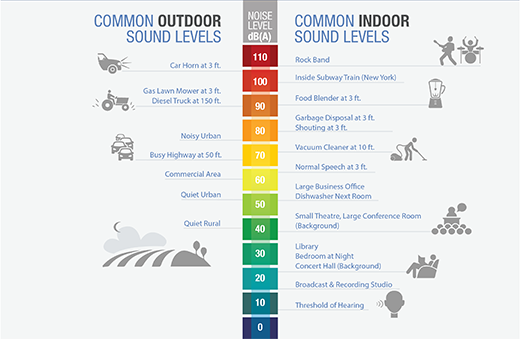
The human ear also responds to different pitches or frequencies of sound differently. We are less able to hear low frequencies like the rumble of thunder but hear high frequencies like the cry of a baby more strongly.
To account for differences in how people respond to sound, FAA uses the "A-weighted" scale (dBA) as the accepted measure to consider aircraft noise. This scale most closely approximates the relative loudness of sounds in air as perceived by the human ear. It provides a more useful way to evaluate the effect of noise exposure on humans by focusing on those parts of the frequency spectrum where we hear most.
For noise sources in motion, like aircraft, noise levels can change over time. For example, the sound level of a plane increases as it approaches, then decreases as it flies away. It can be useful to measure the maximum sound level, abbreviated as Lmax, of a particular noise "event." While max notes the moment of maximum sound level, it does not account for the duration of a sound event. The maximum sound level of a gun firing a bullet is high but very brief, whereas a freight train can have the same maximum sound level, if you are very close to it, but the sound has a long duration.
To account for the differences in duration and loudness of sounds, different metrics are used. These metrics are used to compare individual noise events as well as many events that take place over an extended period of time.
Noise Metrics
The Sound Exposure Level (SEL) metric represents all the acoustic energy (sound pressure) of an individual noise event as if that event had occurred within a one-second period. SEL captures both the level (magnitude) and the duration of a sound event in a single numerical quantity, by "squeezing" all the noise energy from an event into one second. This provides a uniform way to make comparisons among noise events of various durations.
Sound Pressure Level (SPL, dB) At One Microphone Location
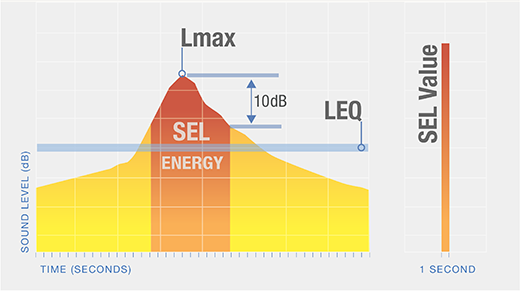
The equivalent sound level (LEQ) measures the average acoustic energy over a period of time to take account of the cumulative effect of multiple noise events. This could, for example, provide a measure of the aggregate sound at a location that has airplane flyovers throughout the day. LEQ is defined as the level of continuous sound over a given time period that would deliver the same amount of energy as the actual, varying sound exposure.
Finally, the day-night average sound level (DNL) noise metric is used to reflect a person's cumulative exposure to sound over a 24-hour period, expressed as the noise level for the average day of the year on the basis of annual aircraft operations. The DNL noise metric provides a mechanism to describe the effects of environmental noise in a simple and uniform way. DNL is the standard noise metric used for all FAA studies of aviation noise exposure in airport communities. (For more on DNL, see FAA History of Noise.) DNL and the closely related CNEL metric used in California are both similar to LEQ, but they differ in how noise is treated during the evening and nighttime.
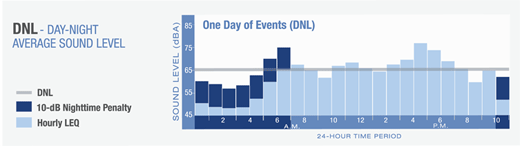
Because DNL takes into account both the amount of noise from each aircraft operation as well as the total number of operations flying throughout the day, there are many ways in which aircraft noise can add up to a specific DNL. Small numbers of relatively loud operations can result in the same DNL as large numbers of relatively quiet operations.
Equivalent Operations For DNL = 65
1 Event/Day SEL 114.4 dBA = DNL 65
10 Events/Day SEL 104.4 dBA = DNL 65
100 Events/Day SEL 94.4 dBA = DNL 65
Noise Contours
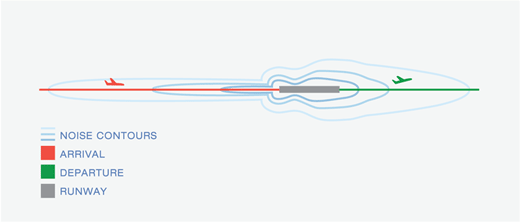
Noise levels can be computed at individual locations of interest, but to show how noise can vary over extended areas, noise metric results like DNL are often drawn on maps in terms of lines connecting points of the same decibel (dBA). Similar to topographical maps showing the elevation of terrain in an area, these noise "contours" are useful for comparing aircraft noise exposure throughout an airport community. The shape of noise contours depends on many factors, but are influenced by things like whether more arriving or departing aircraft are flying over an area.
Noise Contour Map
2011 Frequently Asked Questions (FAQ)
In response to the numerous questions regarding the O'Hare Modernization Program and in a continuing effort to provide communication through community outreach, FAA will be posting the questions and FAA's responses on this web site. If the questions posed are outside FAA's jurisdiction we will forward them, as appropriate, to the O'Hare Noise Compatibility Commission (ONCC) or the City of Chicago. You may submit your questions at...
How to File a Noise Complaint
Friday, January 30, 2026Who Should I Contact with My Concern?
Noise at My Local Airport
For any concerns regarding noise from your local airport, it is best to reach out directly to the airport manager or staff. They are familiar with the noise abatement methods at the airport and have a good understanding of the local area.
Airports are chiefly responsible for noise reduction around their facilities, including site selection, design improvements, ground noise abatement, land acquisition, and usage restrictions—ensuring actions are fair, do not impede federal safety, or interfere with interstate or international commerce. State and local governments, along with planning agencies, support these efforts by incorporating land use planning to minimize noise impact on nearby residents.
Action Steps:
- Look up the airport's contact information online or in your local telephone directory.
- Many airports provide noise abatement information and contact details on their websites.
General Noise Concerns or Inquiries to the FAA
The FAA regulates aircraft noise and air traffic by establishing federal certification standards for aircraft noise, emission standards, developing flight procedures, and air traffic management practices. These efforts aim to ensure safety and efficiency of the airspace while minimizing the impacts of aviation noise near residential areas when feasible.
For concerns or inquiries about noise standards, environmental impacts, flight procedures, or air traffic management, you can share them directly with the FAA through theAviation Noise Complaint and Inquiry Response (ANCIR) Portal.
The ANCIR Portal allows you to:
- Submit detailed feedback or complaints regarding aircraft noise and provides a platform for addressing environmental questions related to FAA-regulated activities.
- Receive information from a subject matter expert to better understand FAA policies on noise management, community engagement, and air traffic operations.
The ANCIR Portal ensures effective and efficient responses to noise concerns while minimizing the burden on submitters. It is mobile-friendly and compliant with Section 504 and Section 508 accessibility standards. Trend analysis and reporting capabilities are also improved over other correspondence methods.
Complaints submitted to the ANCIR Portal rarely lead to changes in airspace; however, they do provide valuable insights to the FAA and policymakers about areas of noise concern.
Other Complaint or Inquiry Types: Low-Flying Aircraft, Helicopters, and Military
Noise from low-flying aircraft is not considered a safety issue and should not be reported to an FAA Flight Standards District Office (FSDO). However, if you observe an aircraft operating unsafely/flying in a potentially hazardous manner, you should contact your regional FSDO.
Helicopters generally fly under visual flight rules (VFR) in which case they are not required to file a flight plan. As a result, historical flight track data is often not available to help identify helicopters by their registration numbers. Additionally, the FAA does not have restrictions that prevent helicopters from hovering.
Aircraft safety, including helicopter safety, is governed by 14 CFR Part 91.119, which sets minimum safe altitudes but allows helicopters to operate lower than other aircraft, given their operational ability to better avoid hazards to people or property on the ground. This flexibility accommodates their unique capabilities and specific roles like emergency response, while still prioritizing ground safety.
Under 14 CFR Part 91.119, minimum safe altitudes for aircraft are as follows:
- Over Congested Areas: Aircraft must fly at least 1,000 feet above the highest obstacle within a 2,000-foot horizontal radius.
- Over Open Areas: In areas like open water or sparsely populated regions, aircraft must stay at least 500 feet away from any person, vessel, vehicle, or structure.
- A helicopter may be operated at less than the minimums listed above provided each person operating the helicopter complies with any routes or altitudes specifically prescribed for helicopters by the FAA.
- Anywhere Else: Aircraft should fly at an altitude allowing for an emergency landing without undue risk to people or property on the ground, even if specific minimums don’t apply.
Action Steps:
- For information about specific helicopter operations, contact the helicopter operator directly.
- If you believe helicopters are flying unsafely, report your concerns to your local FAA FSDO.
- If you would like to share your noise concern with the FAA, please visit the Aircraft Noise Complaint Inquiry and Reporting (ANCIR) Portal and submit an inquiry.
Noise from Military Aircraft
The FAA does not release information regarding the operations of military aircraft. If you live near a military installation, contact their noise office or community relations department for more information on their operations in your community. If the military base was not responsible for the noise you experienced, they may be able to direct you to the correct military installation for more information.
Program Support and Safety Recommendations
Program Support and Safety Recommendations Section will provide support for AFS-200 programs and safety recommendation for air carrier safety.
- Aircraft Leases
- Enforcement Investigation
- FAA Safety Recommendations
- NTSB Safety Recommendations
- Special Evaluations
Address:
Federal Aviation Administration
Technical Programs Section,
Room # 831
800 Independence Avenue, S.W.,
Washington, DC 20591
Phone: (202) 267-8166
Fax: (202) 267-5229
Email: 9-AFS-200-Correspondence@faa.gov
Voluntary Safety and Rulemaking Section
The Voluntary Programs and Rulemaking Section will provide support with rulemaking and voluntary programs to improve air carrier safety.
Voluntary Safety Programs
- Aviation Safety Action Program (ASAP)
- Aviation Safety Reporting System (ASRS)
- Flight Operational Quality Assurance (FOQA)
- Internal Evaluation Program (IEP)
- Line Operations Safety Audit (LOSA)
- Voluntary Disclosure Reporting Program (VDRP)
Address:
Federal Aviation Administration
Technical Programs Section,
Room # 831
800 Independence Avenue, S.W.,
Washington, DC 20591
Phone: (202) 267-8166
Fax: (202) 267-5229
Email: 9-AFS-200-Correspondence@faa.gov
Information for Applicants and Design Approval Holders
Latest News
- The 2023 FAA TSO Workshop was held on September 20-21. Briefings and Presentations from this event are available below in the Technical Briefings & Outreach Presentations section.
- Added a new section below: Recent Policies Issued
- Previous News Items
Cargo Safety Controls
A risk control provides a mean to reduce or eliminate the effects of a hazard. The implementation of specific controls is based on an operator's analysis and acceptance of risk. It should be included in a Cargo Risk Assessment prior to implementation, to tailor their use and monitor their effectiveness. Ultimately, the operator is responsible for accepting risks introduced into their systems, and for implementing appropriate risk controls.