

New York Airspace
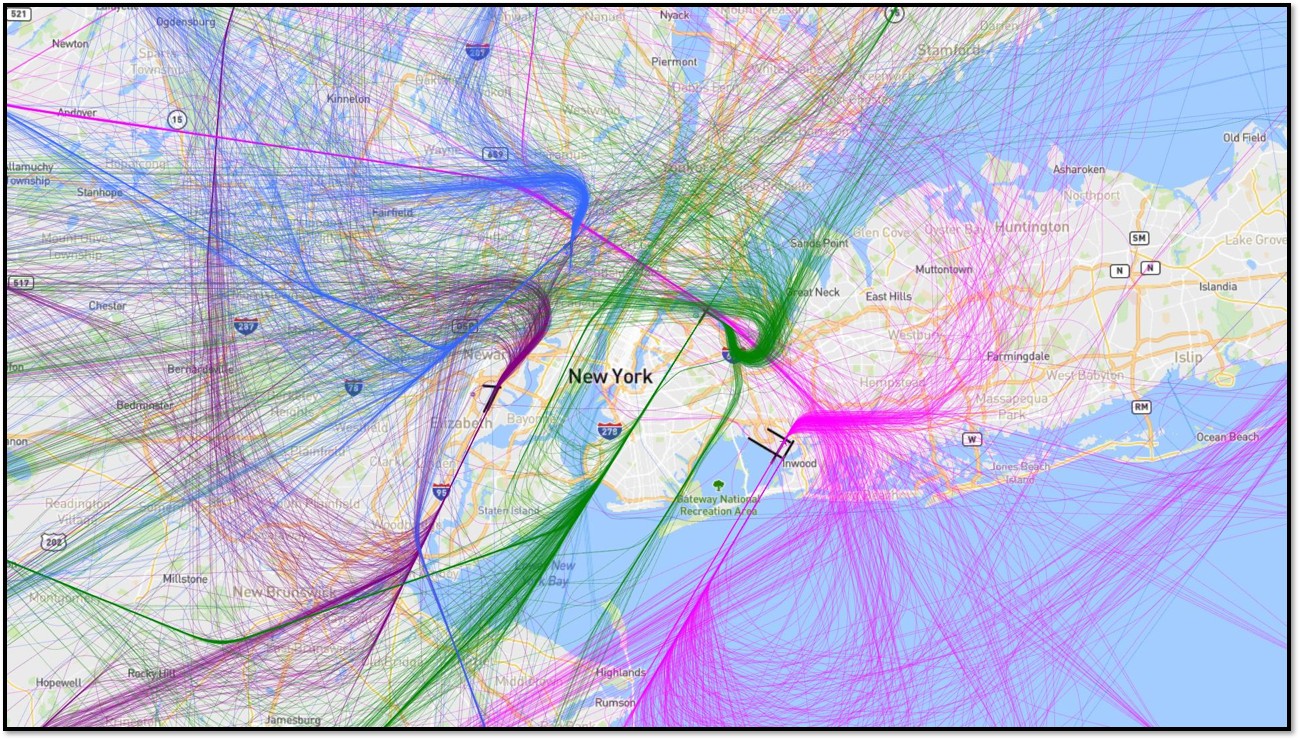
The New York - New Jersey Metro Area has the most complex, congested and busiest airspace in the United States and operates over the most densely populated area in the country.
On a typical day approximately 5,000 commercial and business aircraft, helicopters and general aviation pilots fly through this airspace both domestically and internationally. This airspace has three major airports, John F. Kennedy International (JFK), Newark Liberty International (EWR) and LaGuardia (LGA), and the very busy general aviation airport, Teterboro (TEB), all operating in close proximity. This means that an issue at one airport can impact airport operations for all the metro airports, and that aircraft must arrive and depart on very specific routes to maintain safety and efficiency.
In 2025, Port Authority of New York and New Jersey and Federal Aviation Administration data showed that JFK, EWR, LGA and Teterboro airports handled approximately $1.7 million aircraft operations, 146 million passengers and 2.3 million tons of air cargo contributing $73.5 billion in economic activity. This supported 315,000 jobs, creating 35.5 billion annual wages for the New York-New Jersey metro area.
New York-New Jersey metro airports are also some of the most delayed airports in the country. Due to the high volume of traffic that uses the airspace both domestically and internationally this means that a delay here can ripple across the entire United States. Air traffic delays have multiple factors; weather, airspace complexity, and high volume of air traffic are the primary reasons. Delays not only affect passengers and cargo delivery. Aircraft landing later in the day, due to a delay, can produce aircraft noise during more sensitive nighttime hours.
Airport proximity, high volume of traffic and delays are challenges for the New York - New Jersey Metro airspace. While these challenges exist, this high volume of air traffic also brings economic prosperity to the New York - New Jersey Metro area with millions of passengers and tons of cargo that create thousands of jobs.
Let’s take a closer look at these challenges.
Airspace Management
The New York-New Jersey metro area includes more than fifty airports, including John F Kennedy International, LaGuardia, and Newark Liberty International airports and Teterboro which services general aviation. This video provides an overview of how Air Traffic Control manages runways, separation standards, and interactions between the many airports sharing this high traffic airspace.
Airport Proximity
The FAA standardizes how close aircraft can operate. These are called separation standards which in the New York area may dictate the runways being used. For example, when JFK is using Runway 22Left for arrivals, aircraft depart from LaGuardia using Runway 13. These departures then turn to the right or left to maintain the minimum required separation from the arriving aircraft to JFK. The animation shows an example of spacing between arriving and departing aircraft.
Runway Selection
Runway selection at each airport is determined by several factors: wind direction, inclement weather, low visibility due to rain, fog, snow, and runway maintenance closures. Airports operating in close proximity depend on one another and Air Traffic Control to adjust runway usage as needed.
Weather
This video shows how a large thunderstorm impacts aircraft arriving to Newark, LaGuardia, John F. Kennedy, and Teterboro. The storm causes Newark, LaGuardia, and John F. Kennedy to go into a ground stop – which holds aircraft on the ground preventing aircraft bound for the NY airports from departing their origin airports. Aircraft arriving to these airports that took off before the ground stop was issued, are put into holding patterns due to the storm. Air Traffic Control will also increase separation to slow arrivals to Teterboro airport.
Resources
The Operations Network (OPSNET)
Port Authority of New York and New Jersey Airport Traffic Statistics