


FAA Statements on Midair Collision at Reagan Washington National Airport
Under Secretary Duffy’s leadership the FAA took immediate action to improve safety for the flying public following the January 29 accident at Ronald Reagan Washington National Airport (DCA). As part of the FAA’s continuous efforts to improve safety, we have taken a number of additional actions to address operations, procedures and personnel. Safety remains the FAA’s highest priority.
View the timeline of these safety improvements below. Actions directly affecting DCA are in blue, while Nationwide efforts are in green.
- Download a PDF version of the safety improvement timeline.
- FAA Statement on NTSB Recommendations for DCA.
- Review the frequently asked questions (FAQs) about the incident.
May 19, 2026
Statement on FAA Responses to NTSB Safety Recommendations
The FAA values and appreciates the NTSB’s expertise and recommendations and we have worked side-by-side with the agency throughout the investigation of the January 2025 midair collision near Ronald Reagan Washington National Airport (DCA).
We acted immediately to address urgent safety issues right after the accident and independently took numerous additional key safety actions. To date, we have already addressed several NTSB recommendations and by the end of this year we plan to address several more.
We exceeded what the NTSB recommended in requiring greater separation between helicopters and airplanes. We did this by issuing a general notice (GENOT) suspending the use of visual separation between airplanes and helicopters near busy airports nationwide and mandating that air traffic controllers use radar to keep them separated by specific lateral or vertical distances.
We are evaluating how to address the other recommendations, some of which would require rulemaking and/or developing or updating technology safety standards.
January 27, 2026
Statement on NTSB Safety Recommendations
The FAA values and appreciates the NTSB’s expertise and input. We have worked side-by-side with the NTSB throughout this accident investigation and acted immediately to implement urgent safety recommendations it issued in March 2025. We will carefully consider the additional recommendations the NTSB made today.
Safety is and will always be the FAA’s top priority. Protecting pilots, flight attendants, crews, and the traveling public requires identifying risks early, addressing them transparently, and taking decisive action to keep the National Airspace System safe.
Following the DCA tragedy, the FAA immediately acted to improve safety. We reduced the DCA hourly arrival rate from 36 to 26 and restricted helicopter traffic in the surrounding airspace. We gradually increased the arrival rate to 30 after determining that uptick could be handled safely, where it remains today.
The FAA also moved quickly to bolster the DCA tower staffing. We increased the number of authorized certified professional controllers (CPCs), support managers, support staff specialists, operations managers and operations supervisors, while simultaneously filling those additional positions. DCA is authorized 30 CPCs. Right now, there are 22 working in the tower with eight controllers in training. We have temporarily assigned four additional controllers from other facilities to augment staffing while we focus on certifying controllers in training.
Since Secretary Duffy took office, he and the FAA have taken decisive steps to correct past failures, strengthen accountability, and modernize the NAS. Today, we are acting proactively to mitigate risks before they affect the traveling public.
The Emergency Order issued during the government shutdown is a clear example of this. We saw signs of stress in the system and proactively reduced flights to keep the American people flying safe. The NTSB recognized this change in approach. Chair Homendy posted on X stating:
“Conducting safety risk assessments and then using data to mitigate that risk is exactly what @USDOT and @FAANews should be doing to proactively ensure safety for the traveling public. Great work @SecDuffy and @FAA_Bryan!”
January 27, 2026
Statement on Van Nuys Airport and Hollywood Burbank Airport
The FAA acted immediately to improve safety following the tragic midair collision, both at DCA and around the country. In February 2025, we began using innovative AI tools to identify similar hotspots with high volumes of mixed helicopter and airplane traffic and implement appropriate mitigations. One of our primary focus areas was Van Nuys Airport and nearby Hollywood Burbank Airport in the Los Angeles area. Based our safety analysis, the FAA lowered the Van Nuys traffic pattern by 200 feet during an evaluation in 2025 to see if that would reduce conflicts with aircraft landing at Burbank. Preliminary data indicated the change resulted in a reduction of Traffic Collision Avoidance System (TCAS) alerts for Burbank arrivals and we permanently lowered the Van Nuys traffic pattern effective Jan. 5, 2026.
January 22, 2026
Trump’s Transportation Secretary Formalizes Permanent Restrictions for Aircraft in Reagan National Airport Airspace
U.S. Transportation Secretary Sean P. Duffy today announced that the Federal Aviation Administration (FAA) is formalizing permanent restrictions for helicopters and powered-lift from operating in certain areas near Ronald Reagan Washington National Airport (DCA), unless these aircraft are conducting essential operations. These restrictions were put in place immediately following the American Airlines 5342 crash and supported by the NTSB’s preliminary recommendations.
August 8, 2025
FAA Statement on Inspector General Safety Audit
“The inspector general will have the FAA's full support--we welcome the scrutiny. There must never be another tragedy like the one on January 29 at Ronald Reagan Washington National Airport (DCA). As we investigate the cause and cooperate fully with the investigation, the FAA will not hesitate to take action if we identify risk. That is why we took immediate action, including requiring ADS-B Out for military helicopters,” said FAA Administrator Bryan Bedford.
As a reminder, U.S. Transportation Secretary Sean P. Duffy called for an independent review of DCA airspace operations.
July 30, 2025
Statement
A Letter of Agreement between Ronald Reagan Washington National Airport (DCA) Air Traffic Control Tower and the Pentagon Heliport (JPN) Air Traffic Control Tower incorporates the new restrictions on helicopter activity near DCA that have been put in place since the Jan. 29 accident. The LOA was effective July 1, 2025. Flights have not resumed from JPN.
June 12, 2025
FAA Statement on Updated DCA Helicopter Charts
As part of the FAA’s continuous efforts to improve safety in the National Capital Region, the agency has published modifications to helicopter zones and routes around Ronald Reagan Washington National Airport (DCA).
The new safety measures do not change permanent restrictions, route closures and procedures for urgent missions announced in March after the NTSB preliminary recommendations. The FAA requires all aircraft operating around DCA to broadcast their position and identification using ADS-B Out, with very limited exceptions.
The boundaries of Zones 3 and 4 were reduced in size, moving them farther away from the airport, ensuring required safe separation between helicopters and other aircraft. A new Broad Creek Transition has been established for helicopters traveling south of the airport, creating greater vertical separation from commercial aircraft on final approach to the airport. The updated chart is effective June 12, 2025.
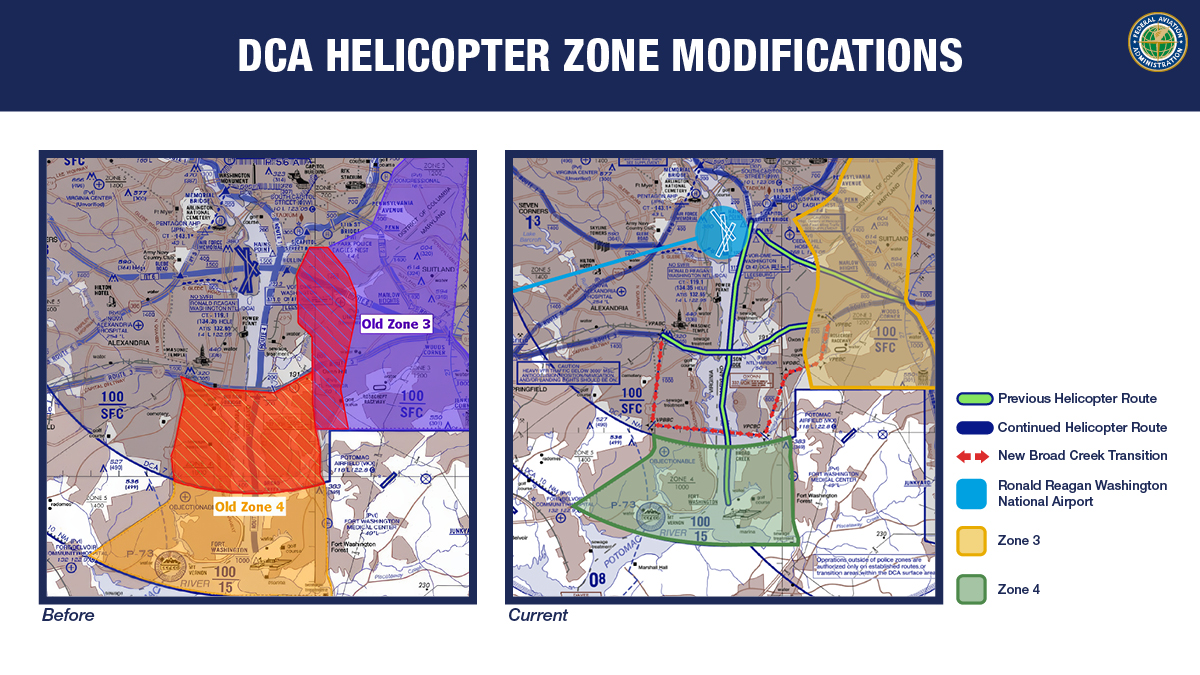
The FAA hosted stakeholder engagement meetings with the Department of Defense, DC Metropolitan Police and medical helicopter operators, and participated in Congressional and community engagement to discuss route changes. The FAA issued these changes as part of the standard charting schedule, which occurs every 56 days. The digital copy was available about 20 days before the effective date. Pilots must ensure they are using current and accurate aeronautical data for safety and compliance. Additionally, the FAA trained all local air traffic controllers.
The agency continues to assess safety data and areas of risk in the Baltimore-Washington area, as well as other cities that have airports with high volumes of mixed traffic.
April 2, 2025
Statement
The Federal Aviation Administration (FAA) is increasing support and oversight for the air traffic controller team at Ronald Reagan Washington National Airport (DCA). The FAA is also evaluating current arrival rates at DCA.
To support the well-being of controllers, a Critical Incident Stress Management (CISM) team will visit DCA in early April, offering confidential support for staff following stressful events. The FAA will also conduct regular wellness checks at the facility.
Additional Actions:
- Increase Operational Supervisor staffing from six to eight
- Review Certified Professional Controller staffing numbers at DCA
- Review DCA’s arrival rate of aircraft per hour, which is disproportionately concentrated within the last 30 minutes of each hour
February 11, 2025
Statement
Runways 4/22 and 15/33 at Reagan Washington National Airport (DCA) have reopened and we have increased the hourly arrival rate to 28 aircraft. The restrictions on helicopter traffic around DCA remain in effect.
You can look up real-time airport status here.
Background
The regular maximum hourly arrival rate for DCA is 32. The NTSB is leading the investigation into the Jan. 29 accident and will provide all updates. We cannot comment on any aspect of open investigations.
February 7, 2025
The FAA is clarifying the restrictions on helicopter traffic in the area over the Potomac River around Ronald Reagan Washington National Airport (DCA). We issued the clarifications based on feedback from air traffic controllers and helicopter operators. We are not changing the initial restrictions. The restrictions on simultaneous fixed wing and helicopter operations within this airspace remain in place and retain the same level of airspace safety. The revised TFR graphic clarifying the restrictions can be viewed here and airspace NOTAM #: 5/1069.
February 6, 2025
On January 31, at Secretary Duffy’s direction, the FAA began restricting helicopter traffic in the area over the Potomac River around Ronald Reagan Washington National Airport (DCA) and stretching to Wilson Bridge. These restrictions will remain in place until the NTSB completes its preliminary investigation of the air carrier incident at which point it will be reviewed based on NTSB’s report.
Additionally, we have also begun reviewing other airports with high volumes of mixed helicopter and airplane traffic nearby.
FAA investigators are closely supporting the NTSB-led investigation and we will quickly take any additional necessary actions and conduct appropriate reviews based on the evidence.
January 31, 2025
With the support of President Trump and in consultation with the Secretary of Defense, effective today, the Federal Aviation Administration (FAA) will restrict helicopter traffic in the area over the Potomac River around Ronald Reagan Washington National Airport (DCA) and stretching to Wilson Bridge. These restrictions will remain in place until the NTSB completes its preliminary investigation of the air carrier incident at which point it will be reviewed based on NTSB’s report. Review the full announcement.
January 30, 2025
FAA investigators are supporting the NTSB-led investigation of Wednesday night’s midair collision near Reagan Washington National Airport. The NTSB is leading the investigation and will provide all updates. We cannot comment on any aspect of open investigations. The FAA will quickly take any actions necessary based on evidence from the investigation.
January 29, 2025
A PSA Airlines Bombardier CRJ700 regional jet collided in midair with a Sikorsky H-60 helicopter while on approach to Runway 33 at Reagan Washington National Airport around 9 p.m. local time. PSA was operating as Flight 5342 for American Airlines. It departed from Wichita, Kansas. The FAA and NTSB will investigate. The NTSB will lead the investigation and will provide all updates.