


Navigation Programs - Systems Engineering
The Navigation Systems Engineering Team (NSET) provides critical engineering and program management expertise to ensure the safe, reliable, and resilient operation of Navigation Systems in the National Airspace System (NAS). NSET contributes to the FAA’s mission by supporting ground-based, satellite-based, and visual navigation capabilities that enable pilots to navigate with precision in all phases of flight.
In addition to engineering oversight, NSET manages several key portfolios and initiatives that directly enhance safety and resiliency. This includes program management of the Runway Safety Area (RSA) program, hurricane projects, and the Landing and Lighting portfolio, which collectively sustain critical infrastructure and improves operational reliability.
NSET plays a central role in sustaining legacy systems while advancing the transition to modern Performance Based Navigation (PBN) and national Position, Navigation, and Timing (PNT) goals. Through engineering analysis, system integration, and program management, NSET ensures that navigation infrastructure continues to meet operational needs, support safety and security, and enable the future of air traffic management.
In 2000, the FAA Office of Airports launched a program to enhance safety areas for commercial service runways that did not meet FAA design standards. This initiative evaluated over 1,000 runways at airports certified under Title 14 CFR 139, Certification of Airports, Section 139.309 (Safety Areas), to ensure compliance with current standards. To support these efforts, the Navigation Programs Runway Safety Area (RSA) Program was established to eliminate navigation-related objects within RSAs that exceed three inches above the grade and are not frangible. The program also addressed violations involving FAA-owned navigation aids (NavAids) by implementing corrective actions to bring them into compliance.
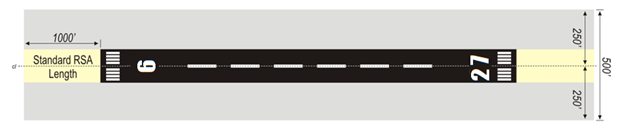
As shown in the diagram, a standard RSA extends 1,000 feet beyond each runway end and 250 feet wide from the centerline. These areas must remain clear of objects that exceed three inches above the grade and are not frangible. At identified sites, frangible connections were installed on navigation structures, or equipment was relocated. Specifically, objects within the RSA are categorized as either "fixed by function" or "not fixed by function." Objects fixed by function which cannot perform their intended purpose if relocated may be granted waivers with frangible mountings. Objects not fixed by function are moved outside the RSA.
Navigation Programs has procedures in place to respond quickly when a hurricane damages operational Navigation and Lighting systems in the National Airspace System (NAS). The team coordinates across lines of business to provide equipment and resources to restore the systems and service as soon as possible.
The Federal Aviation Administration (FAA) Navigation Programs Office, AJM-3200, Landing & Lighting (L&L) systems implement critical ground infrastructure that collectively enables all aircraft to navigate the established aircraft routes in the sky, as well as the ability to safely descend and land on airport runways. The L&L infrastructure consists of approximately 10,000 Navigation Aids (NAVAIDs) that enable over 6,000 instrument fight procedures and routes. These conventional navigation services form the backbone of the National Airspace System (NAS) and serve a dual purpose, providing primary navigation services and functioning as the back-up for satellite navigation.
Navigation Programs adopted a portfolio approach to more effectively manage and maintain the varied legacy systems and services in the NAS with available resources, funding, and equipment. The Program Office introduced this approach in 2017 and the L&L programs have been successfully operating as a portfolio since FY18 through coordination with the Capital Investment Team (CIT). The objectives of the portfolio are to:
- Establish funding priorities for NAVAID sustainment that will minimize operational impacts to users
- Allocate services/equipment to locations where the greatest benefit will be derived for cost in order to maintain a safe and efficient NAS
- Realign funding based on the prioritization of establishment, sustainment and discontinuance requirements
- Increase flexibility within the Navigation Programs budget process
- Rank projects from Portfolio Capital Investment Plans (CIPs) using the navigation Prioritization Tool (P-tool) and the Portfolio Tool.
Program Manager
Kevin Teel (Acting)