


FAA DiSCVR Tool
Information resources supporting law enforcement response to drone-related incidents.
- Overview
- What is DiSCVR?
- How does it work?
- What information can DiSCVR provide?
- Capabilities and Limitations
- Obtaining Access to the DHS Portal for DiSCVR
- Requesting Information Without DiSCVR Access
DiSCVR Overview
DiSCVR is an FAA system that integrates information from the FAA’s DroneZone and Low Altitude Authorization and Notification Capability (LAANC) databases. The system processes queries submitted by authorized agencies, correlates the information against DroneZone and LAANC records, and returns any matching results.
External authorized agencies that have entered into data sharing agreements with the FAA connect to DiSCVR through an application programming interface (API) that allows secure exchange of information between each agency’s systems. The external agency maintains their own interface and sets of authorized users that can access it, often via a web portal with secure login.
Authorized users managed by an external agency then log in through the interface and can submit requests for information to DiSCVR.
DiSCVR enables authorized law enforcement to enter identifying information about a drone of interest (such as Remote ID position information, serial number, or registration number) and receive available FAA-related information, if a match exists.
As of March 16, 2024, unless otherwise excepted, all drones over 249g, operating under Part 107, or operating under Part 91 waivers are required to broadcast a Remote ID (RID) number. Many have compared Remote ID to a digital license plate—a number that can be seen by everyone, but only specific entities can look up its registration.
The primary benefit of this information is ruling out an identified drone and its operator from further investigation when responding to an event / incident.
An absence of data from DiSCVR does not necessarily indicate that a drone is operating unlawfully or without authorization.
How does it work?
Accessing the Service. Access to DiSCVR by non-FAA law enforcement (i.e., FSLTT) is managed by the Department of Homeland Security (DHS) through their Geospatial Information Infrastructure (GII) service. For guidance on how to get access to this DHS service, see the section (below) titled “Submitting Queries & Requesting Access”.
Submitting Information. Law enforcement authorized to use the service provides one or more of the following pieces of information to DiSCVR as part of a query:
- Serial Number, which can be obtained by:
- Receiving a Remote ID broadcast message, which contains the drone’s Serial ID.
- Reading the Serial ID from the manufacturer’s identifying markings.
- FAA Registration Number, which is labeled on the drone by the registered owner (if the drone has been registered with the FAA).
- Location and Date Range, which may be used when querying for airspace authorization records.
DiSCVR returns available FAA registration and authorization information associated with the information provided, if a matching record is found.
What information can DiSCVR provide?
The response by queries to DiSCVR depends on what information correlates with the submitted query. The following table provides an overview of the input information and potential returned information.
| Query Type | DHS GII Inquiry Fields for DiSCVR | Information Returned (if available) |
|---|---|---|
| Registration Data Query |
|
|
| Airspace Authorization Query | Location (area) & date range |
|
NOTE:
- DiSCVR is an informational support service. It supports decision-making by authorized users but does not independently provide a complete or real-time picture of airspace activity.
- Results depend on the information provided and may not be available for all drones or operations.
For enforcement cases and / or information not provided by DiSCVR, FSLTT law enforcement must request information from an FAA LEAP agent.
Capabilities and Limitations
The table below provides an overview of what DiSCVR can do, and what it cannot.
| DiSCVR Does… | Does NOT… | Important Considerations |
|---|---|---|
| Return available FAA registration and airspace authorization information associated with a provided drone identifier (e.g., Remote ID, serial number, or registration number). | Does not detect, track, or monitor drones. | DiSCVR only returns information based on identifiers provided by the user. It does not receive or ingest Remote ID signals directly. |
| Allow authorized users to check whether a drone may have associated FAA records. | Does not identify drones or operators independently. | DiSCVR associates provided identifiers with FAA records; it does not determine the identity of a drone without user-provided information. |
| Provide information that may help law enforcement contact a registered drone operator, when available. | Does not identify non-compliant or unauthorized drones. | A lack of results does not necessarily indicate non-compliance. Some drones or operations may not require FAA registration or authorization. |
| Provide access to certain airspace authorization records (e.g., LAANC or DroneZone), when applicable. | Does not provide a complete or real-time picture of all drone activity in an area. | FAA does not collect information on all drone operations, and not all activity is reflected in available records. |
| Support law enforcement decision-making by providing FAA-related information. | Does not determine operator intent or distinguish between lawful and malicious activity. | Additional investigation may be required to assess the nature of an operation. |
| Provide information in support of situational awareness. | Does not provide enforcement or mitigation authority. | Enforcement actions and operational decisions remain the responsibility of the appropriate authorities. |
| Return results based on available data and user access permissions. | Does not function as a real-time clearance or “approved drone list” (whitelisting system). | Results depend on the information provided and may vary based on access level and data availability. |
Obtaining Access to the DHS Portal for DiSCVR
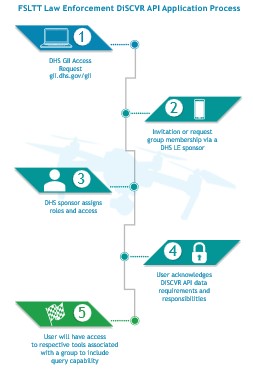
Some law enforcement agencies may obtain access to DiSCVR through the DHS-managed portal available from their GII service (an overview of the application process can be found here).
Eligibility. Persons eligible to request access include federal, state, local, tribal, and territorial (FSLTT) law enforcement personnel.
Access to the DHS portal:
- Is limited and not available to all agencies.
- Requires application and approval through DHS.
- Requires DHS sponsorship and assignment of user roles.
To apply for access:
- Contact your local Federal Air Marshal Service (FAMS) counter-UAS (cUAS) agent to request sponsorship.
- If you need assistance identifying or contacting your local FAMS cUAS agent, contact your regional DHS Fusion Center.
Once authorized, users can submit queries (as noted in the table above) through the DHS portal. If a matching record is found, the system will return available FAA-related registration or airspace authorization information.
Access to DiSCVR information is controlled and subject to applicable privacy, security, and data-use requirements.
Requesting Information Without DiSCVR Access
Law enforcement agencies without access to the DHS DiSCVR portal may still request FAA drone-related information through established partners.
FSLTT law enforcement may request information by:
- Contacting their local FAA LEAP agent (see note below), or
- Coordinating through DHS partners, such as a regional Fusion Center.
These partners can facilitate requests and provide relevant information in support of law enforcement activities.
Note: FAA LEAP agents can assist with information requests but do not grant or manage access to the DHS DiSCVR portal.